Trends in reporting methadone-associated cardiac arrhythmia, 1997-2011: an analysis of registry data
- PMID: 23689766
- PMCID: PMC3793842
- DOI: 10.7326/0003-4819-158-10-201305210-00008
Trends in reporting methadone-associated cardiac arrhythmia, 1997-2011: an analysis of registry data
Abstract
Background: Long-acting opioids are a leading cause of accidental death in the United States, and methadone is associated with greater mortality rates. Whether this increase is related to the proarrhythmic properties of methadone is unclear.
Objective: To describe methadone-associated arrhythmia events reported in the U.S. Food and Drug Administration Adverse Event Reporting System (FAERS).
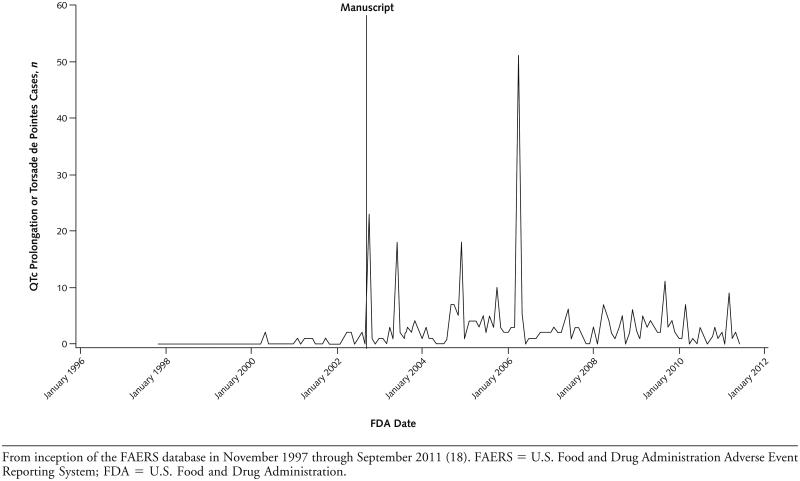
Design: Description of national adverse event registry data before and after publication of a 2002 report describing an association between methadone and arrhythmia.
Setting: FAERS, November 1997 and June 2011.
Patients: Adults with QTc prolongation or torsade de pointes and ventricular arrhythmia or cardiac arrest.
Measurements: FAERS reports before and after the 2002 report.
Results: 1646 cases of ventricular arrhythmia or cardiac arrest and 379 cases of QTc prolongation or torsade de pointes were associated with methadone. Monthly reports of QTc prolongation or torsade de pointes increased from a mean of 0.3 (95% CI, 0.1 to 0.5) before the 2002 publication to a mean of 3.5 (CI, 2.5 to 4.8) after it. After 2000, methadone was the second-most common primary suspect in cases of QTc prolongation or torsade de pointes after dofetilide (a known proarrhythmic drug) and was associated with disproportionate reporting similar to that of antiarrhythmic agents known to promote torsade de pointes. Antiretroviral drugs for HIV were the most common coadministered drugs.
Limitation: Reports to FAERs are voluntary and selective, and incidence rates cannot be determined from spontaneously reported data.
Conclusion: Since 2002, reports to FAERS of methadone-associated arrhythmia have increased substantially and are disproportionately represented relative to other events with the drug. Coadministration of methadone with antiretrovirals in patients with HIV may pose particular risk.
Primary funding source: Colorado Clinical and Translational Sciences Institute, National Institutes of Health, and Agency for Healthcare Research and Quality.
Figures
References
-
- Risk Evaluation and Mitigation Strategies (REMS) for Extended-Release and Long-Acting Opioid Analgesics. Joint Meeting of the Anesthetic and Life Support Drugs Advisory Committee and the Drug Safety and Risk Management Advisory Committee; Adelphi, Maryland: Jul 22-23, 2010. Accessed at www.fda .gov/downloads/AdvisoryCommittees/CommitteesMeetingMaterials/Drugs/ AnestheticAndLifeSupportDrugsAdvisoryCommittee/UCM217510.pdf on 15 April 2012.
-
- Warner M, Chen LH, Makuc DM, Anderson RN, Mininño AM. Drug poisoning deaths in the United States, 1980-2008. NCHS Data Brief. 2011:1–8. [PMID: 22617462] - PubMed
-
- Paulozzi LJ, Logan JE, Hall AJ, McKinstry E, Kaplan JA, Crosby AE. A comparison of drug overdose deaths involving methadone and other opioid analgesics in West Virginia. Addiction. 2009;104:1541–8. [PMID: 19686524] - PubMed
-
- Centers for Disease Control and Prevention (CDC) Vital signs: risk for overdose from methadone used for pain relief—United States, 1999-2010. MMWR Morb Mortal Wkly Rep. 2012;61:493–7. [PMID: 22763888] - PubMed
-
- Hall AJ, Logan JE, Toblin RL, Kaplan JA, Kraner JC, Bixler D, et al. Patterns of abuse among unintentional pharmaceutical overdose fatalities. JAMA. 2008;300:2613–20. [PMID: 19066381] - PubMed
Publication types
MeSH terms
Substances
Grants and funding
LinkOut - more resources
Full Text Sources
Other Literature Sources