. 2013 Sep;8(4):988-97.
doi: 10.1007/s11481-013-9472-6. Epub 2013 May 21.

Time and time again: temporal processing demands implicate perceptual and gating deficits in the HIV-1 transgenic rat

Affiliations

Time and time again: temporal processing demands implicate perceptual and gating deficits in the HIV-1 transgenic rat

Landhing M Moran et al. J Neuroimmune Pharmacol. 2013 Sep.

Abstract

HIV-1-associated neurocognitive disorders (HAND) afflict up to 50 % of HIV-1+ individuals, despite the effectiveness of combination antiretroviral therapy (CART) in reducing the prevalence of more severe neurocognitive impairment. Alterations in brainstem auditory evoked potentials (BAEP), a measure of temporal processing, are one of the earliest neurological abnormalities of HIV-1-positive individuals. Prepulse inhibition (PPI) of the auditory startle response (ASR), a measure of sensorimotor gating, was studied in HIV-1 transgenic (Tg) rats, which express 7 of the 9 HIV-1 genes. Ovariectomized female Fischer HIV-1 Tg and control rats (ns = 41-42) were tested for PPI at three test periods, with at least 2 months separating each test period, using auditory and visual prepulses, an auditory startle stimulus, and interstimulus intervals (ISI) ranging from 0 to 4000 msec. Auditory and visual prepulse trial blocks were presented in counterbalanced order. For both auditory and visual prepulses, HIV-1 Tg animals exhibited a flatter ISI function, which did not sharpen with age, as it did in controls. Over time, auditory prepulses precipitated a temporal shift in peak inhibition in HIV-1 Tg animals relative to controls, whereas with visual prepulses, both groups displayed peak inhibition at the 40 msec ISI. A lack of perceptual sharpening with age and a relative insensitivity to the temporal dimension of sensorimotor gating are evident in the HIV-1 Tg rat prior to clinical signs of wasting. Deficits in sensorimotor gating may not only provide an early subtle diagnostic marker of HAND, but may also afford a key target for development of potential therapeutics.


Conflict of interest statement

Conflict of Interest

The authors declare that they have no conflict of interest.

Figures
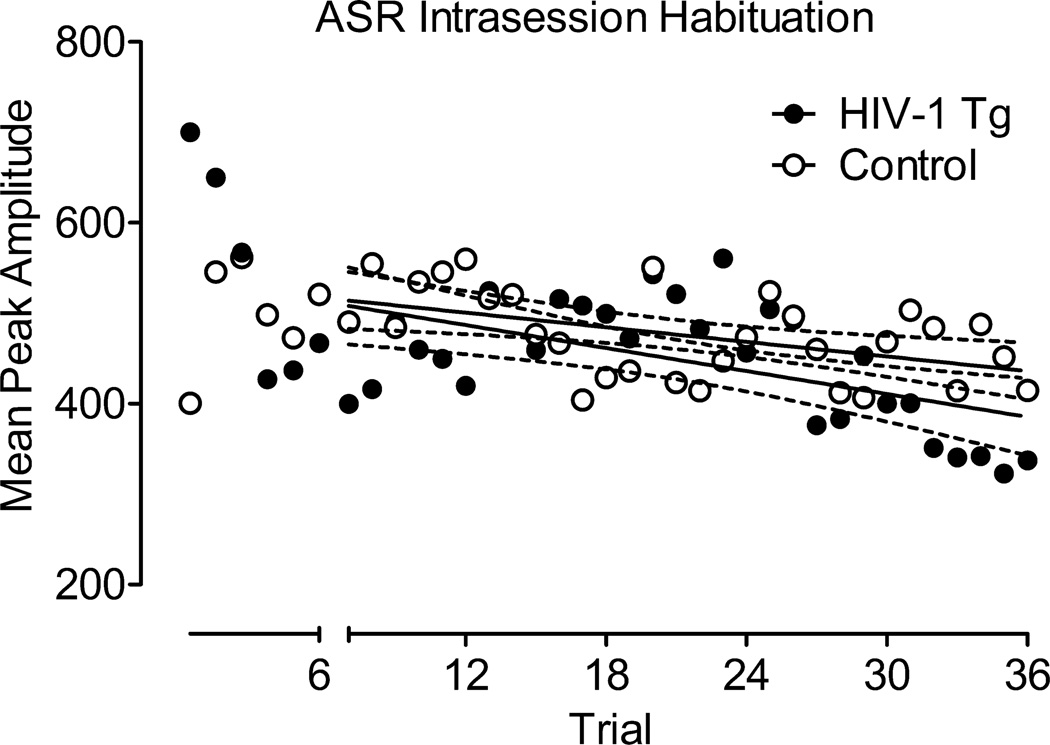
Fig. 1
Fig. 1
Mean peak ASR amplitude data from the habituation session (±95% CI). After the initial 6 trials, the HIV-1 Tg and control groups showed no difference in overall ASR (F=0.17), and did not differ in rate of habituation to the auditory startle stimulus. Linear regression line slopes: HIV-1 Tg, −4.24+/−1.24; Control, −2.7+/−0.91.
Fig. 2
Fig. 2
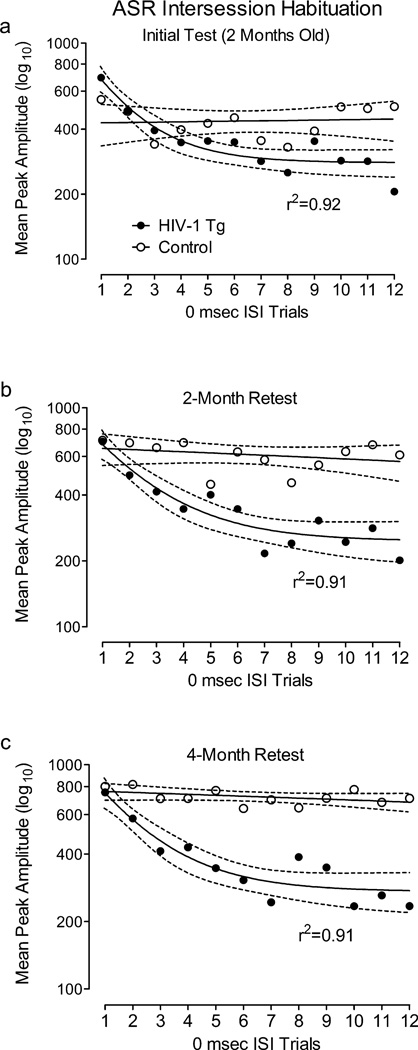
Mean peak ASR amplitude during 0 msec ISI control trials across the PPI test session at each age (±95% CI). Trials are numbered 1 through 12 for simplicity, although they were presented across the 72-trial session in a Latin square. The ASR of the HIV-1 Tg group decreased across 0 msec ISI trials within each test session, with a single phase decay function accounting for over 90% of the variance in each session. In contrast, the ASR of the control group did not significantly change across 0 msec ISI trials during any test session.
Fig. 3
Fig. 3
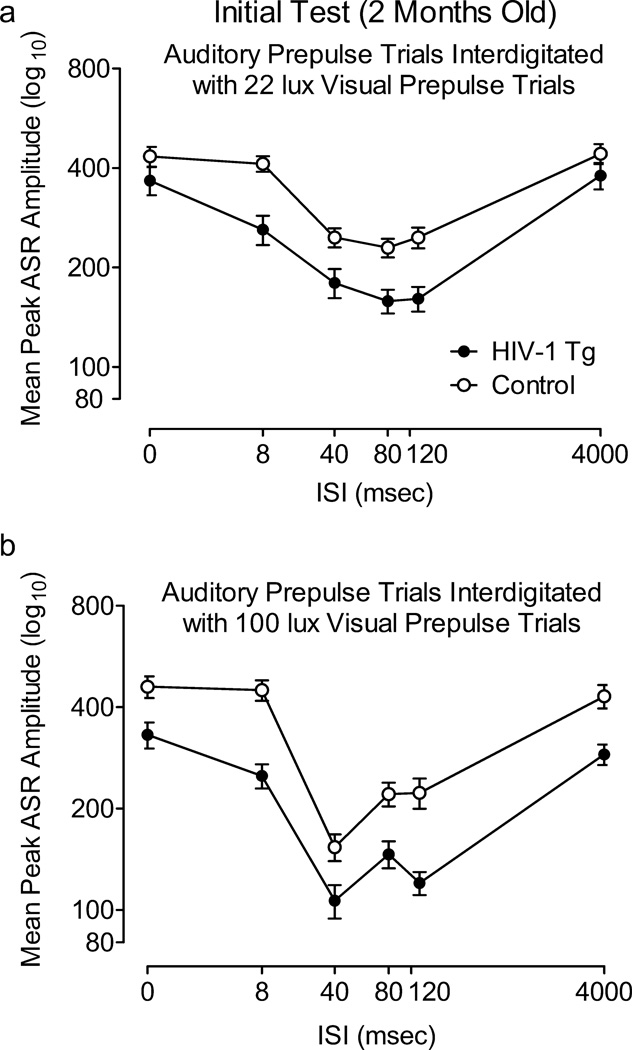
Prepulse inhibition (PPI) with an auditory prepulse during sessions interdigitated with 22 lux (A) and 100 lux (B) visual prepulse trials conducted at 2 months of age. A significant condition × interstimulus interval (ISI) interaction was detected, indicating that the HIV-1 Tg rats were less sensitive to the manipulation of ISI, as illustrated by their flatter ISI functions. Both groups’ ISI functions changed in a similar manner with the increased visual prepulse intensity; i.e., there was a leftward shift in peak inhibition to the 40 msec ISI, and the ISI functions sharpened. Percent PPI at point of peak inhibition: 1 light: HIV-Tg, 30.0%±5.5, Control, 15.2%±7.8; 2 lights: HIV-1 Tg, 46.3%±5.2; Control, 44.0%±4.5.
Fig. 4
Fig. 4
Prepulse inhibition (PPI) with an auditory prepulse interdigitated with 22 lux visual prepulse trials across all three test ages. A significant main effect of age and an age × interstimulus interval (ISI) interaction were found in the control group (A), but not confirmed in the HIV-1 Tg group (B).The control group increased in percent PPI across test ages, from 15.2%±7.8 at 2 months to 64.0%±3.9 at 6–8 months, whereas the HIV-1 Tg group showed a much smaller increase, from 30.0%±5.5 at 2 months of age to 52.8%±4.4 at 6–8 months.
Fig. 5
Fig. 5
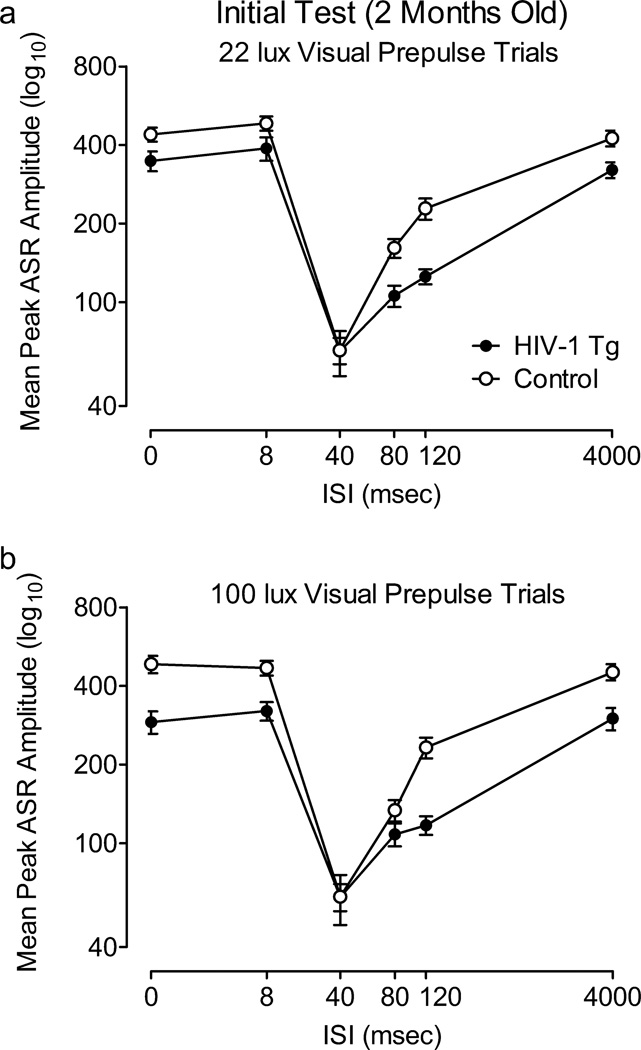
Prepulse inhibition (PPI) with 22 lux (A) and 100 lux (B) visual prepulses conducted at 2 months of age. A significant condition × interstimulus interval (ISI) interaction was detected, indicating that the HIV-1 Tg group was less sensitive to the manipulation of ISI, as illustrated by their flatter ISI functions. Percent PPI at the point of peak inhibition: 1 light: HIV-1-Tg, 74.9%±2.5; Control, 72.2%±2.6; 2 lights: HIV-1-Tg, 66.3%±3.8; Control, 73.9%±3.1.
Fig. 6
Fig. 6
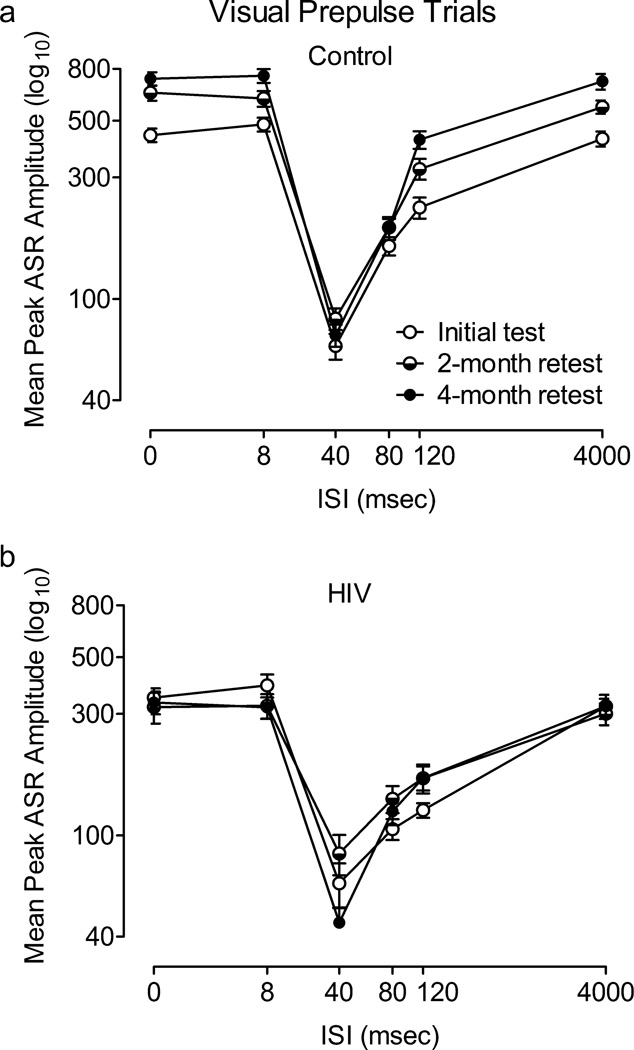
Prepulse inhibition (PPI) with a 22 lux visual prepulse across all three test sessions. A main effect of age and an age × interstimulus interval (ISI) interaction were found in the control group (A), but not confirmed in the HIV-1 Tg group (B). The HIV-1 Tg and control groups each displayed peak inhibition at the 40 msec ISI at each age tested. Percent PPI at the 40 msec ISI: 2 months:HIV-1-Tg, 74.9%±2.5, Control, 72.2%±2.6; 4–6 months:HIV-1 Tg = 58.2%±4.2; Control = 78.6%±1.9; 6–8 months: HIV-1 Tg: 72.1%±2.7; Control: 77.9%±3.6.

References

    1. Adler LE, Pachtman E, Franks RD, Pecevich M, Waldo MC, Freedman R. Neurophysiological evidence for a defect in neuronal mechanisms involved in sensory gating in schizophrenia. Biol Psychiatry. 1982;17:639–654. - PubMed
    1. Ances BM, Ellis RJ. Dementia and neurocognitive disorders due to HIV-1 infection. Semin Neurol. 2007;27:86–92. - PubMed
    1. Aksenov MY, Aksenova MV, Silvers JM, Mactutus CF, Booze RM. Different effects of selective dopamine uptake inhibitors, GBR 12909 and WIN 35428, on HIV-1 Tat toxicity in rat fetal midbrain neurons. Neurotoxicology. 2008;29:971–977. - PMC - PubMed
    1. Aksenova MV, Silvers JM, Aksenov MY, Nath A, Ray PD, Mactutus CF, Booze RM. HIV- 1 Tat neurotoxicity in primary cultures of rat midbrain fetal neurons: changes in dopamine transporter binding and immunoreactivity. Neurosci Lett. 2006;395:235–239. - PubMed
    1. Bankaitis AE. The effects of click rate on the auditory brain stem response (ABR) in patients with varying degrees of HIV-infection: a pilot study. Ear Hear. 1995;16:321–324. - PubMed

Publication types

LinkOut - more resources