. 2013 Jun 11;110(24):9704-9.
doi: 10.1073/pnas.1303888110. Epub 2013 May 20.

Mass spectrometry reveals synergistic effects of nucleotides, lipids, and drugs binding to a multidrug resistance efflux pump

Affiliations

Mass spectrometry reveals synergistic effects of nucleotides, lipids, and drugs binding to a multidrug resistance efflux pump

Julien Marcoux et al. Proc Natl Acad Sci U S A. .

Abstract

Multidrug resistance is a serious barrier to successful treatment of many human diseases, including cancer, wherein chemotherapeutics are exported from target cells by membrane-embedded pumps. The most prevalent of these pumps, the ATP-Binding Cassette transporter P-glycoprotein (P-gp), consists of two homologous halves each comprising one nucleotide-binding domain and six transmembrane helices. The transmembrane region encapsulates a hydrophobic cavity, accessed by portals in the membrane, that binds cytotoxic compounds as well as lipids and peptides. Here we use mass spectrometry (MS) to probe the intact P-gp small molecule-bound complex in a detergent micelle. Activation in the gas phase leads to formation of ions, largely devoid of detergent, yet retaining drug molecules as well as charged or zwitterionic lipids. Measuring the rates of lipid binding and calculating apparent KD values shows that up to six negatively charged diacylglycerides bind more favorably than zwitterionic lipids. Similar experiments confirm binding of cardiolipins and show that prior binding of the immunosuppressant and antifungal antibiotic cyclosporin A enhances subsequent binding of cardiolipin. Ion mobility MS reveals that P-gp exists in an equilibrium between different states, readily interconverted by ligand binding. Overall these MS results show how concerted small molecule binding leads to synergistic effects on binding affinities and conformations of a multidrug efflux pump.

Keywords: mass spectrometry from native state; real time substrate monitoring.


Conflict of interest statement

The authors declare no conflict of interest.

Figures

Fig. 1.
Fig. 1.
Interaction of P-gp with detergent and phospholipids. Mass spectra of P-gp recorded following release in the gas phase from detergent micelles formed in solution from DDM at 2 × the critical micelle concentration (CMC) (A). Selected charge states for mass spectra recorded 15 min after incubation with two equivalents of zwitterionic lipids (POPE and POPC) (B) or anionic lipids (POPA and POPG) (C). Plot of the relative abundance of seven different species [(P-gP POPG)0.0.7] as a function of time (D). Apparent KD values calculated from time courses recorded for binding of the xth lipid where x ≤ 6 (E).
Fig. 2.
Fig. 2.
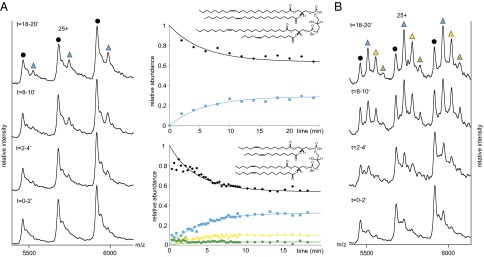
CL binding to P-gp in real time. Two equivalents of (A) CL24 and (B) CL14 were added to P-gp in DDM micelles. Peaks are assigned as apo P-gp (black) and incorporation of the first, second, and third CL, labeled cyan, yellow, and green, respectively. Plots of the relative intensity of the peaks assigned to CL24 (Upper) and CL14, against time (Lower).
Fig. 3.
Fig. 3.
Apo P-gp exists predominantly in an open inward conformation. (A) Mass spectra and corresponding ATD for the 26+ charge state recorded after 30 min of incubation of P-gp with one equivalent of CL24. (B) Structures of the P-gp homolog MsbA obtained in the outward (PDB ID code: 3B5Z), inward open (PDB ID code 3B5W), and inward closed (PDB ID code 3B5X) conformations. The CCSs were calculated from the respective PDB files using Driftscope (Waters). (C) Docking of CL14 to P-gp showing the interaction with residues K822 and K230. Oxygen and phosphorous atoms are red and orange, respectively. A simulated spectrum for lipid binding is shown (red line).
Fig. 4.
Fig. 4.
CsA binding to P-gp. Nano-electrospray mass spectra obtained before (Lower) and after (Upper) 5 min incubation with 1, 5, and 10 equivalents of CsA. Peaks assigned to apo P-gp and DDM are labeled (black and red, respectively). Molecular docking reveals the likely location of the first (cyan) and second (yellow) CsA molecule to P-gp. The presence of a low level of DDM molecules in addition to CsA is implied through the high mass tail on all peaks.
Fig. 5.
Fig. 5.
Binding of nucleotides lipids, and drugs. Spectra recorded after 30 min of incubation of P-gp with 5, 20, or one equivalent of CsA, ATP, or CL24 individually (A, i) or concomitantly as indicated (B, i). Binding of the first and second ATP, CsA, and CL (24)3–14 are labeled cyan and yellow, respectively. Simulated spectra for lipid and drug binding alone and summed for concomitant binding are shown (red lines). Corresponding ATDs for the 26+ charge state of P-gp and ligands as indicated (A, ii and B, ii). Different conformations are represented schematically with predominant species in darker green.

References

    1. Darby RA, Callaghan R, McMahon RM. P-glycoprotein inhibition: The past, the present and the future. Curr Drug Metab. 2011;12(8):722–731. - PubMed
    1. Szakács G, Paterson JK, Ludwig JA, Booth-Genthe C, Gottesman MM. Targeting multidrug resistance in cancer. Nat Rev Drug Discov. 2006;5(3):219–234. - PubMed
    1. Sharom FJ, Lu P, Liu R, Yu X. Linear and cyclic peptides as substrates and modulators of P-glycoprotein: Peptide binding and effects on drug transport and accumulation. Biochem J. 1998;333(Pt 3):621–630. - PMC - PubMed
    1. Sharom FJ. Shedding light on drug transport: Structure and function of the P-glycoprotein multidrug transporter (ABCB1) Biochem Cell Biol. 2006;84(6):979–992. - PubMed
    1. Sauna ZE, Ambudkar SV. About a switch: How P-glycoprotein (ABCB1) harnesses the energy of ATP binding and hydrolysis to do mechanical work. Mol Cancer Ther. 2007;6(1):13–23. - PubMed

Publication types

MeSH terms