


What evidence exists for initiatives to reduce risk and incidence of sexual violence in armed conflict and other humanitarian crises? A systematic review
- PMID: 23690945
- PMCID: PMC3655168
- DOI: 10.1371/journal.pone.0062600
What evidence exists for initiatives to reduce risk and incidence of sexual violence in armed conflict and other humanitarian crises? A systematic review
Abstract
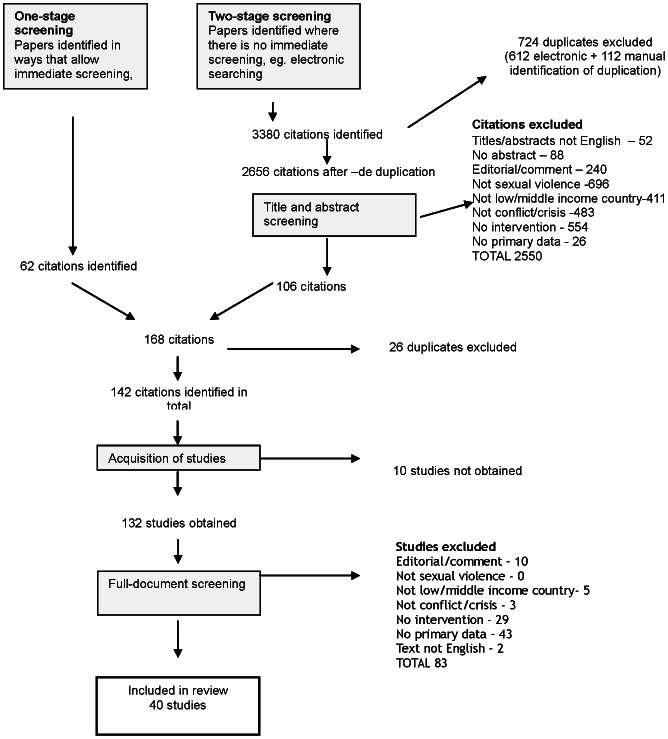
Sexual violence is highly prevalent in armed conflict and other humanitarian crises and attracting increasing policy and practice attention. This systematic review aimed to canvas the extent and impact of initiatives to reduce incidence, risk and harm from sexual violence in conflict, post-conflict and other humanitarian crises, in low and middle income countries. Twenty three bibliographic databases and 26 websites were searched, covering publications from 1990 to September 2011 using database-specific keywords for sexual violence and conflict or humanitarian crisis. The 40 included studies reported on seven strategy types: i) survivor care; ii) livelihood initiatives; iii) community mobilisation; iv) personnel initiatives; v) systems and security responses; vi) legal interventions and vii) multiple component interventions. Conducted in 26 countries, the majority of interventions were offered in African countries. Despite the extensive literature on sexual violence by combatants, most interventions addressed opportunistic forms of sexual violence committed in post-conflict settings. Only one study specifically addressed the disaster setting. Actual implementation of initiatives appeared to be limited as was the quality of outcome studies. No studies prospectively measured incidence of sexual violence, although three studies provided some evidence of reductions in association with firewood distribution to reduce women's exposure, as did one program to prevent sexual exploitation and abuse by peacekeeping forces. Apparent increases to risk resulted from lack of protection, stigma and retaliation associated with interventions. Multiple-component interventions and sensitive community engagement appeared to contribute to positive outcomes. Significant obstacles prevent women seeking help following sexual violence, pointing to the need to protect anonymity and preventive strategies. This review contributes a conceptual framework for understanding the forms, settings, and interventions for conflict and crisis-related sexual violence. It points to the need for thorough implementation of initiatives that build on local capacity, while avoiding increased risk and re-traumatisation to survivors of sexual violence.
Conflict of interest statement
References
-
- Saikia Y (2004) Beyond the archive of silence: narratives of violence of the 1971 Liberation War of Bangladesh. History Workshop Journal 58: 275–287.
-
- UNIFEM, Department of Peacekeeping Operations (2010) Addressing conflict- related sexual violence: An analytical inventory of peacekeeping practice. New York United Nations
-
- United Nations Security Council (2000) United Nations Security Council Resolution 1325. 31 October 2000. New York United Nations
-
- United Nations Security Council (2008) United Nations Security Council Resolution 1820 .19 June 2008. New York United Nations
-
- United Nations Security Council (2009a) United Nations Security Council Resolution 1888. 20 September 2009.
Publication types
MeSH terms
LinkOut - more resources
Full Text Sources
Other Literature Sources
Medical
