


Burkholderia species are the most common and preferred nodulating symbionts of the Piptadenia group (tribe Mimoseae)
- PMID: 23691052
- PMCID: PMC3655174
- DOI: 10.1371/journal.pone.0063478
Burkholderia species are the most common and preferred nodulating symbionts of the Piptadenia group (tribe Mimoseae)
Abstract
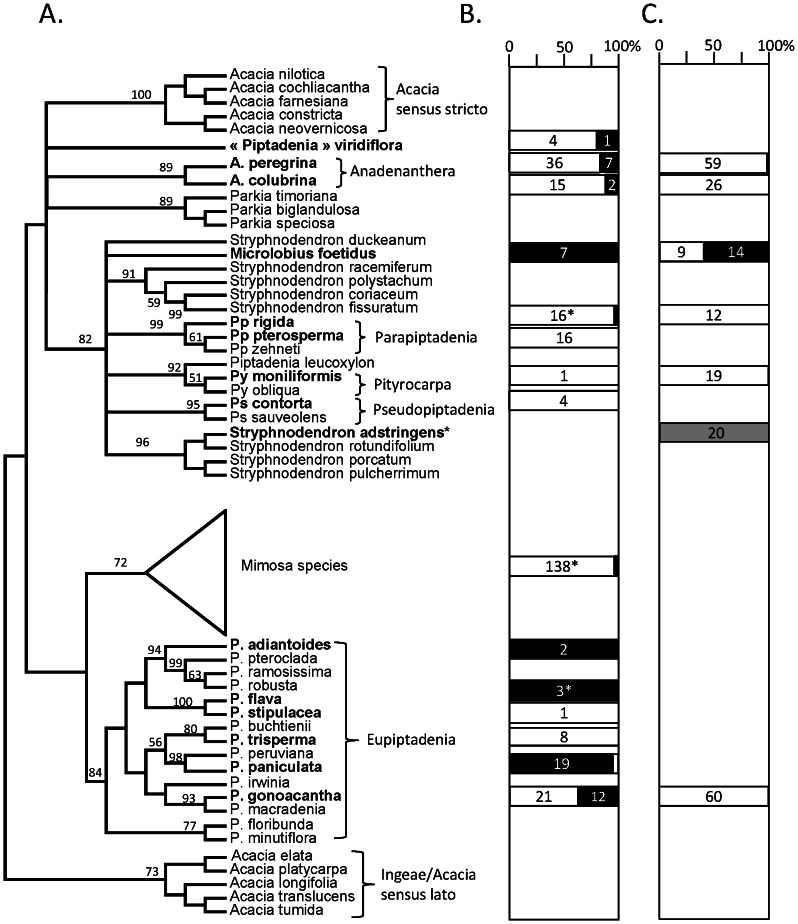
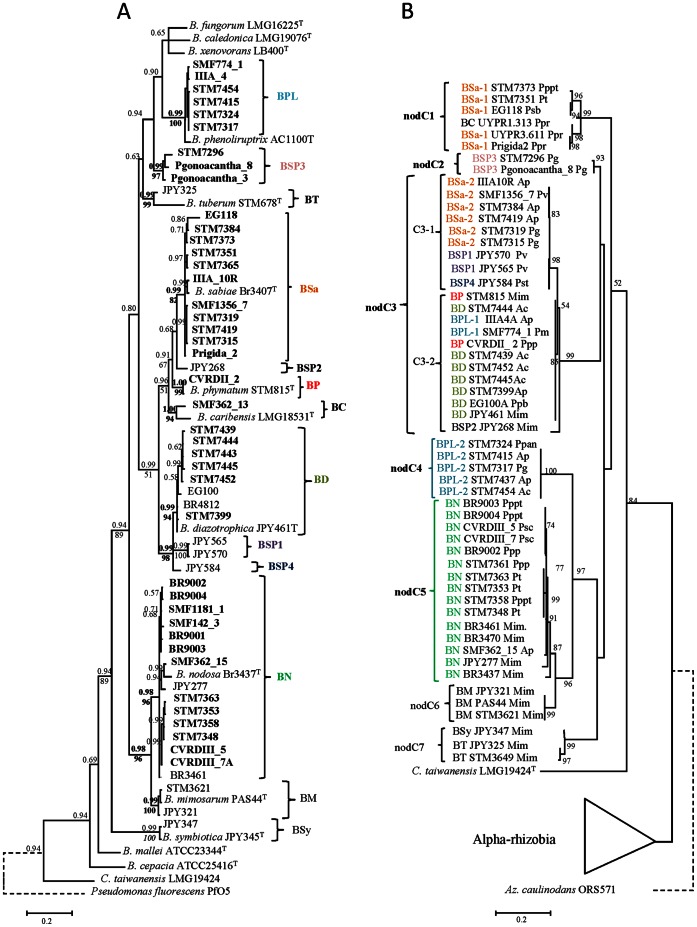
Burkholderia legume symbionts (also called α-rhizobia) are ancient in origin and are the main nitrogen-fixing symbionts of species belonging to the large genus Mimosa in Brazil. We investigated the extent of the affinity between Burkholderia and species in the tribe Mimoseae by studying symbionts of the genera Piptadenia (P.), Parapiptadenia (Pp.), Pseudopiptadenia (Ps.), Pityrocarpa (Py.), Anadenanthera (A.) and Microlobius (Mi.), all of which are native to Brazil and are phylogenetically close to Mimosa, and which together with Mimosa comprise the "Piptadenia group". We characterized 196 strains sampled from 18 species from 17 locations in Brazil using two neutral markers and two symbiotic genes in order to assess their species affiliations and the evolution of their symbiosis genes. We found that Burkholderia are common and highly diversified symbionts of species in the Piptadenia group, comprising nine Burkholderia species, of which three are new ones and one was never reported as symbiotic (B. phenoliruptrix). However, α-rhizobia were also detected and were occasionally dominant on a few species. A strong sampling site effect on the rhizobial nature of symbionts was detected, with the symbiont pattern of the same legume species changing drastically from location to location, even switching from β to α-rhizobia. Coinoculation assays showed a strong affinity of all the Piptadenia group species towards Burkholderia genotypes, with the exception of Mi. foetidus. Phylogenetic analyses of neutral and symbiotic markers showed that symbiosis genes in Burkholderia from the Piptadenia group have evolved mainly through vertical transfer, but also by horizontal transfer in two species.
Conflict of interest statement
Figures

References
-
- Lewis G, Schrire B, Mackinder B, Lock M (2005) Legumes of the World. Kew, Royal Botanic Gardens: Kew Publishing.
-
- Maynaud G, Willems A, Soussou S, Vidal C, Mauré L, et al. (2012) Molecular and phenotypic characterization of strains nodulating Anthyllis vulneraria in mine tailings, and proposal of Aminobacter anthyllidis sp. nov., the first definition of Aminobacter as legume-nodulating bacteria. Systematic and Applied Microbiology 35: 65–72. - PubMed
-
- Ardley J, Parker M, De Meyer S, Trengove R, O’Hara G, et al. (2012) Strains of Gram-negative, rod-shaped, non-spore-forming bacteria were isolated from nitrogen-fixing nodules of the native legumes Listia angolensis (from Zambia) and Lupinus texensis (from Texas, USA). International Journal of Systematic and Evolutionary Microbiology 62: 2579–2588.
-
- Moulin L, Munive a, Dreyfus B, Boivin-Masson C (2001) Nodulation of legumes by members of the beta-subclass of Proteobacteria. Nature 411: 948–950. - PubMed
-
- Chen WM, Laevens S, Lee TM, Coenye T, De Vos P, et al. (2001) Ralstonia taiwanensis sp. nov., isolated from root nodules of Mimosa species and sputum of a cystic fibrosis patient. International Journal of Systematic and Evolutionary Microbiology 51: 1729–1735. - PubMed
Publication types
MeSH terms
LinkOut - more resources
Full Text Sources
Other Literature Sources
Molecular Biology Databases
Miscellaneous
