


Malaria infected mosquitoes express enhanced attraction to human odor
- PMID: 23691073
- PMCID: PMC3655188
- DOI: 10.1371/journal.pone.0063602
Malaria infected mosquitoes express enhanced attraction to human odor
Abstract
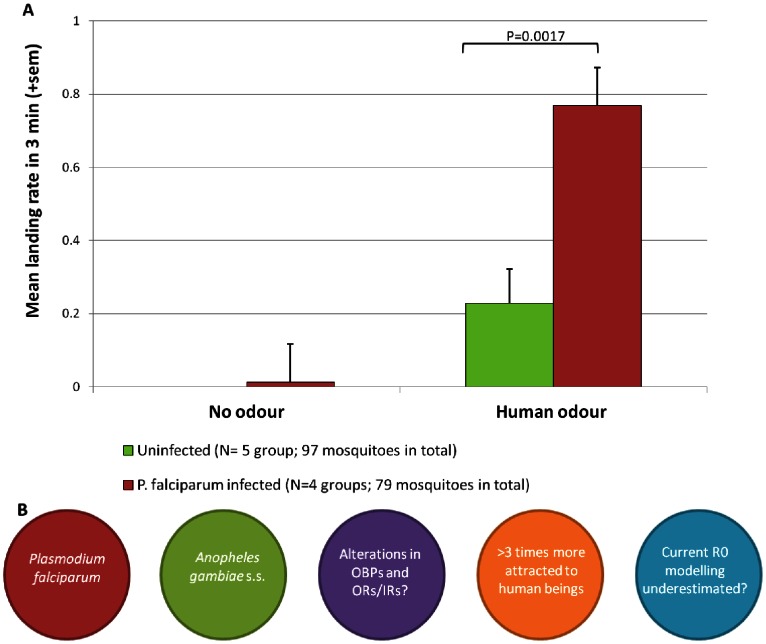
There is much evidence that some pathogens manipulate the behaviour of their mosquito hosts to enhance pathogen transmission. However, it is unknown whether this phenomenon exists in the interaction of Anopheles gambiae sensu stricto with the malaria parasite, Plasmodium falciparum--one of the most important interactions in the context of humanity, with malaria causing over 200 million human cases and over 770 thousand deaths each year. Here we demonstrate, for the first time, that infection with P. falciparum causes alterations in behavioural responses to host-derived olfactory stimuli in host-seeking female An. gambiae s.s. mosquitoes. In behavioural experiments we showed that P. falciparum-infected An. gambiae mosquitoes were significantly more attracted to human odors than uninfected mosquitoes. Both P. falciparum-infected and uninfected mosquitoes landed significantly more on a substrate emanating human skin odor compared to a clean substrate. However, significantly more infected mosquitoes landed and probed on a substrate emanating human skin odor than uninfected mosquitoes. This is the first demonstration of a change of An. gambiae behaviour in response to olfactory stimuli caused by infection with P. falciparum. The results of our study provide vital information that could be used to provide better predictions of how malaria is transmitted from human being to human being by An. gambiae s.s. females. Additionally, it highlights the urgent need to investigate this interaction further to determine the olfactory mechanisms that underlie the differential behavioural responses. In doing so, new attractive compounds could be identified which could be used to develop improved mosquito traps for surveillance or trapping programmes that may even specifically target P. falciparum-infected An. gambiae s.s. females.
Conflict of interest statement
Figures
References
-
- Hurd H (2010) Olfaction in vector-host interactions. Wageningen Academic Publishers. 349–364.
-
- Koella JC, Sørensen FL, Anderson RA (1989) Proc. R. Soc. London Ser. B 265: 763–768.
-
- Rossignol PA, Ribeiro JMC, Spielman A (1986) Am. J. Trop. Med. Hyg. 35: 277–279. - PubMed
MeSH terms
LinkOut - more resources
Full Text Sources
Other Literature Sources
