. 2013 Sep;154(9):1668-1679.
doi: 10.1016/j.pain.2013.05.021. Epub 2013 May 18.

HDAC inhibitors attenuate the development of hypersensitivity in models of neuropathic pain

Affiliations

HDAC inhibitors attenuate the development of hypersensitivity in models of neuropathic pain

Franziska Denk et al. Pain. 2013 Sep.

Abstract

Histone deacetylase inhibitors (HDACIs) interfere with the epigenetic process of histone acetylation and are known to have analgesic properties in models of chronic inflammatory pain. The aim of this study was to determine whether these compounds could also affect neuropathic pain. Different class I HDACIs were delivered intrathecally into rat spinal cord in models of traumatic nerve injury and antiretroviral drug-induced peripheral neuropathy (stavudine, d4T). Mechanical and thermal hypersensitivity was attenuated by 40% to 50% as a result of HDACI treatment, but only if started before any insult. The drugs globally increased histone acetylation in the spinal cord, but appeared to have no measurable effects in relevant dorsal root ganglia in this treatment paradigm, suggesting that any potential mechanism should be sought in the central nervous system. Microarray analysis of dorsal cord RNA revealed the signature of the specific compound used (MS-275) and suggested that its main effect was mediated through HDAC1. Taken together, these data support a role for histone acetylation in the emergence of neuropathic pain.

Keywords: Histone deacetylase; Histone deacetylase inhibitors; Neuropathic pain.


Figures

Fig. 1
Fig. 1
Intrathecal histone deacetylase inhibitor HDACI treatment improved mechanical hypersensitivity after peripheral nerve injury. (A) A summary of the percentage difference between ipsilateral and contralateral paw withdrawal thresholds (in grams) collected across 4 independent experiments (n = 36, n = 14, n = 15, and n = 11 for the respective treatment groups). Compared with vehicle, delivery of HDACI (MS-275 at 30 nmol/d, MS-275 at 60 nmol/d, MGDC0103 at 60 nmol/d) significantly reduced withdrawal thresholds (as measured by automatic von Frey) in nerve-injured rats. Some of the raw data are displayed in parts B through D. (B) Intrathecal delivery of MS-275 (30 nmol/d via an osmotic pump) improved mechanical hypersensitivity after L5 spinal nerve transection: repeated-measures analysis of variance (ANOVA) (n = 6) with baseline as a covariate; main effect of drug (F1,9 = 3.73, P < .001); interaction between drug × day (F2,18 = 36.4, P = .045). Drug delivery started 5 days before the injury and did not cause any change in baseline withdrawal thresholds (BL + D). (C) MS-275 also significantly increased von Frey withdrawal thresholds after partial sciatic nerve ligation: repeated-measures ANOVA (n = 7), main effect of drug (F2,19 = 3.785, P = .041). (D) A different class I HDACI (MGCD0103) had similar analgesic effects after L5 spinal nerve transection. Repeated-measures ANOVA (n = 6, vehicle and 60-nmol dose, n = 4, 30-nmol dose) with baseline as a covariate, main effect of drug (F2,12 = 4.902, P = .028), interaction between drug × injury (F2,12 = 4.341, P = .038). (E) Area under the curve measurements for the 3 graphs (B–D), with stars indicating significant differences at P < .005 (independent samples t tests). BL = baseline; BL + D = baseline measured while drugs were delivered intrathecally; pi = post-injury; SNT = L5 spinal nerve transection; SNL = partial sciatic nerve ligation. Error bars indicate SEM. Stars designate individual days on which the difference between drug and vehicle treatment was particularly striking and survived Bonferroni post hoc tests (P < .05).
Fig. 2
Fig. 2
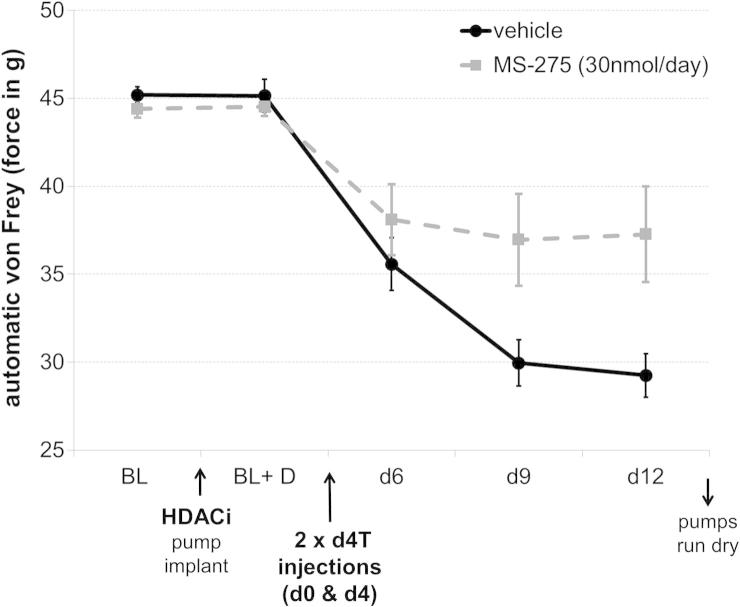
Intrathecal (HDACI) treatment attenuated mechanical hypersensitivity in a more clinically relevant model of antiretroviral (d4T)–induced neuropathy. HDACI pretreatment (MS-275 at 30 nmol/d) was delivered for 7 days, followed by induction of neuropathy using 2 tail vein injections of the antiretroviral drug d4T. The presence of the inhibitor significantly reduced mechanical hypersensitivity: repeated-measures ANOVA (n = 7), interaction between day × drug (F5,60 = 5.002, P = .028). Stars designate individual days on which the difference between drug and vehicle treatment was particularly striking and survived Bonferroni post hoc tests (P < .05).
Fig. 3
Fig. 3
HDACI treatment improved thermal hypersensitivity after neuropathic injury. In 2 separate experiments, pretreatment with intrathecal MS-275 was found to increase withdrawal thresholds after nerve injury on a radiant heat paw withdrawal assay. (A) A 30-nmol/d dose: repeated-measures ANOVA (n = 6), main effect of drug (F1,11 = 5.67, P = .036). (B) A 60-nmol/d dose: repeated-measures ANOVA (n = 6), main effect of drug (F1,11) = 6.265, P = .029). Insets show area under the curve measurements (independent-sample t tests, P < .05, #P = 0.1).
Fig. 4
Fig. 4
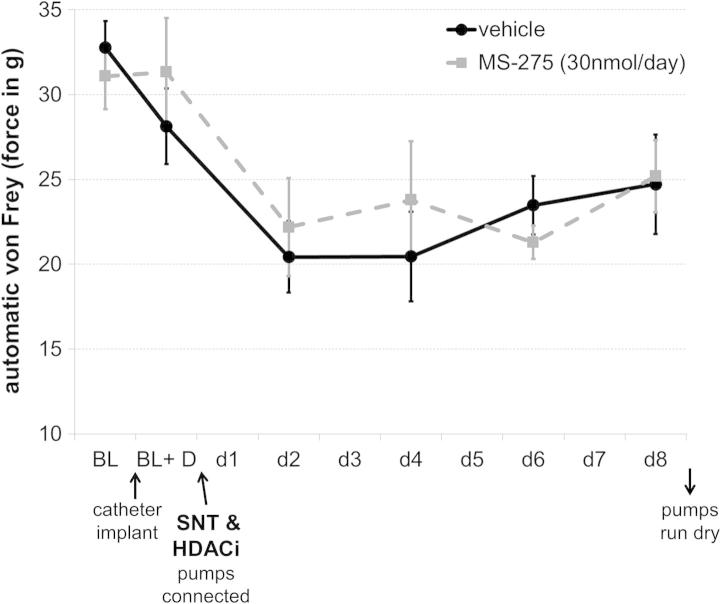
HDACI treatment did not reverse already established hypersensitivity. Pumps were connected immediately after the nerve injury was carried out, resulting in the drug reaching the spinal cord ∼24 hours after the initial insult. No effect on von Frey thresholds was observed with this treatment paradigm. SNT = spinal nerve transaction.
Fig. 5
Fig. 5
Intrathecal HDACI treatment globally increased acetylation at lysine residue 9 of histone 3 (H3K9ac) in the dorsal spinal cord. Shown are representative Western blots against H3K9ac after vehicle, MS-275 (MS30, MS60 at 30 nmol and 60 nmol/d, respectively) and MGCD0103 treatment (MG30, MG60 at 30 nmol and 60 nmol/d, respectively). Protein was obtained from ipsilateral dorsal spinal cord of animals with neuropathy as a result of spinal nerve transection (A) or antiretroviral drug injection (C). The blots were stripped and reprobed with an antibody against total H3 as a loading control. (B, D) Quantification of Western blot data using band-density analysis in ImageJ software. Significantly increased H3K9 acetylation was observed in the nerve injury model after both MS-275 and MGCD0103 treatment (n = 4, independent-sample t tests, P < .01) and in the drug-induced neuropathy model after MS-275 treatment (n = 3, independent-sample t test, P = .017).
Fig. 6
Fig. 6
Intrathecal HDACi administration globally increased acetylation in rat spinal cord in a dose-dependent manner. MS-275 was administered to the spinal cord at increasing doses (7.5–60 nmol/d), the protein extracted from dorsal lumbar segments and probed with an antibody against the acetylated lysine residue 9 of histone 3 (H3K9ac). Shown here is a representative Western blot with its corresponding loading control against histone H3. Quantification of 2 separate blots with several biological replicates (n = 2–3) was performed using band-density analysis in ImageJ software. Data are expressed relative to H3.
Fig. 7
Fig. 7
With the intrathecal delivery method used, HDACI did not appear to have a measurable effect on dorsal root ganglion (DRG) acetylation, suggesting that the mechanism of action was mostly central. (A) Representative Western blot of single rat L5 DRG after nerve transection and intrathecal vehicle or HDACi treatment. Total H3 was used as a loading control for acetylated H3K9. (B) Quantification of global H3K9ac revealed no difference between vehicle and HDACI treatment groups (n = 4, P = not significant [n.s.]).
Fig. 8
Fig. 8
ChIP–quantitative polymerase chain reaction (qPCR) revealed changes in H3K9ac with drug treatment at several promoters in the spinal cord, but not the dorsal root ganglia (DRG). (A) ChIP-qPCR of dorsal ipsilateral spinal cord tissue examining H3K9ac at relevant promoters. Shown here is the ratio of enrichment of H3K9ac over H3 for a gene desert control region and the transcriptional start sites of 6 genes: Hdacs1, 2, and 11; the calcium channel subunit α2δ1 (Cacna2d1), and the transcription factors Rest and Mecp2. Histone deacetylase inhibitor resulted in increased enrichment at 4 of 6 of the genes tested, statistically significant in the case of Cacna2d1 and Mecp2 (n = 4, independent-sample t tests, uncorrected P = .016, P = .047, respectively). (B) In the DRG, MS-275- and vehicle-treated ipsilateral DRG revealed no significant differences between treatment groups at any of the genes tested. P < 0.05, #P < 0.1.
Fig. 9
Fig. 9
Causal reasoning applied to spinal cord microarray data revealed an MS-275 signature and suggested that the effect of this particular HDACI was mediated through HDAC1. Shown here are the causal networks for MS-275 (A) and HDAC1 (B). Yellow nodes represent the upstream regulators. Red and green nodes are genes in the nominally significant list of transcripts that were observed to increase or decrease in expression, respectively. Blue nodes are intermediaries introduced by the algorithm and can be either proteins or biological processes. The arrow and bar edge endings indicate an activating or repressive relationship, respectively. Genes chosen for further validation were MT1E (rat ortholog Mt1a), MT1H (rat ortholog Mt2a), and desmin.
Fig. 10
Fig. 10
Quantitative real-time polymerase chain reaction (qRT-PCR) validation of spinal cord microarray data confirmed increased expression of (HDAC)1 targets and of a mitochondrial transfer RNA. Primers were designed against HDAC1 targets (2 metallothioneins [Mt1a, Mt2a, human orthologs: MT1E, MT1H] and desmin) as well as the cysteine transfer RNA (tRNA-cys) identified via microarray. All values were normalized to Gapdh (2^-ddCT), and relative expression values were calculated in relation to the vehicle average. Increased transcription was observed in drug-treated tissue, highly significant in the case of tRNA-cys: uncorrected P values of .027 (Mt1a), .026 (Mt2a), .047 (desmin), and .00013 (tRNA-cys); independent-sample t tests, n = 4.

References

    1. Agrawal R.P., Goswami J., Jain S., Kochar D.K. Management of diabetic neuropathy by sodium valproate and glyceryl trinitrate spray: a prospective double-blind randomized placebo-controlled study. Diabetes Res Clin Pract. 2009;83:371–378. - PubMed
    1. Bai G., Wei D., Zou S., Ren K., Dubner R. Inhibition of class II histone deacetylases in the spinal cord attenuates inflammatory hyperalgesia. Mol Pain. 2010;6:51. - PMC - PubMed
    1. Bantscheff M., Hopf C., Savitski M.M., Dittmann A., Grandi P., Michon A.M., Schlegl J., Abraham Y., Becher I., Bergamini G., Boesche M., Delling M., Dumpelfeld B., Eberhard D., Huthmacher C., Mathieson T., Poeckel D., Reader V., Strunk K., Sweetman G., Kruse U., Neubauer G., Ramsden N.G., Drewes G. Chemoproteomics profiling of HDAC inhibitors reveals selective targeting of HDAC complexes. Nat Biotechnol. 2011;29:255–265. - PubMed
    1. Barth T.K., Imhof A. Fast signals and slow marks: the dynamics of histone modifications. Trends Biochem Sci. 2010;35:618–626. - PubMed
    1. Bie B., Wang Y., Cai Y.Q., Zhang Z., Hou Y.Y., Pan Z.Z. Upregulation of nerve growth factor in central amygdala increases sensitivity to opioid reward. Neuropsychopharmacology. 2012;37:2780–2788. - PMC - PubMed

Publication types