. 2013 Oct;111(4):286-92.
doi: 10.1038/hdy.2013.47. Epub 2013 May 22.

Local adaptation within a hybrid species

Affiliations

Local adaptation within a hybrid species

F Eroukhmanoff et al. Heredity (Edinb). 2013 Oct.

Abstract

Ecological divergence among populations may be strongly influenced by their genetic background. For instance, genetic admixture through introgressive hybridization or hybrid speciation is likely to affect the genetic variation and evolvability of phenotypic traits. We studied geographic variation in two beak dimensions and three other phenotypic traits of the Italian sparrow (Passer italiae), a young hybrid species formed through interbreeding between house sparrows (P. domesticus) and Spanish sparrows (P. hispaniolensis). We found that beak morphology was strongly influenced by precipitation regimes and that it appeared to be the target of divergent selection within Italian sparrows. Interestingly, however, the degree of parental genetic contribution in the hybrid species had no effect on phenotypic beak variation. Moreover, beak height divergence may mediate genetic differentiation between populations, consistent with isolation-by-adaptation within this hybrid species. The study illustrates how hybrid species may be relatively unconstrained by their admixed genetic background, allowing them to adapt rapidly to environmental variation.


Figures
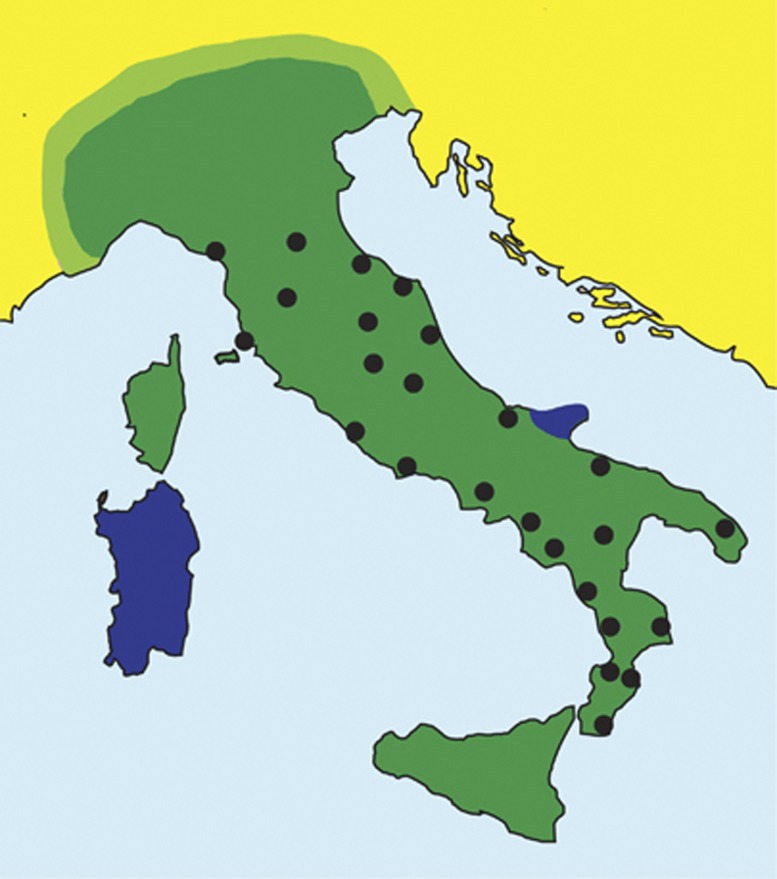
Figure 1
Figure 1
Map of Italy reporting the 25 different sampling localities used in this study. Regions colored in green represent the distribution of the hybrid Italian sparrow, whereas regions in blue and yellow represent the surrounding distributions of both parental species (the Spanish sparrow and the house sparrow, respectively).
Figure 2
Figure 2
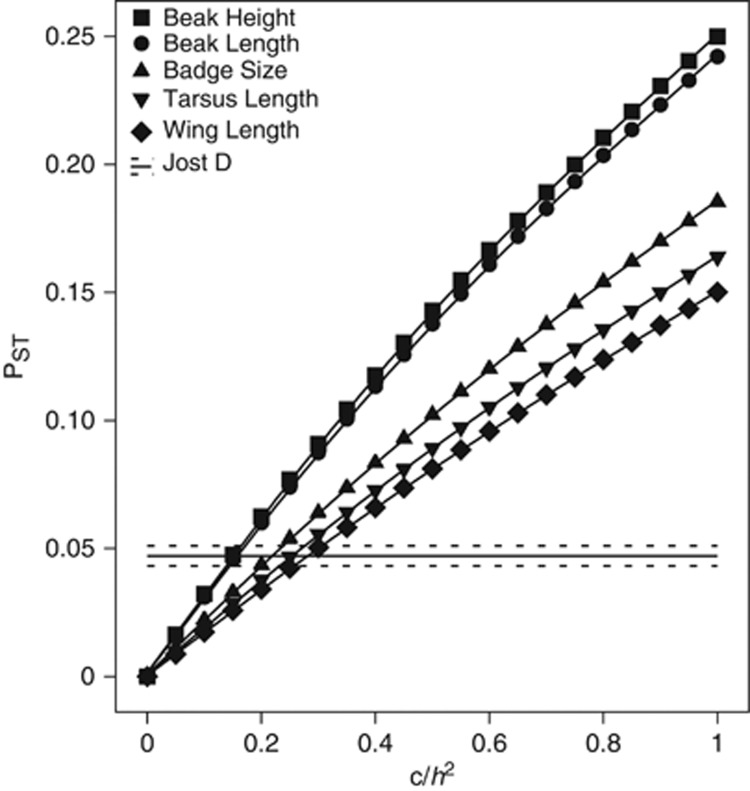
Local adaptation in beak dimensions. Comparisons of PST for each trait with Jost's D comparisons among populaitons. Jost's D among populations was estimated after a 1000 randomizations (Jost's D=0.04, solid black line, 95% confidence intervals in dashed black lines (0.04;0.05)) and PST for each trait are plotted in the same graph against c/h2, the ratio between the proportion of phenotypic variation among populations that is due to additive genetic effects in a trait and its heritability. Note how PST for beak height and length is higher than neutral genetic differentiation even when c/h2=0.2, unlike for other traits.
Figure 3
Figure 3
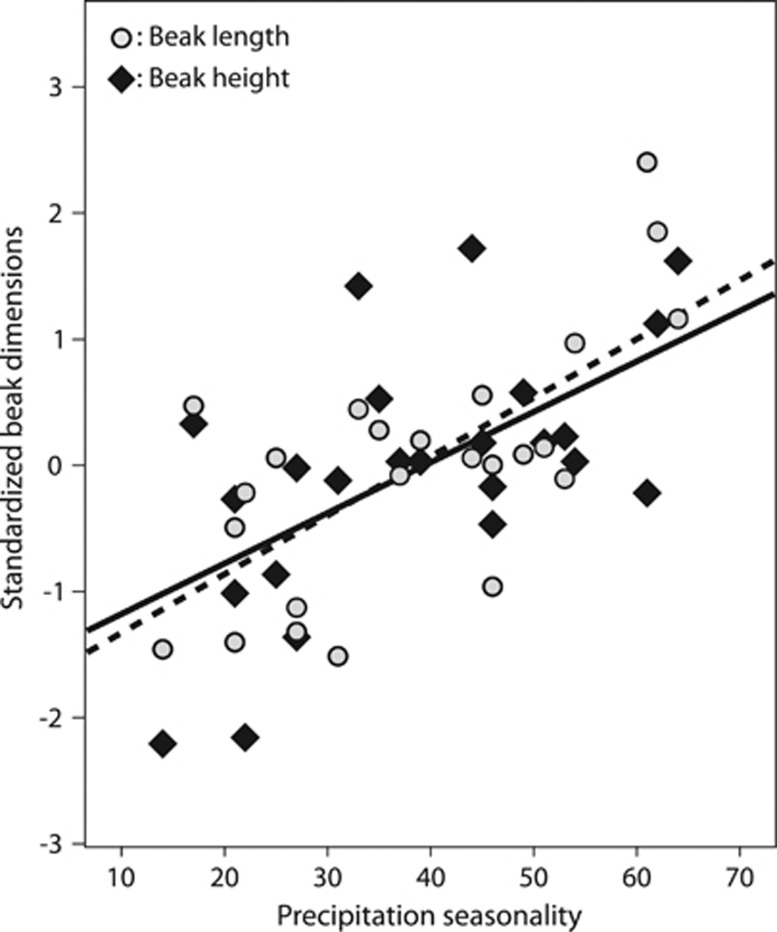
The effect of precipitation seasonality on the beak of the Italian sparrow as defined as the predictor (x axis) explaining most of phenotypic variation among the nine genetic, geographical and environmental factors. Both beak height (diamonds) and length (circles) have been standardized by mean and s.d. to facilitate comparison between the regression slopes (beak height, solid line; beak length, dashed line).
Figure 4
Figure 4
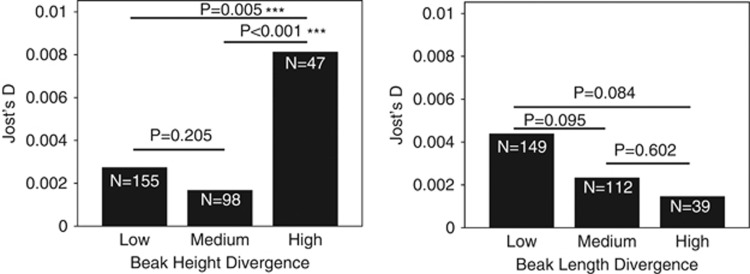
Effects of beak divergence on population genetic differentiation. Beak height divergence had a significant overall effect on gene flow between populations (F1,297=7.92, P=0.01, 1000 randomizations), unlike beak length (F1,297=2.67, P=0.29, 1000 randomizations). Note how pairs of populations exhibiting high levels of divergence in beak height (differing by at least 2 s.d. in beak height) were also significantly more differentiated at the genetic level than other pairs of populations of low or medium divergence (P-values from pairwise comparisons also obtained after 1000 randomizations). N indicates the number of pairwise population comparisons for each category of beak height or length divergence out of a total of 300.

References

    1. Abbott R, Albach D, Ansell S, Arntzen JW, SJE Baird, Bierne N, et al. Hybridization and speciation. J Evol Biol. 2013;26:229–246. - PubMed
    1. Barton NH. The role of hybridization in evolution. Mol Ecol. 2001;10:551–568. - PubMed
    1. Brennan AC, Barker D, Hiscock SJ, Abbott RJ. Molecular genetic and quantitative trait divergence associated with recent homoploid hybrid speciation: a study of Senecio squalidus (Asteraceae) Heredity. 2012;108:87–95. - PMC - PubMed
    1. Brommer JE. Whither Pst? The approximation of Qst by Pst in evolutionary and conservation biology. J Evol Biol. 2011;24:1160–1168. - PubMed
    1. Calsbeek R, Smith TB. Ocean currents mediate evolution in island lizards. Nature. 2003;426:552–555. - PubMed

Publication types