Comparative Study
. 2013 Aug;37(8):1511-7.
doi: 10.1007/s00264-013-1925-2. Epub 2013 May 22.

Reoperation after lumbar disc surgery in two hundred and seven patients

Affiliations
Comparative Study

Reoperation after lumbar disc surgery in two hundred and seven patients

Jiwei Cheng et al. Int Orthop. 2013 Aug.

Abstract

Purpose: The purpose of this study was to compare the causes and characteristics of reoperations after different primary operations for lumbar disc herniation (LDH).

Methods: Out of a series of 5,280 patients who underwent operations for LDH between 2001 and 2012, 207 patients (135 male and 72 female, mean age 47.7 years) underwent primary and revision operations, which were included in this study. The following clinical parameters were retrospectively assessed: the primary surgical methods, the intervals between primary and revision operations, and surgical findings in the revisions.

Results: In total, 232 lumbar discs underwent reoperations. One hundred and nineteen reoperations were performed after microendoscopic discectomy (MED group), 68 after percutaneous endoscopic lumbar discectomy (PELD group) and 45 after open disc surgery (open group). The locations of revision operations had priority over those of primary surgery, with a moderate correlation (kappa coefficient = 0.533). A total of 46.6 % of reoperations were performed within 0.5 years after primary surgery, and 35.3 % were performed between one and five years. Real recurrent herniation (homolateral herniations at the same level) was significantly more common than other reoperative surgical findings (70.6 % in PELD group, 47.1 % in MED group, 37.8 % in open group). The overall mean interval until revision surgery was 18.9 months (8.1 months in the PELD group vs. 19.7 months in the MED group vs. 33.1 months in the open group, p < 0.01).

Conclusions: For LDH, real recurrent herniation was the most common cause of reoperations, and more reoperations for real recurrent herniations and shorter intervals were found after minimally invasive endoscopic discectomy than after open disc surgery.


Figures

Fig. 1
Fig. 1
The reoperative surgical findings’ distribution across different intervals. Real recurrent herniation was the most common reoperative surgical finding in almost all of the time intervals. Reoperations for real recurrent herniations accounted for almost one third of reoperations in the open group, half in the MED and two thirds in the PELD group across each interval. Most of “others” were found within one year after primary operations. Other reoperative surgical findings, included scar or adhesive arachnoiditis, infection, haematoma, and cerebrospinal fluid leakage
Fig. 2
Fig. 2
The time interval distribution in different primary operation groups. Different reoperation peaks occurred in different groups. In the open group, 60 % of reoperations were performed in the one- to five-year period. In the microendoscopic discectomy (MED) group, more reoperations were performed in the 0–0.5 year and one- to five-year periods than during other intervals. In the percutaneous endoscopic lumbar discectomy (PELD) group, 76.5 % of reoperations were performed within 0.5 years after primary surgery
Fig. 3
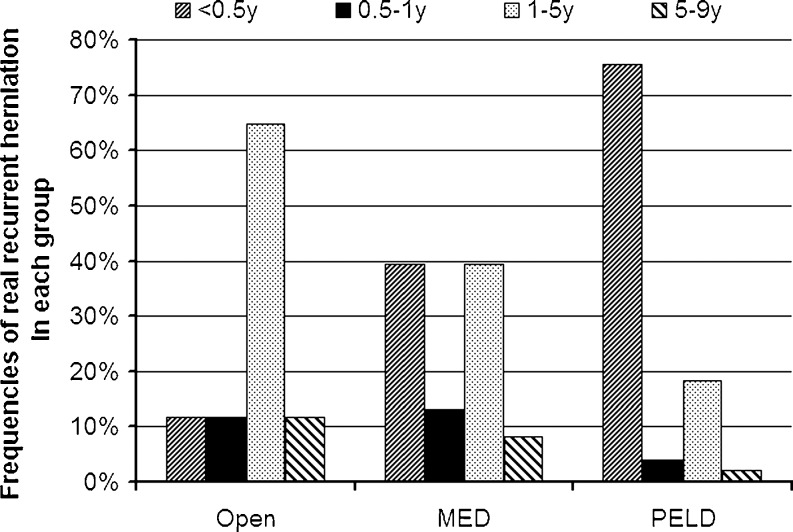
Fig. 3
The time interval distribution of real recurrent herniations in different primary operation groups. Different reoperation peaks occurred in different groups. In the open group, 64.7 % of reoperations were performed in the one- to five-year period. In the microendoscopic discectomy (MED) group, more reoperations were performed in the 0–0.5 year and one- to five-year periods than during other interval times. In the percutaneous endoscopic lumbar discectomy (PELD) group, 75.5 % of reoperations were performed within 0.5 years after primary surgery

References

    1. Fandino J, Botana C, Viladrich A, Gomez-Bueno J. Reoperation after lumbar disc surgery: results in 130 cases. Acta Neurochir (Wien) 1993;122(1–2):102–104. doi: 10.1007/BF01446994. - DOI - PubMed
    1. Suk KS, Lee HM, Moon SH, Kim NH. Recurrent lumbar disc herniation: results of operative management. Spine (Phila Pa 1976) 2001;26(6):672–676. doi: 10.1097/00007632-200103150-00024. - DOI - PubMed
    1. Atlas SJ, Keller RB, Chang Y, Deyo RA, Singer DE. Surgical and nonsurgical management of sciatica secondary to a lumbar disc herniation: five-year outcomes from the Maine Lumbar Spine Study. Spine (Phila Pa 1976) 2001;26(10):1179–1187. doi: 10.1097/00007632-200105150-00017. - DOI - PubMed
    1. Hakkinen A, Kiviranta I, Neva MH, Kautiainen H, Ylinen J. Reoperations after first lumbar disc herniation surgery; a special interest on residives during a 5-year follow-up. BMC Musculoskelet Disord. 2007;9(8):2. doi: 10.1186/1471-2474-8-2. - DOI - PMC - PubMed
    1. Matsumoto M, Watanabe K, Hosogane N, Tsuji T, Ishii K, Nakamura M, Chiba K, Toyama Y. Recurrence of lumbar disc herniation after microendoscopic discectomy. J Neurol Surg A Cent Eur Neurosurg. 2012 - PubMed

Publication types