


Understanding differences in electronic health record (EHR) use: linking individual physicians' perceptions of uncertainty and EHR use patterns in ambulatory care
- PMID: 23698256
- PMCID: PMC3912724
- DOI: 10.1136/amiajnl-2012-001377
Understanding differences in electronic health record (EHR) use: linking individual physicians' perceptions of uncertainty and EHR use patterns in ambulatory care
Abstract
Objective: Electronic health records (EHR) hold great promise for managing patient information in ways that improve healthcare delivery. Physicians differ, however, in their use of this health information technology (IT), and these differences are not well understood. The authors study the differences in individual physicians' EHR use patterns and identify perceptions of uncertainty as an important new variable in understanding EHR use.
Design: Qualitative study using semi-structured interviews and direct observation of physicians (n=28) working in a multispecialty outpatient care organization.
Measurements: We identified physicians' perceptions of uncertainty as an important variable in understanding differences in EHR use patterns. Drawing on theories from the medical and organizational literatures, we identified three categories of perceptions of uncertainty: reduction, absorption, and hybrid. We used an existing model of EHR use to categorize physician EHR use patterns as high, medium, and low based on degree of feature use, level of EHR-enabled communication, and frequency that EHR use patterns change.
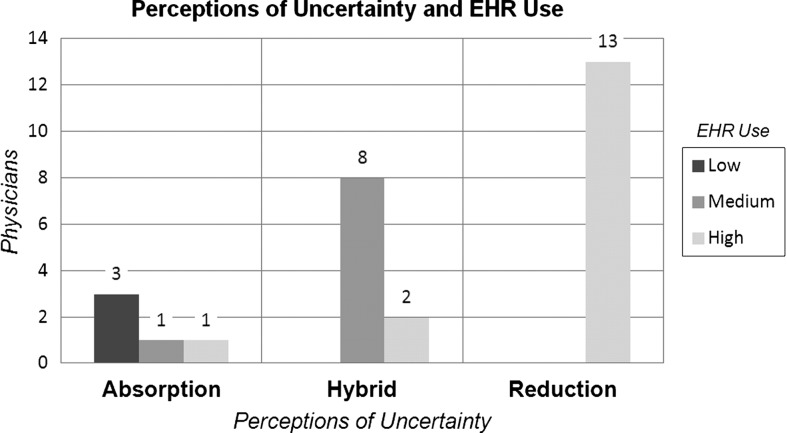
Results: Physicians' perceptions of uncertainty were distinctly associated with their EHR use patterns. Uncertainty reductionists tended to exhibit high levels of EHR use, uncertainty absorbers tended to exhibit low levels of EHR use, and physicians demonstrating both perspectives of uncertainty (hybrids) tended to exhibit medium levels of EHR use.
Conclusions: We find evidence linking physicians' perceptions of uncertainty with EHR use patterns. Study findings have implications for health IT research, practice, and policy, particularly in terms of impacting health IT design and implementation efforts in ways that consider differences in physicians' perceptions of uncertainty.
Keywords: ambulatory care; complexity science; electronic health record use; physician perceptions of uncertainty; uncertainty management.
Figures
References
-
- DesRoches CM, Worzala C, Joshi MS, et al. Small, nonteaching, and rural hospitals continue to be slow in adopting electronic health record systems. Health Aff 2012;31:1092–9 - PubMed
-
- Hsiao C, Hing E. Use and characteristics of electronic health record systems among office-based physician practices: United States, 2001–2012. Hyattsville, MD: National Center for Health Statistics, 2012 Dec. (NCHS Data Brief No. 111). - PubMed
-
- American Recovery and Reinvestment Act of 2009 Open Congress for the 111th United States Congress website. http://www.opencongress.org/bill/111-h1/show (accessed 5 Feb 2012).
-
- Institute of Medicine Committee on patient safety and health information technology board on health care services, chapter 2: evaluating the current state of patient safety and health IT. Health IT and patient safety: building safer systems for better care. Washington, DC: The National Academies Press, 2011:31–58 - PubMed
Publication types
MeSH terms
Grants and funding
LinkOut - more resources
Full Text Sources
Other Literature Sources
