


Review
doi: 10.3390/v5051272.
The dynamics of HCF-1 modulation of herpes simplex virus chromatin during initiation of infection
Affiliations
- PMID: 23698399
- PMCID: PMC3712308
- DOI: 10.3390/v5051272
Item in Clipboard
Review
The dynamics of HCF-1 modulation of herpes simplex virus chromatin during initiation of infection
Viruses.
.
Abstract
Successful infection of herpes simplex virus is dependent upon chromatin modulation by the cellular coactivator host cell factor-1 (HCF-1). This review focuses on the multiple chromatin modulation components associated with HCF-1 and the chromatin-related dynamics mediated by this coactivator that lead to the initiation of herpes simplex virus (HSV) immediate early gene expression.
Figures
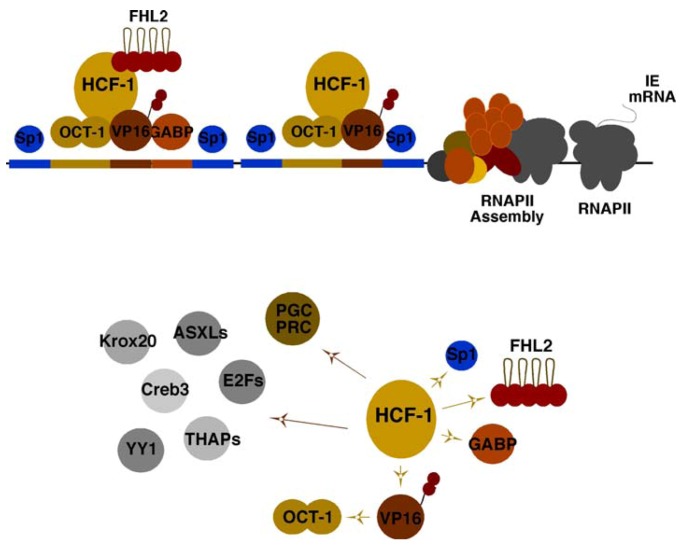
Elements and factors mediating herpes simplex virus (HSV) immediate early (IE) gene expression. (Top Panel) Viral IE promoter domains contain multiple reiterations of an enhancer core element that assembles the core complex (Oct-1, VP16, HCF-1), as well as sites for factors such as GABP and Sp1. FHL2 functions as a coactivator with HCF-1 for stimulation of IE gene transcription. (Bottom Panel) The essential coactivator HCF-1 interacts directly with transcription factors and coactivators that mediate IE gene expression (yellow arrows). A selection of other cellular factors that have been demonstrated to interact and require HCF-1 are illustrated (brown arrows).
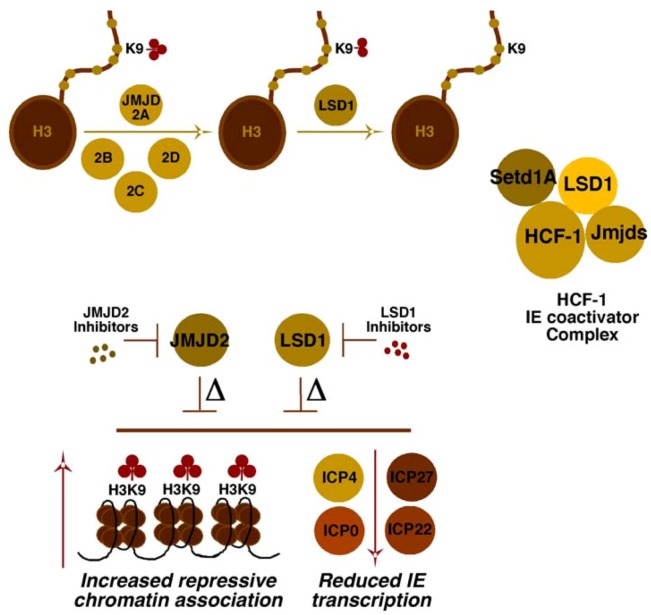
Cooperating activities of the histone demethylases, LSD1 and JMJD2(s), for derepression of HSV IE genes. The JMJD2 family of histone demethylases can remove histone H3K9-me3 but require the cooperating activity of a second demethylase (i.e., LSD1) to remove H3K9-me2/1. The HCF-1 coactivator complex identified contains both a histone H3K4-methyltransferase (Setd1A) and H3K9-demethylases (JMJD2/LSD1) to promote viral IE transcription. Depletion (∆) or inhibition of the catalytic activity of either LSD1 or the JMJD2 family results in reduced viral IE gene transcription and increased assembly of repressive chromatin on IE gene promoter domains.
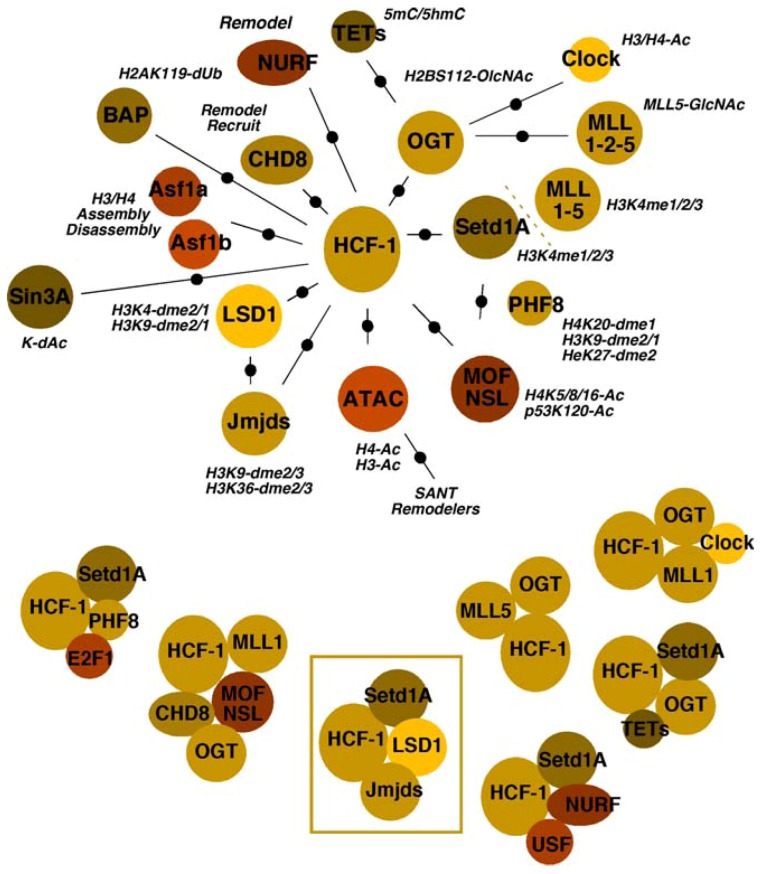
Multiple associations and complexes of the coactivator HCF-1 with chromatin modulation components. The multiple interactions or associations of chromatin modulation machinery are shown relative to HCF-1. Refer to the text for appropriate description and references. (Top Panel) The activities of components/complexes are noted (Ac, acetylation; GlcNAc, O-linked N-acetylglucosamine; dme, demethylation; dUB, deubiquination; dAc, deacetylation). (Bottom Panel) HCF-1 chromatin modulation complexes that have been clearly defined or identified in specific contexts are represented. The HCF-1 complex whose components are critical for viral IE gene expression is boxed.
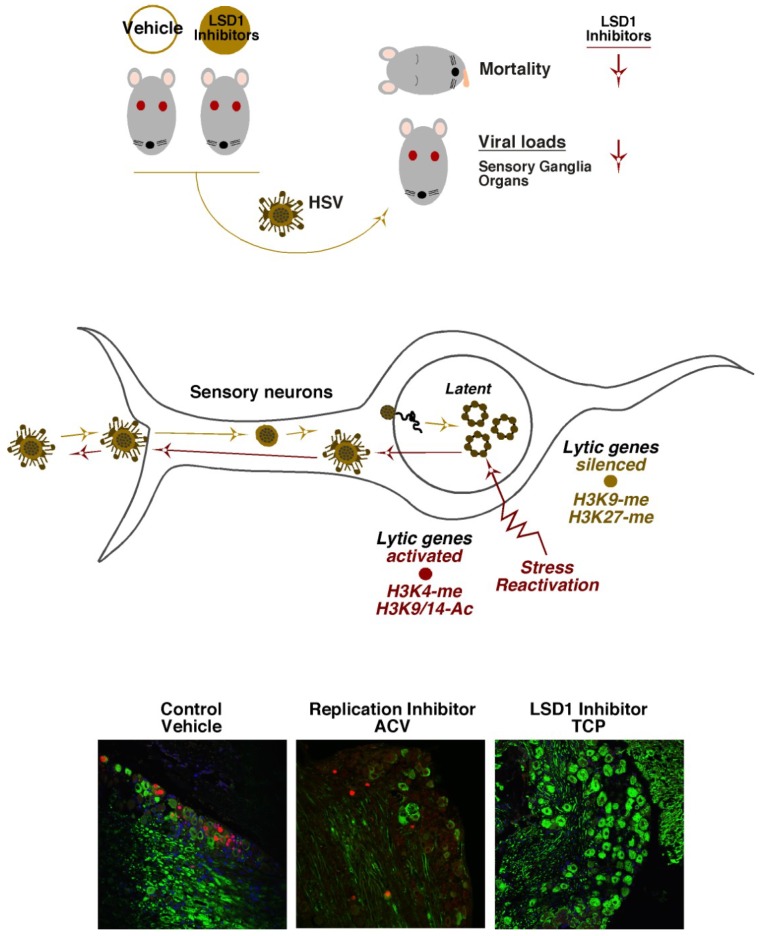
Inhibitors of the HCF-1 associated histone demethylases reduce primary infection and block viral reactivation from latency. (Top Panel) Mice treated with either Vehicle control or LSD1 inhibitors were infected with HSV. Mortality and viral loads were assessed at defined time periods post infection. LSD1 inhibitors reduce mortality and viral loads relative to control. (Middle Panel) HSV infection of sensory neurons results in the establishment of latency in which lytic genes are repressed. Stress-mediated reactivation of viral infection results in conversion of repressive chromatin marks to activating marks on viral lytic genes. (Bottom Panel) Latently infected trigeminal ganglia were explanted into culture to induce viral reactivation in the presence of control vehicle, ACV (acycloguanosine, DNA replication inhibitor), or the LSD1 inhibitor, TCP (tranylcypromine). Ganglia were sectioned and stained for neurofilament (green) and the viral lytic replication protein UL29/ICP8 (red) to mark neurons undergoing productive reactivation.
References
-
- Kristie T.M. Early Events Pre-Initiation of Alphaherpes Viral Gene Expression. In: Arvin A., Campadelli-Fiume G., Mocarski E., Moore P.S., Roizman B., Whitley R., Yamanishi K., editors. Human Herpesviruses: Biology, Therapy, and Immunoprophylaxis. Cambridge University Press; Cambridge, UK: 2007. - PubMed
-
- Roizman B., Knipe D.M., Whitley R.J. Herpes Simplex Viruses. In: Knipe D.M., Howley P.M., editors. Fields Virology. 6th. Lippincott Williams & Wilkins; Philadelphia, PA, USA: 2013.
-
- Kristie T.M., Pomerantz J.L., Twomey T.C., Parent S.A., Sharp P.A. The cellular C1 factor of the herpes simplex virus enhancer complex is a family of polypeptides. J. Biol. Chem. 1995;270:4387–4394. - PubMed
-
- Kristie T.M., Sharp P.A. Purification of the cellular C1 factor required for the stable recognition of the Oct-1 homeodomain by the herpes simplex virus alpha-trans-induction factor (VP16) J. Biol. Chem. 1993;268:6525–6534. - PubMed
Publication types
MeSH terms
Substances
Grants and funding
LinkOut - more resources
Full Text Sources
Other Literature Sources
