


Detection of epidemic USA300 community-associated methicillin-resistant Staphylococcus aureus strains by use of a single allele-specific PCR assay targeting a novel polymorphism of Staphylococcus aureus pbp3
- PMID: 23698534
- PMCID: PMC3719641
- DOI: 10.1128/JCM.00417-13
Detection of epidemic USA300 community-associated methicillin-resistant Staphylococcus aureus strains by use of a single allele-specific PCR assay targeting a novel polymorphism of Staphylococcus aureus pbp3
Abstract
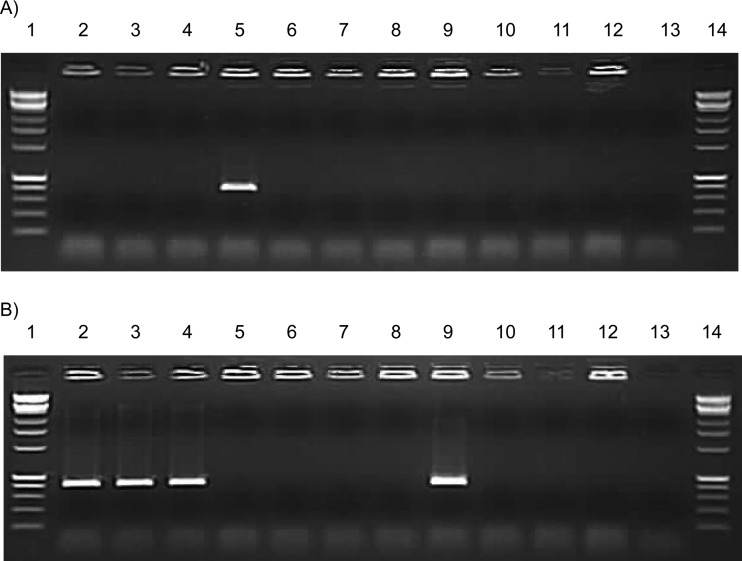
In recent years, the dramatic increase in community-associated methicillin-resistant Staphylococcus aureus (CA-MRSA) infections has become a significant health care challenge. Early detection of CA-MRSA is important because of its increased virulence associated with the arginine catabolic mobile element (ACME), Panton-Valentine leukocidin (PVL), and other toxins that may contribute to disease severity. In particular, the USA300 epidemic clone has emerged and now represents the cause of as much as 98% of CA-MRSA skin and soft tissue infections in the United States. Current diagnostic assays used to identify CA-MRSA strains are based on complex multiplex PCRs targeting the staphylococcal cassette chromosome mec (SCCmec) DNA junction, a multitude of genes, and noncoding DNA fragments or on a number of lengthy sequence-typing methods. Here, two nucleotide polymorphisms, G88A and G2047A, that were found to be in strict linkage disequilibrium in the S. aureus penicillin-binding protein 3 (pbp3) gene were also found to be highly associated with the USA300 clone of CA-MRSA. Clinical isolates that contained this pbp3 allele were also positive for the presence of SCCmec type IV, the ACME, and the PVL toxin gene and matched the t008 or t121 molecular spa types, which are associated specifically with the USA300 CA-MRSA clone. A single allele-specific PCR targeting the G88A polymorphism was developed and was found to be 100% sensitive and specific for the detection of USA300 CA-MRSA and 91.5% sensitive and 100% specific for the detection of all CA-MRSA isolates in this study.
Figures
References
-
- Talan DA, Krishnadasan A, Gorwitz RJ, Fosheim GE, Limbago B, Albrecht V, Moran GJ. 2011. Comparison of Staphylococcus aureus from skin and soft-tissue infections in US emergency department patients, 2004 and 2008. Clin. Infect. Dis. 53:144–149 - PubMed
-
- Engemann JJ, Carmeli Y, Cosgrove SE, Fowler VG, Bronstein MZ, Trivette SL, Briggs JP, Sexton DJ, Kaye KS. 2003. Adverse clinical and economic outcomes attributable to methicillin resistance among patients with Staphylococcus aureus surgical site infection. Clin. Infect. Dis. 36:592–598 - PubMed
-
- Klevens RM, Morrison MA, Nadle J, Petit S, Gershman K, Ray S, Harrison LH, Lynfield R, Dumyati G, Townes JM, Craig AS, Zell ER, Fosheim GE, McDougal LK, Carey RB, Fridkin SK. 2007. Invasive methicillin-resistant Staphylococcus aureus infections in the United States. JAMA 298:1763–1771 - PubMed
-
- Grundmann H, Aires-de-Sousa M, Boyce J, Tiemersma E. 2006. Emergence and resurgence of methicillin-resistant Staphylococcus aureus as a public-health threat. Lancet 368:874–885 - PubMed
Publication types
MeSH terms
Substances
LinkOut - more resources
Full Text Sources
Other Literature Sources
Medical
Molecular Biology Databases
