Review
. 2013 Jul;8(4):318-25.
doi: 10.1097/COH.0b013e328361eaca.

HIV-1 eradication strategies: design and assessment

Affiliations
Review

HIV-1 eradication strategies: design and assessment

Janet D Siliciano et al. Curr Opin HIV AIDS. 2013 Jul.

Abstract

Purpose of review: Recent developments have generated renewed interest in the possibility of curing HIV-1 infection. This review describes some of the practical challenges that will need to be overcome if curative strategies are to be successful.

Recent findings: The latent reservoir for HIV-1 in resting memory CD4 T cells is the major barrier to curing the infection. The most widely discussed approach to curing the infection involves finding agents that reverse latency in resting CD4 T cells, with the assumption that the cells will then die from viral cytopathic effects or be lysed by host cytolytic T lymphocytes (CTLs). A major challenge is the development of in-vitro models that can be used to explore mechanisms and identify latency-reversing agents (LRAs). Although several models have been developed, including primary cell models, none of them may fully capture the quiescent state of the cells that harbour latent HIV-1 in vivo. An additional problem is that LRAs that do not cause T-cell activation may not lead to the death of infected cells. Finally, measuring the effects of LRAs in vivo is complicated by the lack of correlation between different assays for the latent reservoir.

Summary: Progress on these practical issues is essential to finding a cure.


Conflict of interest statement

Conflict of Interest

None.

Figures

Figure 1
Figure 1
Viral dynamics in HIV-1 infection. (A) Basic model of viral dynamics based. Free virus (v) interacts with uninfected cells to generate productively infected cells at a rate that depends on the concentrations of each and a rate constant β. These cells produce virus at rate k . Productively infected cells and free virus undergo exponential decay at rates a and u, respectively. The production and clearance rates for uninfected cells are not shown. The block imposed by ART is indicated by a black box. (B) Expanded model to account for a second phase of viral decay. This phase is due to another population of infected cells with a slower decay rate (m). (C) Futher expansion of the model to account for latently infected cells. Productively infected CD4+ T lymphoblasts can transition into a latent state at rate l, and these cells can be reactivated at rate r. The decay rate of the latent population (a′) is much slower than the decay rate of productively infected cells (a′≪a). (D) The fundamental dynamic in patients on ART. ART blocks new infections, and labile populations decay. The decay rate of the latent reservoir (a′) is so slow as to be negligible.
Figure 2
Figure 2
Quantitative viral outgrowth assay used to define the latent reservoir [5,6,26]. See text for details.
Figure 3
Figure 3
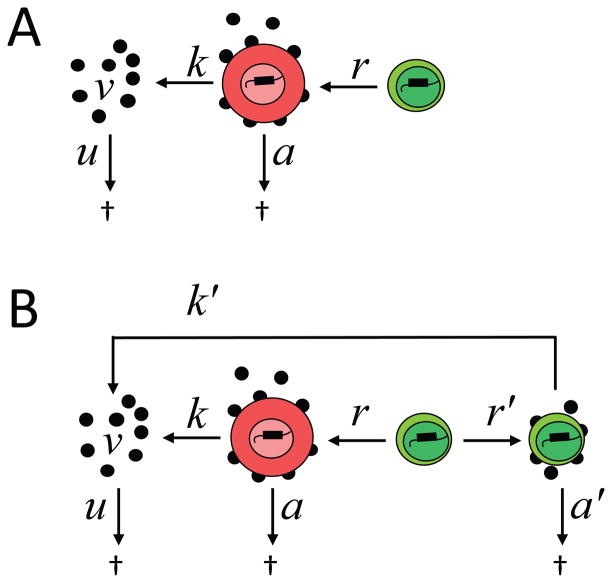
Strategies for targeting latently infected cells. (A) Strategies involving T cell activation. Initial strategies focused on inducing global T cell activation to accelerate the normally slow rate (r) at which latently infected cells become activated, with the assumption that the cells will then die rapidly at rate a. New infections are largely blocked by ART and are not shown. The decay rate of the latent reservoir is extremely slow and is not shown. (B) Current strategies. (B) Alternative strategies. Because of the toxicity associated with inducing global T cell activation, alternative strategies seeks to reactivate latent HIV-1 without inducing T cell activation. The rate of reactivation of HIV-1 gene expression (r′) must be greater than the normal rate r. Because the cells are not activated, the rate of virus production (k′) may be lower than the rate of virus production by activated CD4+ T cells (k′). However, the cells also survive longer (a′≪a). The relationship between these rate constants will determine whether latency reversing agents cause a transient increase in residual viremia and a long term decrease in the size of the latent reservoir.

References

    1. Hutter G, Nowak D, Mossner M, et al. Long-term control of HIV by CCR5 Delta32/Delta32 stem-cell transplantation. N Engl J Med. 2009;360:692–698. - PubMed
    1. Richman DD, Margolis DM, Delaney M, et al. The challenge of finding a cure for HIV infection. Science. 2009;323:1304–1307. - PubMed
    1. Deeks SG, Autran B, et al. The International AIDS Society Scientific Working Group on HIV Cure. Towards an HIV cure: a global scientific strategy. Nat Rev Immunol. 2012;12:607–614. An excellent review and summary of the research agenda for eradication studies. - PMC - PubMed
    1. Chun TW, Finzi D, Margolick J, et al. In vivo fate of HIV-1-infected T cells: quantitative analysis of the transition to stable latency. Nat Med. 1995;1:1284–1290. - PubMed
    1. Chun TW, Carruth L, Finzi D, et al. Quantification of latent tissue reservoirs and total body viral load in HIV-1 infection. Nature. 1997;387:183–188. - PubMed

Publication types