Randomized Controlled Trial
. 2013 May 22;33(21):9039-49.
doi: 10.1523/JNEUROSCI.4094-12.2013.

The aging motor system as a model for plastic changes of GABA-mediated intracortical inhibition and their behavioral relevance

Affiliations
Randomized Controlled Trial

The aging motor system as a model for plastic changes of GABA-mediated intracortical inhibition and their behavioral relevance

Kirstin-F Heise et al. J Neurosci. .

Abstract

Since GABAA-mediated intracortical inhibition has been shown to underlie plastic changes throughout the lifespan from development to aging, here, the aging motor system was used as a model to analyze the interdependence of plastic alterations within the inhibitory motorcortical network and level of behavioral performance. Double-pulse transcranial magnetic stimulation (dpTMS) was used to examine inhibition by means of short-interval intracortical inhibition (SICI) of the contralateral primary motor cortex in a sample of 64 healthy right-handed human subjects covering a wide range of the adult lifespan (age range 20-88 years, mean 47.6 ± 20.7, 34 female). SICI was evaluated during resting state and in an event-related condition during movement preparation in a visually triggered simple reaction time task. In a subgroup (N = 23), manual motor performance was tested with tasks of graded dexterous demand. Weak resting-state inhibition was associated with an overall lower manual motor performance. Better event-related modulation of inhibition correlated with better performance in more demanding tasks, in which fast alternating activation of cortical representations are necessary. Declining resting-state inhibition was associated with weakened event-related modulation of inhibition. Therefore, reduced resting-state inhibition might lead to a subsequent loss of modulatory capacity, possibly reflecting malfunctioning precision in GABAAergic neurotransmission; the consequence is an inevitable decline in motor function.


Figures
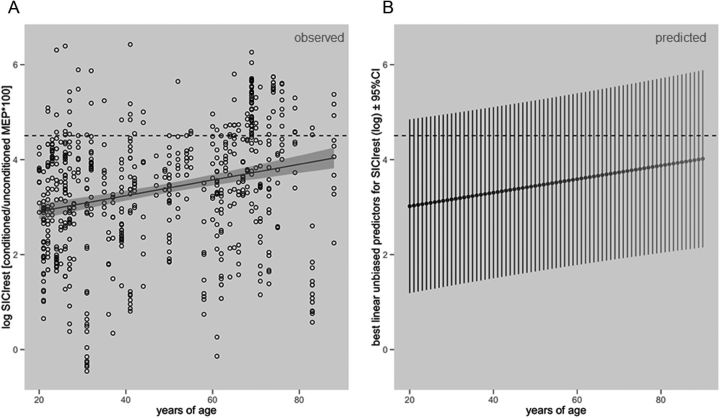
Figure 1.
Figure 1.
A, Observed resting-state SICI reduction over lifetime (linear regression line ± 95% CI region). B, Predicted resting-state SICI reduction over lifetime (best linear unbiased predictors ± 95% prediction intervals). SICI is presented as conditioned MEP amplitude/unconditioned MEP amplitude × 100 (log transformed). Red dashed horizontal line indicates 100% SICI (unconditioned = conditioned MEP amplitude on the log scale).
Figure 2.
Figure 2.
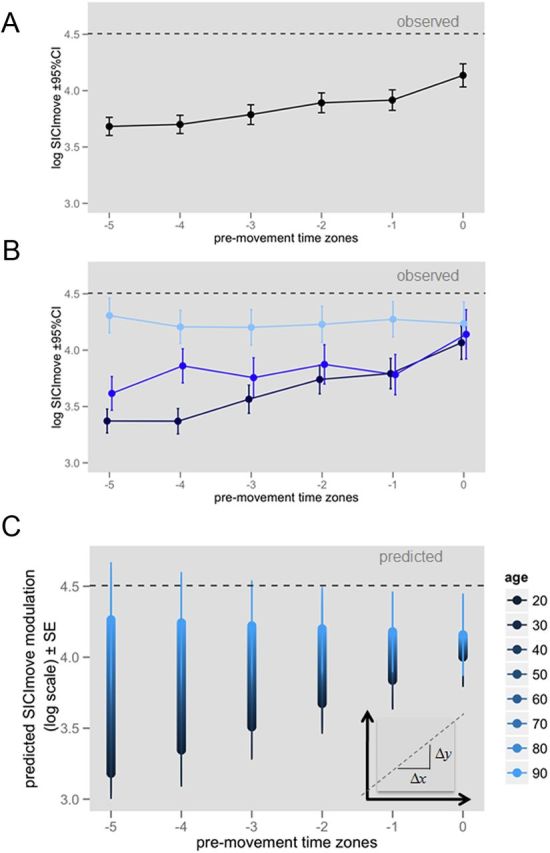
A, Observed SICImove modulation from early to late movement preparation (average ± 95% CI) averaged over the whole sample (N = 64). Time zones of movement preparation ranged from early (−5), indicating ∼35% of individual reaction time, to late (0), indicating ∼95% of individual reaction time in approximately equal steps. B, Observed SICImove modulation (average ± 95% CI) depicted for three example age groups: dark blue, young (20–40 years of age); blue, middle-aged (40–60 years of age); light blue, old (60–90 years of age). C, Predicted age-related decrement in SICImove modulation (best linear unbiased predictors for linear slope ± SE) during movement preparation. SICI is presented as conditioned MEP amplitude/unconditioned MEP amplitude × 100 (log transformed). Dashed horizontal line indicates 100% SICI (unconditioned= conditioned MEP amplitude on the log scale).
Figure 3.
Figure 3.
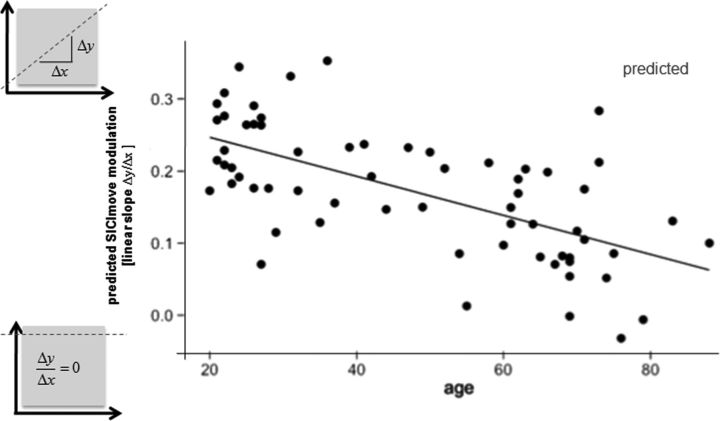
Predicted linear slope of SICImove modulation declines over lifetime indicating a loss of modulatory capacity in the GABAA-mediated intracortical inhibition as a function of age.
Figure 4.
Figure 4.
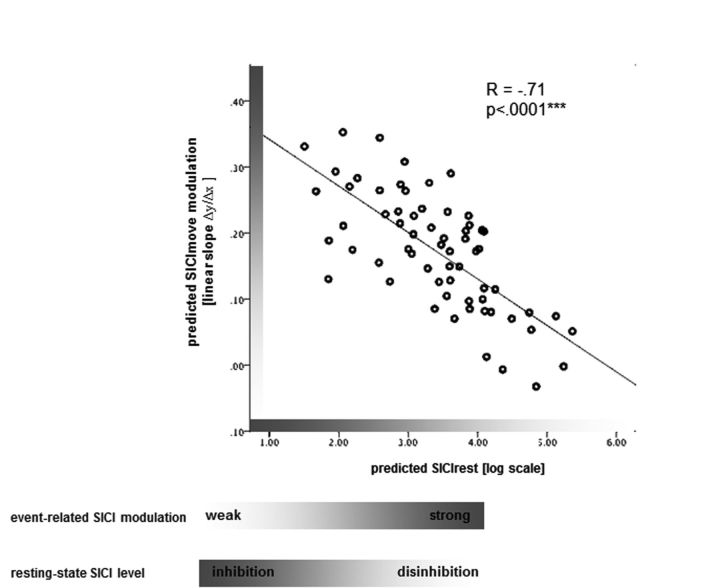
Association between resting-state SICI level and SICImove modulation during movement preparation. The more disinhibited at rest, the weaker the modulation of event-related inhibition.
Figure 5.
Figure 5.
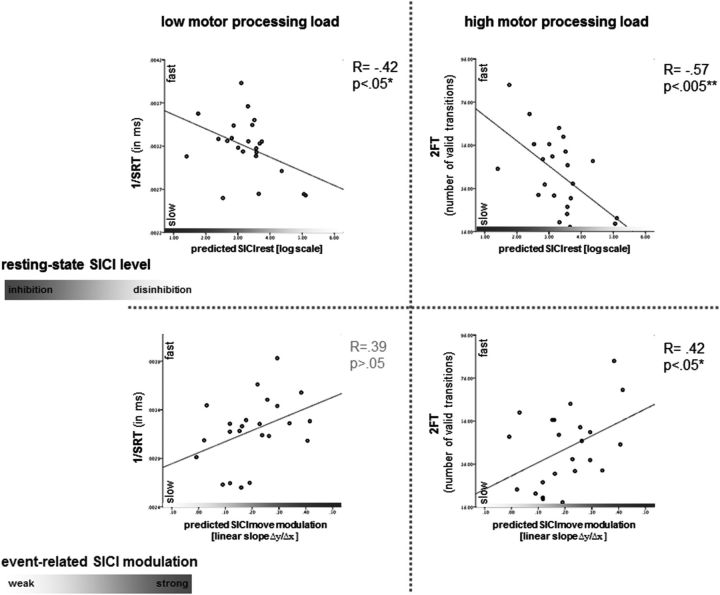
Correlations between behavioral parameters and resting-state inhibition (top row), and event-related modulation of inhibition (bottom row). Overall, stronger resting-state inhibition correlated with overall better manual performance. Stronger event-related modulation of inhibition, expressed as linear slope, was associated with better performance in tasks with higher dexterous demands, i.e., higher motor processing load such as 2FT and CRT.

References

    1. Baroncelli L, Braschi C, Spolidoro M, Begenisic T, Maffei L, Sale A. Brain plasticity and disease: a matter of inhibition. Neural Plast. 2011;2011:286073. - PMC - PubMed
    1. Bacci A, Huguenard JR. Enhancement of spike-timing precision by autaptic transmission in neocortical inhibitory interneurons. Neuron. 2006;49:119–130. doi: 10.1016/j.neuron.2005.12.014. - DOI - PubMed
    1. Beck S, Hallett M. Surround inhibition is modulated by task difficulty. Clin Neurophysiol. 2010;121:98–103. doi: 10.1016/j.clinph.2009.09.010. - DOI - PMC - PubMed
    1. Borg-Graham LJ, Monier C, Frégnac Y. Visual input evokes transient and strong shunting inhibition in visual cortical neurons. Nature. 1998;393:369–373. doi: 10.1038/30735. - DOI - PubMed
    1. Brown H, Prescott R. Applied mixed models in medicine. West Sussex, UK: Wiley; 2006.

Publication types

MeSH terms

LinkOut - more resources