


Posttraumatic stress disorder in survivors of acute lung injury: evaluating the Impact of Event Scale-Revised
- PMID: 23699588
- PMCID: PMC4694105
- DOI: 10.1378/chest.12-0908
Posttraumatic stress disorder in survivors of acute lung injury: evaluating the Impact of Event Scale-Revised
Abstract
Background: Survivors of acute lung injury (ALI) and other critical illnesses often experience substantial posttraumatic stress disorder (PTSD) symptoms. However, most questionnaires have not been validated against a PTSD diagnostic reference standard in this patient population. Hence, in the current study of survivors of ALI, we evaluated the Impact of Events Scale-Revised (IES-R), a questionnaire measure of PTSD symptoms, against the Clinician-Administered PTSD Scale (CAPS), the current state-of-the-art PTSD diagnostic reference standard, which also provides a quantitative assessment of PTSD symptoms.
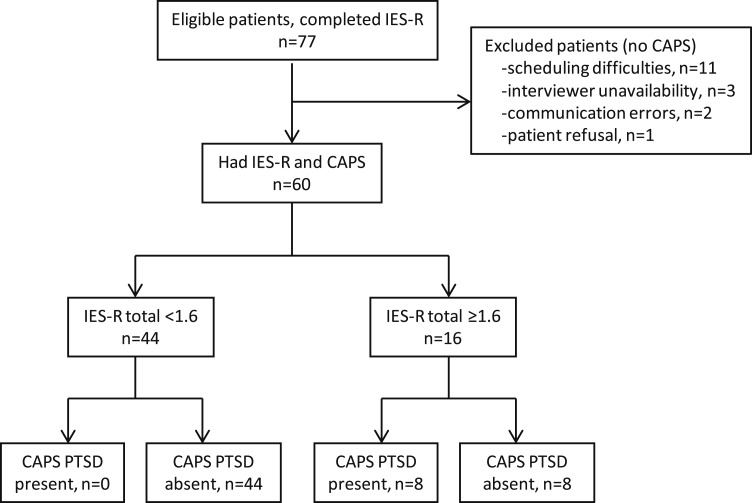
Methods: We evaluated the IES-R questionnaire vs the CAPS diagnostic interview in 60 of 77 consecutively recruited survivors of ALI from two prospective cohort studies of patients 1 to 5 years after ALI.
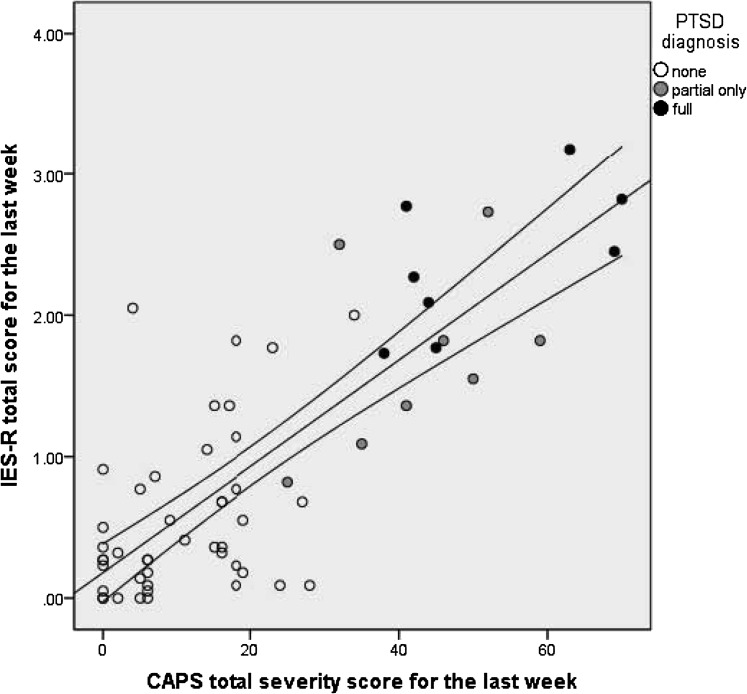
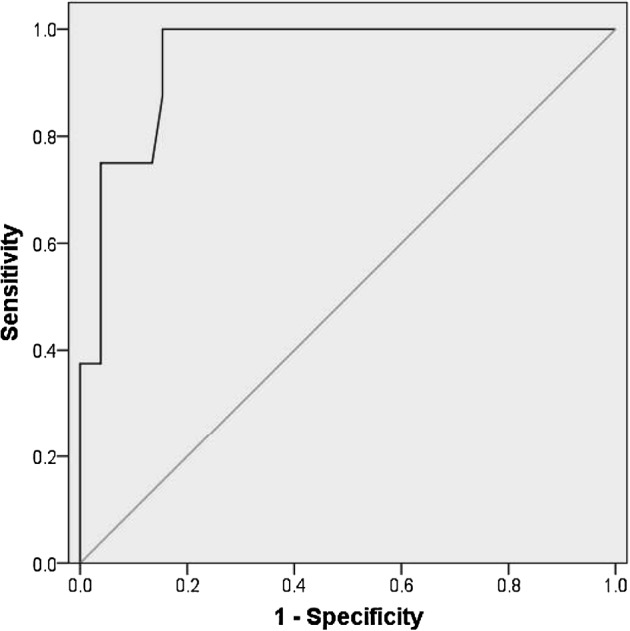
Results: The IES-R total score (range: 0.0-3.2) and the CAPS total severity score (range: 0-70) were strongly related (Pearson r=0.80, Spearman ρ=0.69). Using CAPS data, eight of the 60 patients (13%) had PTSD at the time of assessment, and an additional eight patients had partial PTSD (total prevalence, 27%). In a receiver operating characteristics curve analysis with CAPS PTSD or partial PTSD as criterion variables, the area under the curve ranged from 95% (95% CI, 88%-100%) to 97% (95% CI, 92%-100%). At an IES-R threshold of 1.6, with the same criterion variables, sensitivities ranged from 80% to 100%, specificities 85% to 91%, positive predictive values 50% to 75%, negative predictive values 93% to 100%, positive likelihood ratios 6.5 to 9.0, negative likelihood ratios 0.0 to 0.2, and efficiencies 87% to 90%.
Conclusions: The IES-R appears to be an excellent brief PTSD symptom measure and screening tool in ALI survivors.
Figures
Comment in
-
Surviving the ICU does not mean that the war is over.Chest. 2013 Jul;144(1):1-3. doi: 10.1378/chest.12-3091. Chest. 2013. PMID: 23880668 No abstract available.
-
Diagnostic and statistical manual of mental disorders, fifth edition, and the impact of events scale-revised.Chest. 2013 Dec;144(6):1974. doi: 10.1378/chest.13-1691. Chest. 2013. PMID: 24297138 No abstract available.
-
Response.Chest. 2013 Dec;144(6):1974-1975. doi: 10.1378/chest.13-1940. Chest. 2013. PMID: 24297139 No abstract available.
References
-
- DiMartini A, Dew MA, Kormos R, McCurry K, Fontes P. Posttraumatic stress disorder caused by hallucinations and delusions experienced in delirium. Psychosomatics. 2007;48(5):436-439. - PubMed
-
- Griffiths J, Fortune G, Barber V, Young JD. The prevalence of post traumatic stress disorder in survivors of ICU treatment: a systematic review. Intensive Care Med. 2007;33(9):1506-1518. - PubMed
Publication types
MeSH terms
Grants and funding
LinkOut - more resources
Full Text Sources
Other Literature Sources
Medical
Miscellaneous
