Observational Study
. 2013 May 20;8(5):e63233.
doi: 10.1371/journal.pone.0063233. Print 2013.

Clinical effectiveness of hymenoptera venom immunotherapy: a prospective observational multicenter study of the European academy of allergology and clinical immunology interest group on insect venom hypersensitivity

Affiliations
Observational Study

Clinical effectiveness of hymenoptera venom immunotherapy: a prospective observational multicenter study of the European academy of allergology and clinical immunology interest group on insect venom hypersensitivity

Franziska Ruëff et al. PLoS One. .

Abstract

Background: Treatment failure during venom immunotherapy (VIT) may be associated with a variety of risk factors.

Objective: Our aim was to evaluate the association of baseline serum tryptase concentration (BTC) and of other parameters with the frequency of VIT failure during the maintenance phase.

Methods: In this observational prospective multicenter study, we followed 357 patients with established honey bee or vespid venom allergy after the maintenance dose of VIT had been reached. In all patients, VIT effectiveness was either verified by sting challenge (n = 154) or patient self-reporting of the outcome of a field sting (n = 203). Data were collected on BTC, age, gender, preventive use of anti-allergic drugs (oral antihistamines and/or corticosteroids) right after a field sting, venom dose, antihypertensive medication, type of venom, side effects during VIT, severity of index sting reaction preceding VIT, and duration of VIT. Relative rates were calculated with generalized additive models.

Results: 22 patients (6.2%) developed generalized symptoms during sting challenge or after a field sting. A strong association between the frequency of VIT failure and BTC could be excluded. Due to wide confidence bands, however, weaker effects (odds ratios <3) of BTC were still possible, and were also suggested by a selective analysis of patients who had a sting challenge. The most important factor associated with VIT failure was a honey bee venom allergy. Preventive use of anti-allergic drugs may be associated with a higher protection rate.

Interpretation: It is unlikely that an elevated BTC has a strong negative effect on the rate of treatment failures. The magnitude of the latter, however, may depend on the method of effectiveness assessment. Failure rate is higher in patients suffering from bee venom allergy.


Conflict of interest statement

Competing Interests: The authors have the following interests. This study (collection of the data and shipping of the sera samples) was supported by grants from Phadia, Freiburg, Germany and ALK Abelló, Wedel, Germany. Measurement of baseline tryp-tase concentration was done by Phadia in Freiburg, Germany. M. Beatrice Bilò has received within the last five years travel grants and honoraria for speaking or participation at meetings from ALK-Abelló, Allergopharma, Astra, Glaxo, Meda, Menarini. She is member of the editorial board of European Annals of Allergy and Clinical Immunology and of Clinical and Translational Allergy. Floriano Bonifazi has received within the last five years travel grants and honoraria for speaking or participation at meetings from ALK-Abelló, Allergopharma, Chiesi, Glaxo, HAL Allergy, Meda, Menarini, Novartis, Thermo Fisher (former Phadia). Thomas Hawranek has received within the last five years travel grants and honoraria for speaking or participation at meetings from ALK-Abelló, MEDA and Thermo Fisher (former Phadia). He has participated in clinical studies for ALK-Abellò. He is member of several scientific associations. Helmut Küchenhoff has received research grants from ALK-Abelló and Thermo Fisher (former Phadia). Ulrich Müller has received within the last five years travel grants and honoraria for speaking or participation at meetings from ALK-Abelló and Thermo Fisher (former Phadia). He has participated in clinical studies of ALK-Abelló and Thermo Fisher (former Phadia). He is member of the interest group insect venom allergy of the EAACI. Bernhard Przybilla has received within the last five years travel grants and honoraria for speaking or participation at meetings from ALK-Abelló, Novartis, and Stallergenes, and for consulting Jansen. He is board member of the DGAKI and member of the editorial board of Allergologie and several scientific organisations (e.g. DDG). Franziska Ruëff has received within the last five years travel grants and honoraria for speaking or participation at meetings from ALK-Abelló, Bencard, HAL, Hans Karrer, Novartis, and Thermo Fisher (former Phadia). She has participated in clinical studies of Allergopharma, HAL, Novartis, and Pierre Fabre. She is chair of the interest group insect venom allergy of the EAACI and member of several scientific associations, e.g. DGAKI or DDG. She is member of the editorial board of Allergologie and Allergo Journal. Norbert Reider has received within the last five years travel grants and honoraria for speaking or participation at meetings from ALK-Abelló, Bencard, HAL, and Thermo Fisher (former Phadia). He has participated in clinical studies of ALK-Abelló, and HAL. Gunter Sturm has received within the last five years travel grants and honoraria for paid lectures from ALK-Abelló, and Thermo Fisher (former Phadia). Regina Treudler has received within the last five years travel grants and honoraria for speaking or participation at meetings from Abott, ALK-Abelló, Astellas, Basilea, Janssen-Cilag, MSD, Medea, Merckle Ricordati, Novartis, Pfizer, Roche and Shire. She has participated in clinical studies for Abbott, Allergopharma, Astellas, Novartis, MSD, Pfizer, Stallergenes, Therakos. She received research funding from the Federal Ministry of Education and Research, Fraunhofer Society, Leipzig Research Center for Civilization Disease, ALK-Abello, Allergopharma and Phadia. There are no patents, products in development or marketed products to declare. This does not alter the authors’ adherence to all the PLOS ONE policies on sharing data and materials, as detailed online in the guide for authors.

Figures

Figure 1
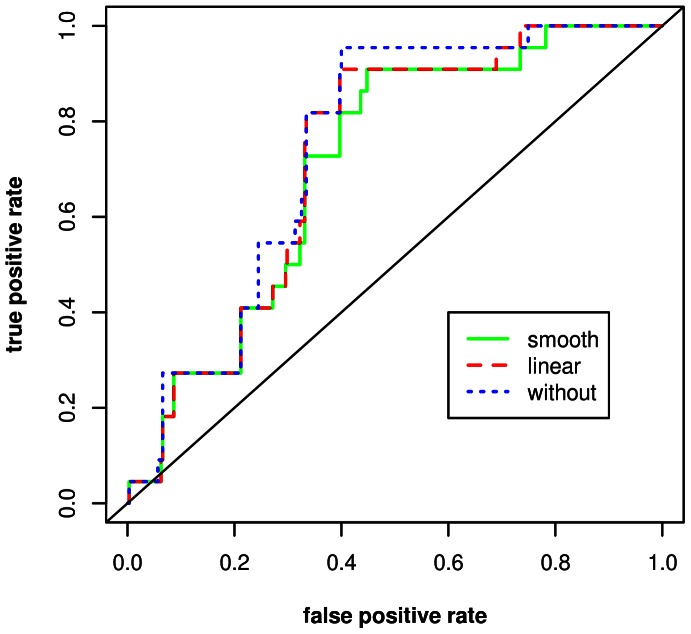
Figure 1. Receiver operating characteristic (ROC) curve for the final multiple logistic regression model predicting the risk to need an emergency intervention during sting challenge or to develop generalized symptoms after a field sting.
Models were tested without including the effect of BTC, or with including a smoothed or a linear effect. Corresponding areas under the curve were 0.7449, 0.7084 or 0.7240.
Figure 2
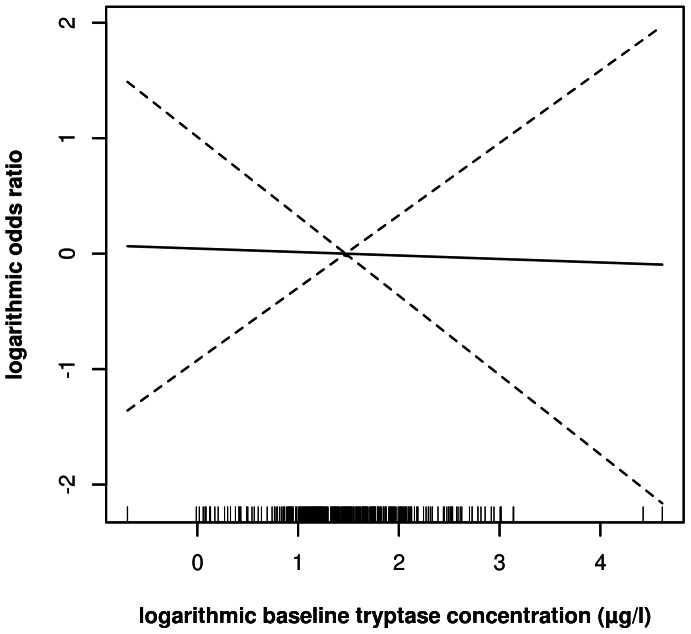
Figure 2. Smooth function and pointwise 95% confidence bands (dashed lines) for the effect of baseline tryptase concentration on the risk to need an emergency intervention during sting challenge or to develop generalized symptoms after a field sting (final multivariate generalized additive model).
Odds ratios are referred to those of the median of tryptase concentration. The odds ratio of the latter has been set at 1.

References

    1. Ruëff F, Przybilla B, Biló MB, Müller U, Scheipl F, et al. (2009) Predictors of severe systemic anaphylactic reactions in Hymenoptera venom allergy: the importance of baseline serum tryptase. J Allergy Clin Immunol 124: 1047–1054. - PubMed
    1. Valent P, Akin C, Arock M, Brockow K, Butterfield JH, et al. (2012) Definitions, criteria and global classification of mast cell disorders with special reference to mast cell activation syndromes: a consensus proposal. Int Arch Allergy Immunol 157: 215–225. - PMC - PubMed
    1. Hidvégi B, Nagy E, Szabó T, Temesvári E, Marschalkó M, et al. (2003) Correlation between T-cell and mast cell activity in patients with chronic urticaria. Int Arch Allergy Immunol 132: 177–182. - PubMed
    1. Dugas-Breit S, Schöpf P, Dugas M, Schiffl H, Ruëff F, et al. (2005) Baseline serum levels of mast cell tryptase are raised in hemodialysis patients and associated with severity of pruritus. J Dtsch Dermatol Ges 3: 343–347. - PubMed
    1. Kawakami T, Kitaura J (2005) Mast cell survival and activation by IgE in the absence of antigen: a consideration of the biologic mechanisms and relevance. J Immunol 175: 4167–4173. - PMC - PubMed

Publication types