The Role of Diverting Stoma After an Ultra-low Anterior Resection for Rectal Cancer
- PMID: 23700573
- PMCID: PMC3659245
- DOI: 10.3393/ac.2013.29.2.66
The Role of Diverting Stoma After an Ultra-low Anterior Resection for Rectal Cancer
Abstract
Purpose: A diverting stoma is known to reduce the consequences of distal anastomotic failure following colorectal surgery. The aim of this study was to evaluate the efficacy of a diverting stoma after an ultra-low anterior resection (uLAR) for rectal cancer.
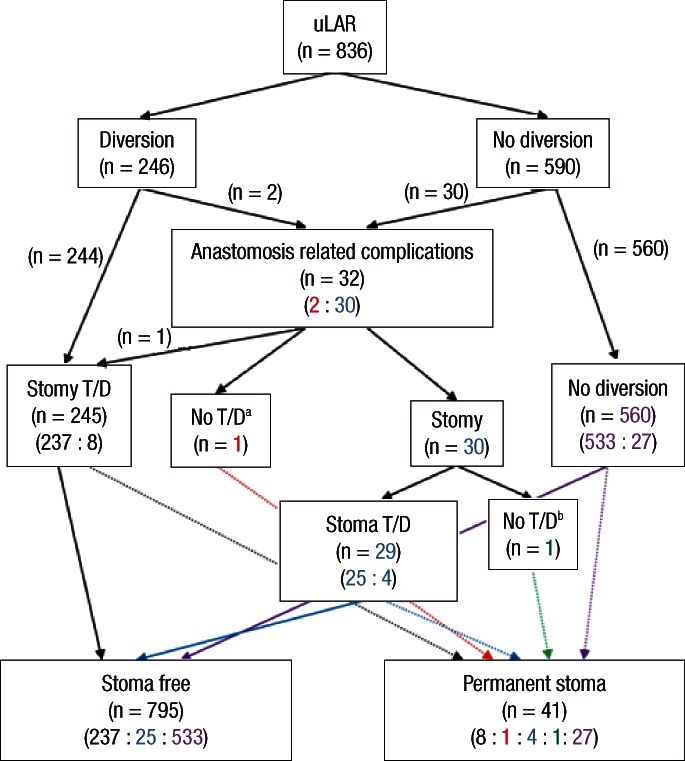
Methods: Between 2000 and 2007, 836 patients who underwent an uLAR were divided into two groups, depending on the fecal diversion: 246 received fecal diversion, and 590 had no diversion. Patient- and disease-related variables were compared between the two groups.
Results: Thirty-two of the 836 patients (3.8%) had immediate anastomosis-related complications and required reoperation. Anastomosis leakage comprised 72% of the complications (23/32). The overall immediate complication rate was significantly lower in patients with a diverting stoma (0.8%, 2/246) compared to those without a diverting stoma (5.1%, 30/590; P = 0.005). The fecal diversion group had lower tumor location, lower anastomosis level, and more preoperative chemo-radiation therapy (P < 0.001). In total, 12% of patients in the diverting stoma group had complications either in making or reversing the stoma (30/246).
Conclusion: The diverting stoma decreased the rate of immediate anastomosis-related complications. However, the rate of complications associated with the diverting stoma was non-negligible, so strict criteria should be applied when deciding whether to use a diverting stoma.
Keywords: Colorectal surgery; Ileostomy; Rectal neoplasms.
Conflict of interest statement
No potential conflict of interest relevant to this article was reported.
Figures
References
-
- Nakagoe T, Ishikawa H, Sawai T, Tsuji T, Takeshita H, Nanashima A, et al. Oncological outcome of ultra-low anterior resection with total mesorectal excision for carcinoma of the lower third of the rectum: comparison of intrapelvic double-stapled anastomosis and transanal coloanal anastomosis. Hepatogastroenterology. 2005;52:1692–1697. - PubMed
-
- Everett WG, Friend PJ, Forty J. Comparison of stapling and handsuture for left-sided large bowel anastomosis. Br J Surg. 1986;73:345–348. - PubMed
-
- Waxman BP. Large bowel anastomoses. II. The circular staplers. Br J Surg. 1983;70:64–67. - PubMed
-
- den Dulk M, Smit M, Peeters KC, Kranenbarg EM, Rutten HJ, Wiggers T, et al. A multivariate analysis of limiting factors for stoma reversal in patients with rectal cancer entered into the total mesorectal excision (TME) trial: a retrospective study. Lancet Oncol. 2007;8:297–303. - PubMed
-
- Jung SH, Yu CS, Choi PW, Kim DD, Park IJ, Kim HC, et al. Risk factors and oncologic impact of anastomotic leakage after rectal cancer surgery. Dis Colon Rectum. 2008;51:902–908. - PubMed
LinkOut - more resources
Full Text Sources
Other Literature Sources