. 2013 Jul 19;8(7):1590-9.
doi: 10.1021/cb400261h. Epub 2013 May 23.

Proteome-wide reactivity profiling identifies diverse carbamate chemotypes tuned for serine hydrolase inhibition

Affiliations

Proteome-wide reactivity profiling identifies diverse carbamate chemotypes tuned for serine hydrolase inhibition

Jae Won Chang et al. ACS Chem Biol. .

Abstract

Serine hydrolases are one of the largest and most diverse enzyme classes in Nature. Inhibitors of serine hydrolases are used to treat many diseases, including obesity, diabetes, cognitive dementia, and bacterial and viral infections. Nonetheless, the majority of the 200+ serine hydrolases in mammals still lack selective inhibitors for their functional characterization. We and others have shown that activated carbamates, through covalent reaction with the conserved serine nucleophile of serine hydrolases, can serve as useful inhibitors for members of this enzyme family. The extent to which carbamates, however, cross-react with other protein classes remains mostly unexplored. Here, we address this problem by investigating the proteome-wide reactivity of a diverse set of activated carbamates in vitro and in vivo, using a combination of competitive and click chemistry (CC)-activity-based protein profiling (ABPP). We identify multiple classes of carbamates, including O-aryl, O-hexafluoroisopropyl (HFIP), and O-N-hydroxysuccinimidyl (NHS) carbamates that react selectively with serine hydrolases across entire mouse tissue proteomes in vivo. We exploit the proteome-wide specificity of HFIP carbamates to create in situ imaging probes for the endocannabinoid hydrolases monoacylglycerol lipase (MAGL) and α-β hydrolase-6 (ABHD6). These findings, taken together, designate the carbamate as a privileged reactive group for serine hydrolases that can accommodate diverse structural modifications to produce inhibitors that display exceptional potency and selectivity across the mammalian proteome.


Figures
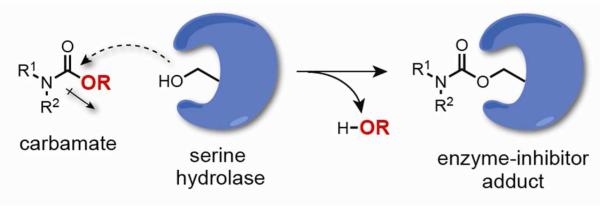
Figure 1
Figure 1
Mechanism of serine hydrolase inhibition by carbamates.
Figure 2
Figure 2
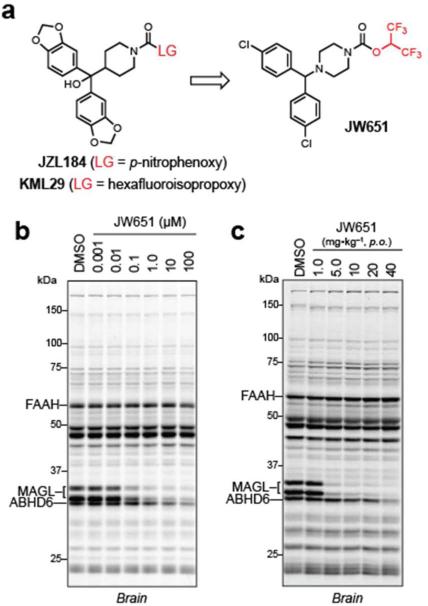
Design and in vitro and in vivo characterization of JW651. (a) Structures of previously developed MAGL inhibitors JZL184 and KML29 leading to the simplified benzhydrylpiperazine scaffold of JW651. (b) In vitro competitive ABPP of JW651 using the serine hydrolase-directed probe FP-Rh in the membrane fraction of the mouse brain proteome. JW651 potently and selectively inhibits FP-Rh labeling of MAGL, with ABHD6 being the only detectable off-target (up to 100 μM JW651). (c) In vivo competitive ABPP of brain proteomes isolated from JW651-treated mice (1.0 – 40 mg•kg–1, p.o.) 4 h after administration. JW651 completely inhibits MAGL in the brain at doses as low as 5 mg•kg–1 (See also Supplementary Figure S1 for endocannabinoid levels in the brain for JW651 treated mice).
Figure 3
Figure 3
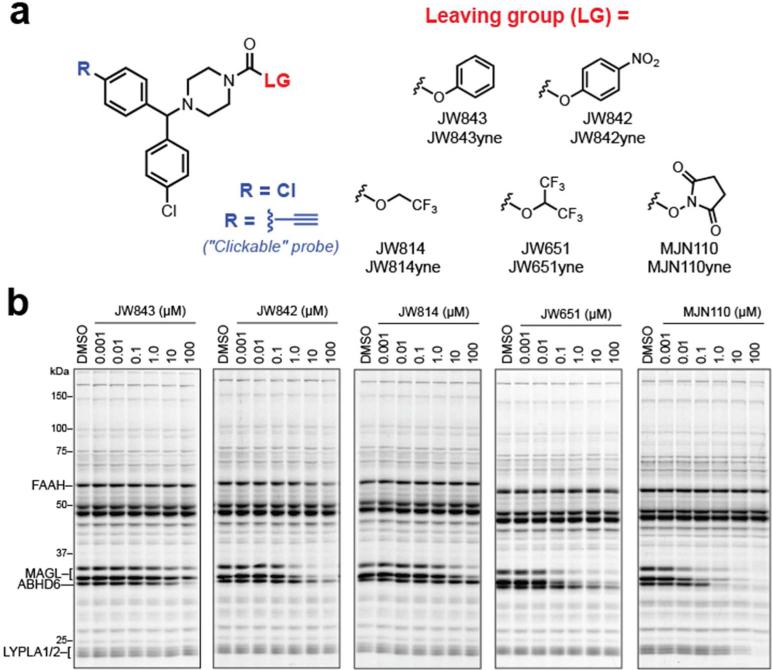
Development of carbamate probes and profiling their reactivity against brain serine hydrolases by competitive ABPP. (a) Structures of parent (R = Cl) and clickable (R = alkyne) carbamate probes with varying leaving groups. (b) In vitro competitive ABPP of mouse brain showing that leaving groups have a significant effect on serine hydrolase reactivity. See also Supplementary Table S1 for calculated IC50 values for MAGL, ABHD6 and FAAH.
Figure 4
Figure 4
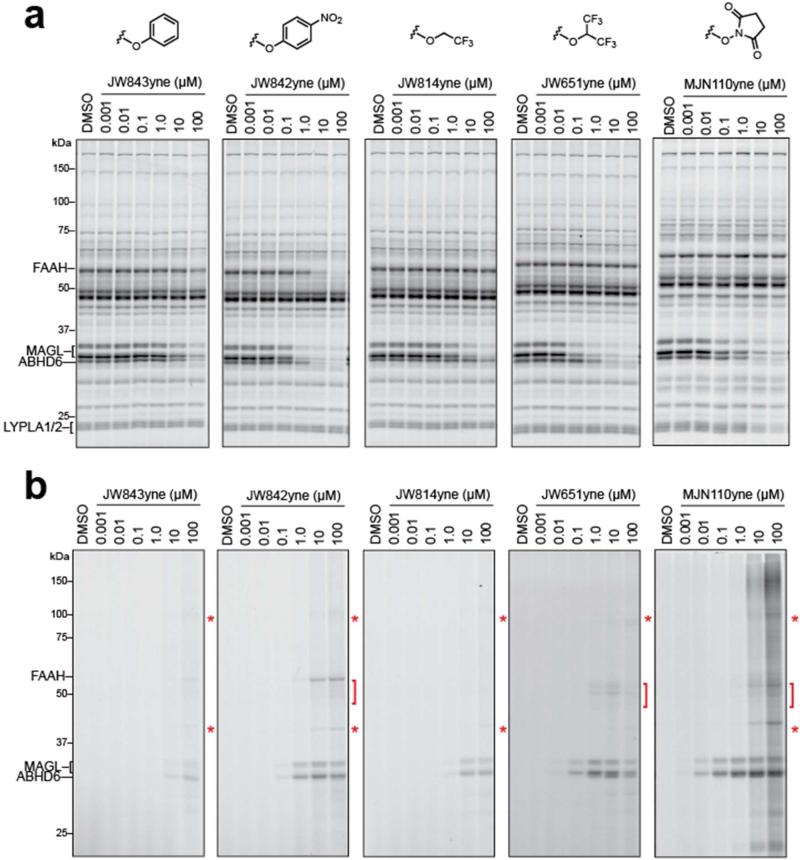
Competitive and CC-ABPP of clickable carbamate probes in vitro. (a, b) In vitro competitive ABPP (a) and CC-ABPP (b) of mouse brain membrane proteomes treated with the indicated concentration of clickable carbamate probes. Each inhibitor labels MAGL and ABHD6—and in the case of JW842yne, FAAH—to varying degrees and also shows a limited number of off-targets (denoted with red asterisks and brackets in (b)), which were not detected by competitive ABPP with the FP-Rh probe (a). See also, Supplementary Figure S2 for Coomassie stain of brain proteomes showing that these off-targets comigrate with highly abundant proteins. Note further that MJN110yne exhibits a more extensive off-target labeling profile at high (10 μM or greater) concentrations of probe.
Figure 5
Figure 5
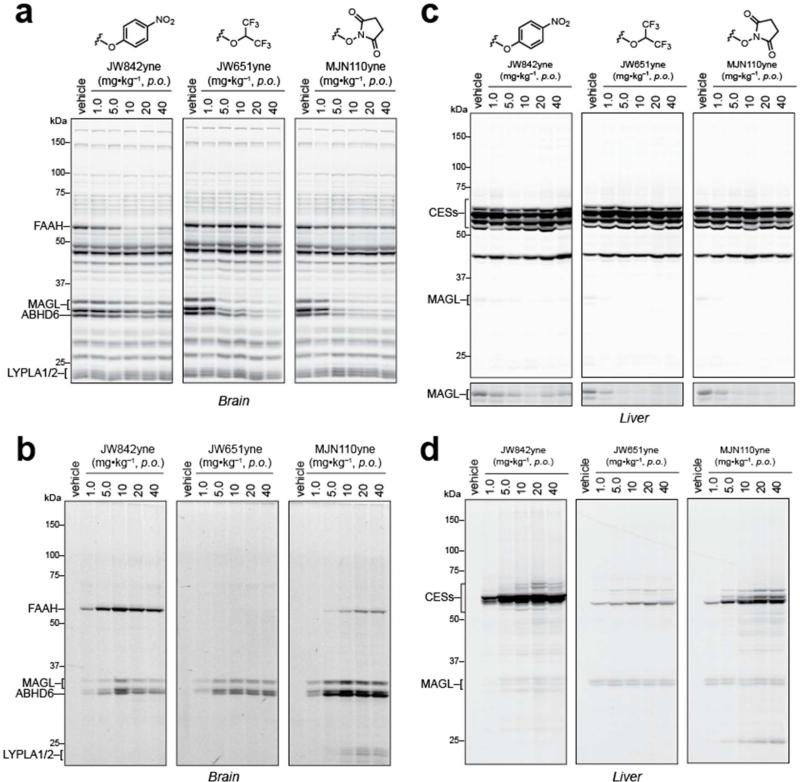
Competitive and CC-ABPP of clickable carbamate probes in vivo. (a–d) Competitive ABPP of brain (a) and liver (c) membrane proteomes isolated from mice treated with indicated doses of each carbamate (1.0 – 40 mg•kg–1, p.o.). CC-ABPP for the same brain (b) and liver (d) proteomes derived from vehicle- or inhibitor-treated mice. Each inhibitor shows clear labeling of MAGL and ABHD6 in the brain, while FAAH is labeled by JW842yne and, to lesser extent, by MJN110yne. Liver profiles reveal differing degrees of off-target cross-reactivities for each carbamate with JW651yne exhibiting the highest selectivity across the proteome.
Figure 6
Figure 6
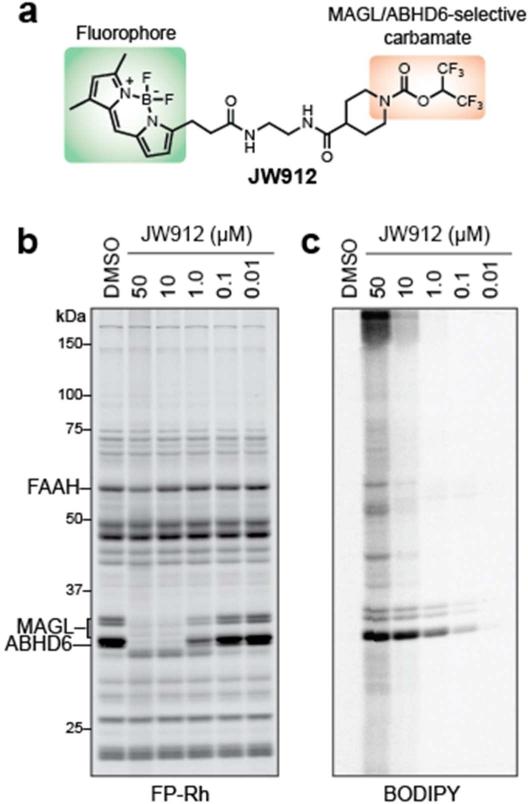
Development of an activity-based imaging probe for MAGL and ABHD6. (a) Structure of JW912 imaging probe highlighting the HFIP carbamate group, which directs this probe to MAGL and ABHD6, and the BOPIDY fluorophore, which allows visualization. (b) Competitive ABPP for JW912 showing selective inhibition of MAGL and ABHD6 over other serine hydrolases in the brain. (c) BODIPY channel gel image revealing that JW912 selectively labels MAGL and ABHD6 at concentrations below 10 μM across the proteome.
Figure 7
Figure 7
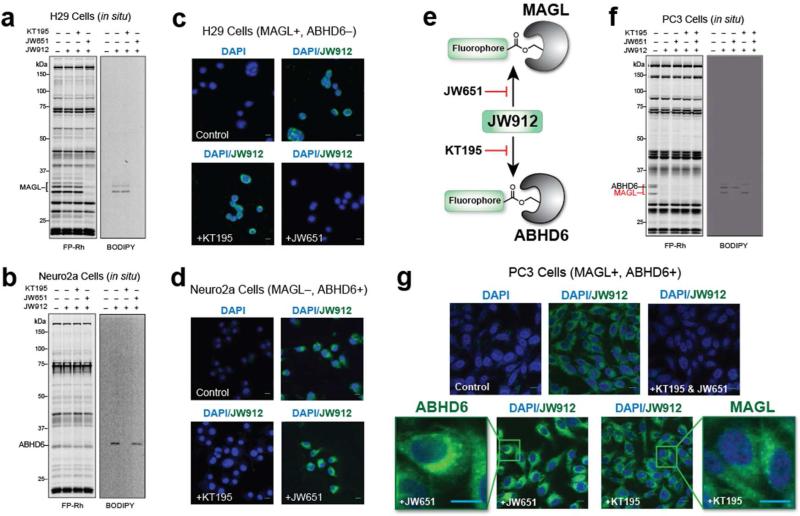
In situ activity-based imaging of MAGL and ABHD6 in cancer cells with JW912. (a-g) Competitive ABPP (FP-Rh) and direct labeling (BODIPY) profiles for H29 (a), Neuro2A (c), and PC3 (f) cells labeled with JW912 (100 nM) following treatment with either DMSO, KT195 (10 nM), or JW651 (10 nM). Confocal imaging of H29 (b), Neuro2A (d), and PC3 (g) cells treated with JW912 ± JW651 (10 nM), KT195 (10 nM) or both to inhibit labeling of MAGL, ABHD6 or both, respectively. (e) Strategy used to selectively image either MAGL or ABHD6 with JW912 in PC3 cells which express both enzymes. Scale bars = 5 μm.

References

    1. Long JZ, Cravatt BF. The metabolic serine hydrolases and their functions in mammalian physiology and disease. Chem. Rev. 2011;111:6022–6063. - PMC - PubMed
    1. Macheboeuf P, Contreras-Martel C, Job V, Dideberg O, Dessen A. Penicillin Binding Proteins: key players in bacterial cell cycle and drug resistance processes. FEMS Microbiol. Rev. 2006;30:673–691. - PubMed
    1. Vermehren J, Sarrazin C. New hepatitis C therapies in clinical development. European journal of medical research. 2011;16:303–314. - PMC - PubMed
    1. Nomura DK, Morrison BE, Blankman JL, Long JZ, Kinsey SG, Marcondes MCG, Ward AM, Hahn YK, Lichtman AH, Conti B, Cravatt BF. Endocannabinoid Hydrolysis Generates Brain Prostaglandins That Promote Neuroinflammation. Science. 2011;334:809–813. - PMC - PubMed
    1. Whitcomb DC, Lowe ME. Human pancreatic digestive enzymes. Digestive diseases and sciences. 2007;52:1–17. - PubMed

Publication types