. 2013 May 23:10:158.
doi: 10.1186/1743-422X-10-158.

Virophages, polintons, and transpovirons: a complex evolutionary network of diverse selfish genetic elements with different reproduction strategies

Affiliations

Virophages, polintons, and transpovirons: a complex evolutionary network of diverse selfish genetic elements with different reproduction strategies

Natalya Yutin et al. Virol J. .

Abstract

Background: Recent advances of genomics and metagenomics reveal remarkable diversity of viruses and other selfish genetic elements. In particular, giant viruses have been shown to possess their own mobilomes that include virophages, small viruses that parasitize on giant viruses of the Mimiviridae family, and transpovirons, distinct linear plasmids. One of the virophages known as the Mavirus, a parasite of the giant Cafeteria roenbergensis virus, shares several genes with large eukaryotic self-replicating transposon of the Polinton (Maverick) family, and it has been proposed that the polintons evolved from a Mavirus-like ancestor.

Results: We performed a comprehensive phylogenomic analysis of the available genomes of virophages and traced the evolutionary connections between the virophages and other selfish genetic elements. The comparison of the gene composition and genome organization of the virophages reveals 6 conserved, core genes that are organized in partially conserved arrays. Phylogenetic analysis of those core virophage genes, for which a sufficient diversity of homologs outside the virophages was detected, including the maturation protease and the packaging ATPase, supports the monophyly of the virophages. The results of this analysis appear incompatible with the origin of polintons from a Mavirus-like agent but rather suggest that Mavirus evolved through recombination between a polinton and an unknown virus. Altogether, virophages, polintons, a distinct Tetrahymena transposable element Tlr1, transpovirons, adenoviruses, and some bacteriophages form a network of evolutionary relationships that is held together by overlapping sets of shared genes and appears to represent a distinct module in the vast total network of viruses and mobile elements.

Conclusions: The results of the phylogenomic analysis of the virophages and related genetic elements are compatible with the concept of network-like evolution of the virus world and emphasize multiple evolutionary connections between bona fide viruses and other classes of capsid-less mobile elements.


Figures
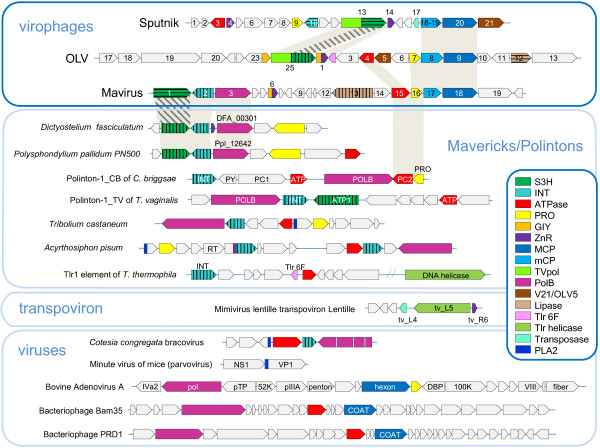
Figure 1
Figure 1
Comparison of genome architectures of the virophages, polintons, some viruses, and transpovirons. Homologous genes are marked by same colors. Different hatching patterns are used to mark non-orthologous primase-helicase, integrase, and lipase. Homologous regions are shaded. Reference sequences were extracted from GenBank (D. fasciculatum, GI:328871053; P. palladium, GI: 281202948; T. castaneum, GI:58197573; A. pisum, GI:156713484; Mimivirus lentille transpoviron Lentille, GI: 374110342; C. congregate bracovirus, GI: 326937614 Minute virus of mice, GI:9626993; Bovine adenovirus A, GI:52801677; Bacteriophage Bam35, GI:38640293; and Bacteriophage PRD1, GI:159192286) and Repbase (Polinton-1_CB and Polinton-1_TV [15,20]). The genome organization of Tlr1was adopted from ref. [18]. T. castaneum and A. pisum genome fragments are shown as in [21]. PLA2 stands for the phospholipase A2 domain of parvovirus capsid protein. Other color key abbreviations are the same as throughout the text.
Figure 2
Figure 2
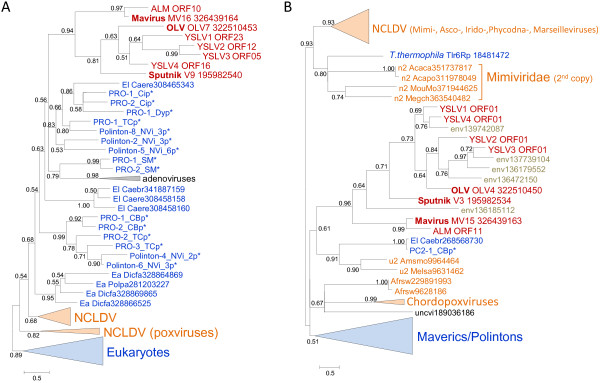
Phylogenetic trees of conserved virophage proteins. A, maturation protease. B, packaging ATPase. Branches with bootstrap support (expected-likelihood weights) less than 0.5 were collapsed. Sequences marked with an asterisks (*) were taken from Repbase [20]. For other sequences, the species name abbreviation and the GenBank identification numbers are indicated; env stands for “marine metagenome.” Species abbreviations: Acaca, Acanthamoeba castellanii mamavirus; Acapo, Acanthamoeba polyphaga mimivirus; Afrsw, African swine fever virus; Amsmo, Amsacta moorei entomopoxvirus 'L'; Caebr, Caenorhabditis brenneri; Caere, Caenorhabditis remanei; Crovi, Crocodilepox virus; Dicfa, Dictyostelium fasciculatum; Fowvi, Fowlpox virus isolate HP-438/Munich; Megch, Megavirus chiliensis; Melsa, Melanoplus sanguinipes entomopoxvirus; MouMo, Moumouvirus Monve; Orfvi, Orf virus; Popla, Polysphondylium pallidum PN500; Tanvi, Tanapox virus; uncvi, uncultured virus; Vacvi, Vaccinia virus Tian Tan. Taxa abbreviations: Ea, Amoebozoa; El, Opisthokonta; n2, mimiviruses; u1, Chordopoxvirinae; u2, Entomopoxvirinae. Color code: Red, virophages; blue, (predicted) polintons and related elements; light brown, NCLDV; gray, unassigned environmental sequences.
Figure 3
Figure 3
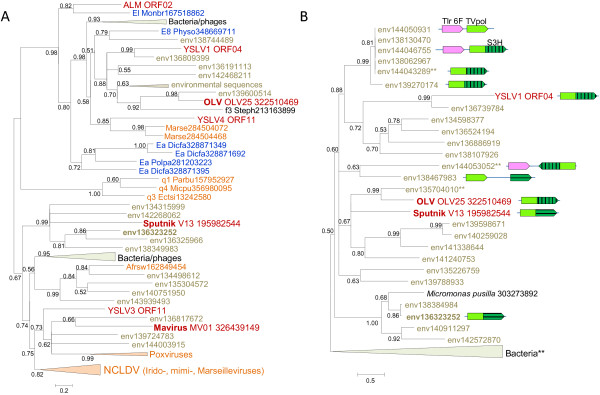
Phylogenetic trees of virophage S3H helicase: A, helicase domain; B, TVpol domain. Branches with bootstrap support (expected-likelihood weights) less than 0.5 were collapsed. TVpol domain genome contexts are shown by same color scheme as in Figure 1. TVpol domain reference sequences (marked with two asterisks) were taken from [22]. For other sequences, the species name abbreviation and the GenBank identification numbers are indicated; env stands for “marine metagenome.” Species abbreviations: Afrsw, African swine fever virus; Dicfa, Dictyostelium fasciculatum; Ectsi, Ectocarpus siliculosus virus 1; Marse, Marseillevirus; Micpu, Micromonas pusilla virus PL1; Monbr, Monosiga brevicollis MX1; Mycph, Mycobacterium phage; Parbu, Paramecium bursaria Chlorella virus NY2A; Physo, Phytophthora sojae; Popla, Polysphondylium pallidum PN500; Steph, Stenotrophomonas phage S1. Taxa abbreviations: E8, stramenopiles; Ea, Amoebozoa; El, Opisthokonta; f3, Siphoviridae; q1, Chlorovirus; q3, Phaeovirus; q4, Prasinovirus. The color code is as in Figure 2.
Figure 4
Figure 4
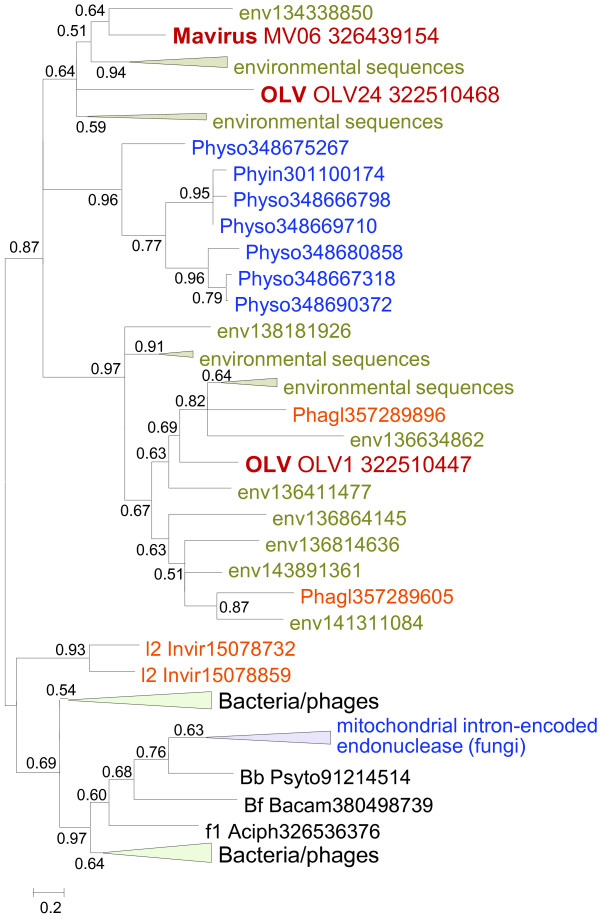
Phylogenetic tree of the GIY-YIG endonuclease. Branches with bootstrap support (expected-likelihood weights) less than 0.5 were collapsed. The species name abbreviation and the GenBank identification numbers are indicated; env stands for “marine metagenome.” Species abbreviations: Aciph, Acinetobacter phage 133; Bacam, Bacillus amyloliquefaciens subsp. plantarum YAU B9601-Y2; Invir, Invertebrate iridescent virus 6; Phagl, Phaeocystis globosa virus 12T; Phyin, Phytophthora infestans T30-4; Physo, Phytophthora sojae; Psyto, Psychroflexus torquis ATCC 700755; Taxa abbreviations: Bb, Bacteriodetes/Chlorobi group; Bf, Firmicutes; l2, Iridovirus. The color code is as in Figure 2.
Figure 5
Figure 5
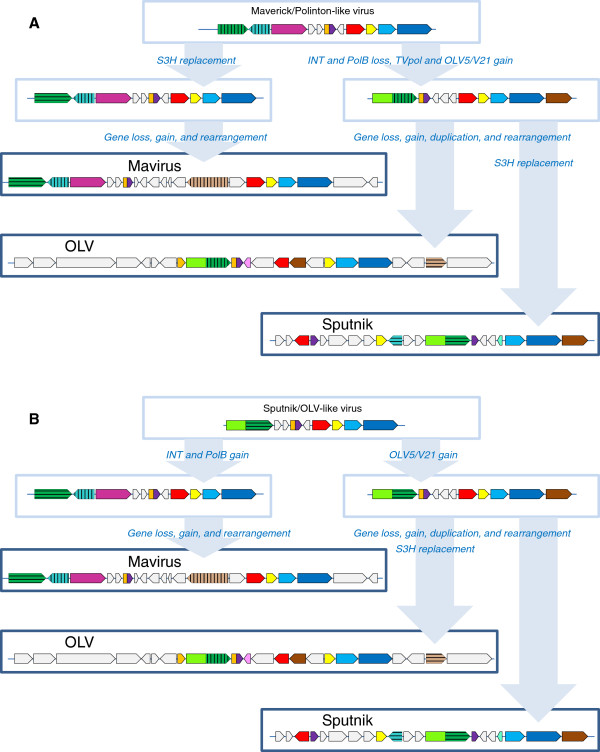
Two alternative evolutionary scenarios for the virophages. A, Mavirus/polinton-like ancestor. B, Sputnik/OLV-like ancestor. The genes are denoted as in Figure 1.
Figure 6
Figure 6
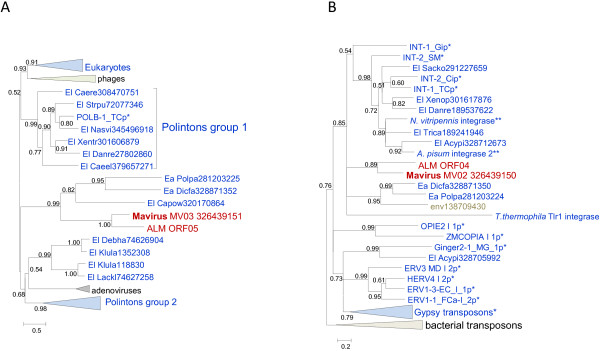
Phylogenetic trees of Mavirus genes shared with Polintons but not with other virophages. A, B family DNA polymerase. B, Catalytic domain of RVE integrase. Branches with the bootstrap support (expected-likelihood weights) less than 0.5 were collapsed. Sequences marked with an astericks (*) were taken from Repbase [20]. For other sequences, the species name abbreviation and the GenBank identification numbers are indicated; env stands for “marine metagenome.” Species abbreviations: Acypi, Acyrthosiphon pisum; Caeel, Caenorhabditis elegans; Caere, Caenorhabditis remanei; Capow, Capsaspora owczarzaki ATCC 30864; Danre, Danio rerio; Debha, Debaryomyces hansenii; Dicfa, Dictyostelium fasciculatum; Klula, Kluyveromyces lactis; Lackl, Lachancea kluyveri; Nasvi, Nasonia vitripennis; Polpa, Polysphondylium pallidum PN500; Sacko, Saccoglossus kowalevskii; Strpu, Strongylocentrotus purpuratus; Trica, Tribolium castaneum; Xentr, Xenopus (Silurana) tropicalis. Taxa abbreviations: Ea, Amoebozoa; El, Opisthokonta. The color code is as in Figure 2.
Figure 7
Figure 7
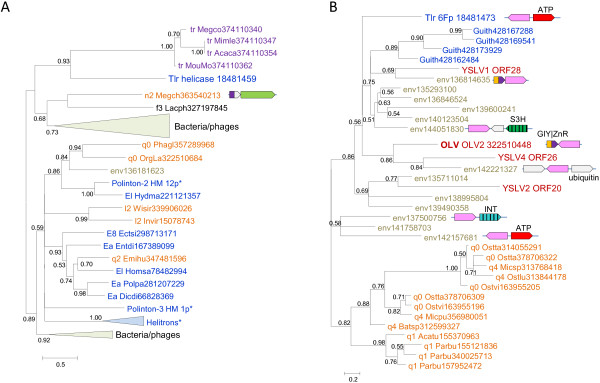
Phylogenetic trees of Tlr1 proteins shared with transpovirons or virophages. A, Superfamily 1 helicase. B, Tlr1 6F protein. Branches with the bootstrap support (expected-likelihood weights) less than 0.5 were collapsed. Genome contexts are shown by same color scheme as on Figure 1. Sequences marked with an astericks (*) were taken from Repbase [20]. For other sequences, the species name abbreviation and the GenBank identification numbers are indicated; tr stands for transpoviron; env stands for environmental (metagenomic) sequence. Species abbreviations: Acaca, Acanthamoeba castellanii mamavirus; Acatu, Acanthocystis turfacea Chlorella virus 1; Batsp, Bathycoccus sp. RCC1105 virus BpV2; Dicdi, Dictyostelium discoideum AX4; Ectsi, Ectocarpus siliculosus; Emihu, Emiliania huxleyi virus 84; Entdi, Entamoeba dispar SAW760; Guith, Guillardia theta; Homsa, Homo sapiens; Hydma, Hydra magnipapillata; Invir, Invertebrate iridescent virus 6; Lacph, Lactococcus phage 949; Megch, Megavirus chiliensis; Megco, Megavirus courdo7; Micpu, Micromonas pusilla virus PL1; Micsp, Micromonas sp. RCC1109 virus MpV1; Mimle, Mimivirus lentille; MouMo, Moumouvirus Monve; OrgLa, Organic Lake phycodnavirus 1; Ostlu, Ostreococcus lucimarinus virus OlV1; Ostta, Ostreococcus tauri virus RT-2011; Ostvi, Ostreococcus virus OsV5; Parbu, Paramecium bursaria Chlorella virus NY2A; Phagl, Phaeocystis globosa virus 12T; Polpa, Polysphondylium pallidum PN500; Wisir, Wiseana iridescent virus. Taxa abbreviations: E8, stramenopiles; Ea, Amoebozoa; El, Opisthokonta; f3, Siphoviridae; l2, Iridovirus; n2, mimiviruses; q0, unassigned Phycodnaviridae; q1, Chlorovirus; q2, Coccolithovirus; q4, Prasinovirus. The color code is as in Figure 2.
Figure 8
Figure 8
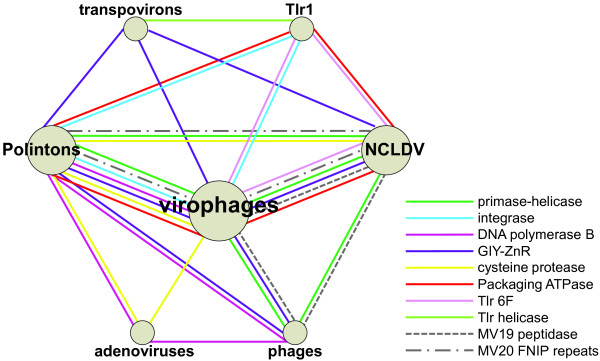
The virophage-polinton evolutionary network. Specific groups of bacteriophages that are involved in the network connections: Tectiviridae (PolB); Caudovirales (tailed bacteriophages: S3H and GIY-YIG); cyanophages (MV19 peptidase). Specific groups of NCLDV that are involved in the network connections: Irido-, Mimi-, Pox-, Marseilleviruses (Mavirus S3H helicase); Marseillevirus (OLV S3H helicase and MV19 peptidase); Phaeocystis globosa virus and Invertebrate iridescent virus 6 (GIY-YIG); Phycodnaviridae (Tlr 6F); Pox- and Asfarviridae (ATPase), and Mimiviridae (MV20 FNIP repeats).

References

    1. Raoult D, Audic S, Robert C, Abergel C, Renesto P, Ogata H, La Scola B, Suzan M, Claverie JM. The 1.2-megabase genome sequence of Mimivirus. Science. 2004;306(5700):1344–1350. doi: 10.1126/science.1101485. - DOI - PubMed
    1. Raoult D, Forterre P. Redefining viruses: lessons from Mimivirus. Nat Rev Microbiol. 2008;6:315–319. doi: 10.1038/nrmicro1858. - DOI - PubMed
    1. Claverie JM, Abergel C. Mimivirus: the emerging paradox of quasi-autonomous viruses. Trends Genet. 2010;26(10):431–437. doi: 10.1016/j.tig.2010.07.003. - DOI - PubMed
    1. Claverie JM, Abergel C, Ogata H. Mimivirus. Curr Top Microbiol Immunol. 2009;328:89–121. doi: 10.1007/978-3-540-68618-7_3. - DOI - PubMed
    1. Claverie JM, Ogata H, Audic S, Abergel C, Suhre K, Fournier PE. Mimivirus and the emerging concept of "giant" virus. Virus Res. 2006;117(1):133–144. doi: 10.1016/j.virusres.2006.01.008. - DOI - PubMed

LinkOut - more resources