Trends in influenza vaccine coverage in pregnant women, 2008 to 2012
- PMID: 23704840
- PMCID: PMC3662276
- DOI: 10.7812/TPP/12-115
Trends in influenza vaccine coverage in pregnant women, 2008 to 2012
Abstract
Context: Pregnant women are at increased risk of severe influenza-related complications and hospitalizations and are a priority group for influenza vaccination.
Objective: To examine coverage of seasonal and pandemic influenza A (H1N1) vaccines in pregnant women in a managed care setting, from 2008 to 2012.
Design: Retrospective cohort study of 10,145 pregnant women.
Main outcome measures: H1N1 and seasonal influenza vaccination rates.
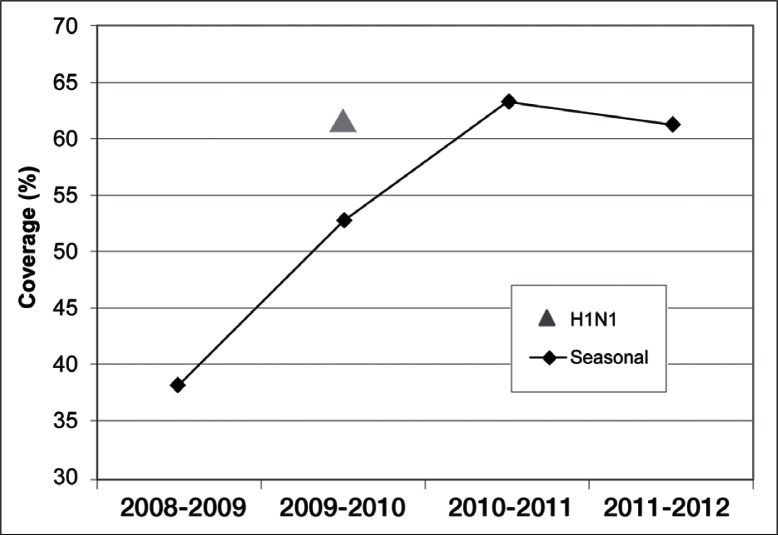
Results: Seasonal influenza vaccine coverage increased from 38% to 63% between the 2008-2009 and 2010-2011 seasons, and then dropped to 61% in 2011-2012. Vaccine coverage was higher in women considered at high risk of influenza complications, increasing from 43% in 2008-2009 to 71% in 2010-2011, before decreasing to 69% in 2011-2012. H1N1 vaccine coverage was greater than seasonal influenza coverage in 2009-2010 in the overall pregnant population (61% vs 53%) and in the high-risk group (64% vs 59%). We observed statistically significant differences in vaccination rates by trimester, gravidity, maternal age, and race/ethnicity.
Conclusions: Vaccination rates increased significantly from 2008 to 2011, then dropped slightly in 2011-2012. Continued efforts are needed to ensure adequate vaccination coverage in this high-risk population.
Figures
References
-
- Centers for Disease Control and Prevention (CDC) 2009 pandemic influenza A (H1N1) in pregnant women requiring intensive care—New York City, 2009. MMWR Morb Mortal Wkly Rep. 2010 Mar 26;59(11):321–6. - PubMed
-
- Creanga AA, Johnson TF, Graitcer SB, et al. Severity of 2009 pandemic influenza A (H1N1) virus infection in pregnant women. Obstet Gynecol. 2010 Apr;115(4):717–26. DOI: http://dx.doi.org/10.1097/AOG.0b013e3181d57947. - DOI - PubMed
-
- Ellington SR, Hartman LK, Acosta M, et al. Pandemic 2009 influenza A (H1N1) in 71 critically ill pregnant women in California. Am J Obstet Gynecol. 2011 Jun;204(6 Suppl 1):S21–30. DOI: http://dx.doi.org/10.1016/j.ajog.2011.02.038. - DOI - PubMed
-
- Jamieson DJ, Honein MA, Rasmussen SA, et al. Novel Influenza A (H1N1) Pregnancy Working Group. H1N1 2009 influenza virus infection during pregnancy in the USA. Lancet. 2009 Aug 8;374(9688):451–8. DOI: http://dx.doi.org/10.1016/S0140-6736(09)61304-0. - DOI - PubMed
-
- Louie JK, Acosta M, Jamieson DJ, Honein MA, California Pandemic (H1N1) Working Group Severe 2009 H1N1 influenza in pregnant and postpartum women in California. N Engl J Med. 2010 Jan 7;362(1):27–35. DOI: http://dx.doi.org/10.1056/NEJMoa0910444. - DOI - PubMed
Publication types
MeSH terms
Substances
LinkOut - more resources
Full Text Sources
Other Literature Sources
Medical