


Incidence and predictors of pregnancy among a cohort of HIV-positive women initiating antiretroviral therapy in Mbarara, Uganda
- PMID: 23704906
- PMCID: PMC3660357
- DOI: 10.1371/journal.pone.0063411
Incidence and predictors of pregnancy among a cohort of HIV-positive women initiating antiretroviral therapy in Mbarara, Uganda
Erratum in
-
Correction: Incidence and Predictors of Pregnancy among a Cohort of HIV-Positive Women Initiating Antiretroviral Therapy in Mbarara, Uganda.PLoS One. 2013 Jun 4;8(6):10.1371/annotation/17310bbb-e5bf-4901-8b6e-529577a280db. doi: 10.1371/annotation/17310bbb-e5bf-4901-8b6e-529577a280db. eCollection 2013. PLoS One. 2013. PMID: 29161730 Free PMC article.
Abstract
Objective: Many people living with HIV in sub-Saharan Africa desire biological children. Implementation of HIV prevention strategies that support the reproductive goals of people living with HIV while minimizing HIV transmission risk to sexual partners and future children requires a comprehensive understanding of pregnancy in this population. We analyzed prospective cohort data to determine pregnancy incidence and predictors among HIV-positive women initiating antiretroviral therapy (ART) in a setting with high HIV prevalence and fertility.
Methods: Participants were enrolled in the Uganda AIDS Rural Treatment Outcomes (UARTO) cohort of HIV-positive individuals initiating ART in Mbarara. Bloodwork (including CD4 cells/mm(3), HIV viral load) and questionnaires (including socio-demographics, health status, sexual behavior, partner dynamics, HIV history, and self-reported pregnancy) were completed at baseline and quarterly. Our analysis includes 351 HIV-positive women (18-49 years) who enrolled between 2005-2011. We measured pregnancy incidence by proximal and distal time relative to ART initiation and used multivariable Cox proportional hazards regression analysis (with repeated events) to identify baseline and time-dependent predictors of pregnancy post-ART initiation.
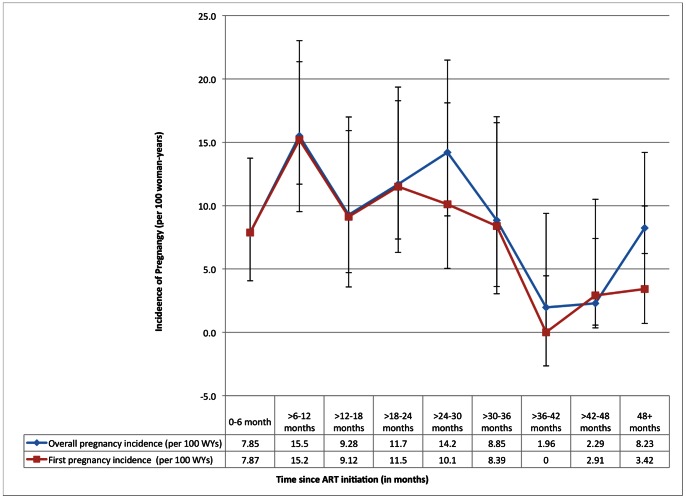
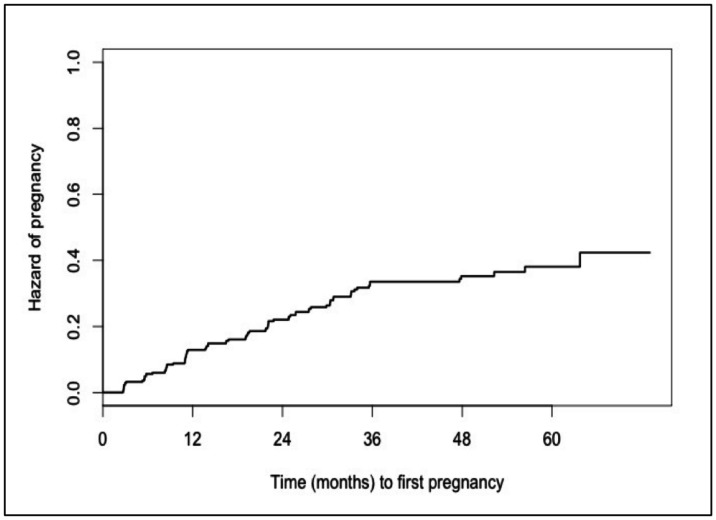
Results: At baseline (pre-ART initiation), median age was 33 years [IQR: 27-37] and median prior livebirths was four [IQR: 2-6]. 38% were married with 61% reporting HIV-positive spouses. 73% of women had disclosed HIV status to a primary sexual partner. Median baseline CD4 was 137 cells/mm(3) [IQR: 81-207]. At enrolment, 9.1% (31/342) reported current pregnancy. After ART initiation, 84 women experienced 105 pregnancies over 3.8 median years of follow-up, yielding a pregnancy incidence of 9.40 per 100 WYs. Three years post-ART initiation, cumulative probability of at least one pregnancy was 28% and independently associated with younger age (Adjusted Hazard Ratio (AHR): 0.89/year increase; 95%CI: 0.86-0.92) and HIV serostatus disclosure to primary sexual partner (AHR: 2.45; 95%CI: 1.29-4.63).
Conclusions: Nearly one-third of women became pregnant within three years of initiating ART, highlighting the need for integrated services to prevent unintended pregnancies and reduce periconception-related risks for HIV-infected women choosing to conceive. Association with younger age and disclosure suggests a role for early and couples-based safer conception counselling.
Conflict of interest statement
Figures
References
-
- UNAIDS (2010) Global Report: UNAIDS Report on the global AIDS epidemic 2010. Geneva: UNAIDS.
-
- Chen JL, Philips KA, Kanouse DE, Collins RL, Miu A (2001) Fertility desires and intentions of HIV-positive men and women. Fam Plann Perspect 33: 144–152, 165. - PubMed
-
- Ogilvie GS, Palepu A, Remple VP, Maan E, Heath K, et al. (2007) Fertility intentions of women of reproductive age living with HIV in British Columbia, Canada. AIDS 21 (Suppl 1)S83–88. - PubMed
-
- Frodsham LC, Boag F, Barton S, Gilling-Smith C (2006) Human immunodeficiency virus infection and fertility care in the United Kingdom: demand and supply. Fertil Steril 85: 285–289. - PubMed
-
- Heard I, Sitta R, Lert F (2007) Reproductive choice in men and women living with HIV: evidence from a large representative sample of outpatients attending French hospitals (ANRS-EN12-VESPA Study). AIDS 21 (Suppl 1)S77–82. - PubMed
Publication types
MeSH terms
Grants and funding
LinkOut - more resources
Full Text Sources
Other Literature Sources
Medical
Research Materials
