


Mental health affects future employment as job loss affects mental health: findings from a longitudinal population study
- PMID: 23705753
- PMCID: PMC3681556
- DOI: 10.1186/1471-244X-13-144
Mental health affects future employment as job loss affects mental health: findings from a longitudinal population study
Abstract
Background: Workforce participation is a key feature of public mental health and social inclusion policies across the globe, and often a therapeutic goal in treatment settings. Understanding the reciprocal relationship between participation and mental health has been limited by inadequate research methods. This is the first study to simultaneously examine and contrast the relative effects of unemployment on mental health and mental health on employment status in a single general population sample.
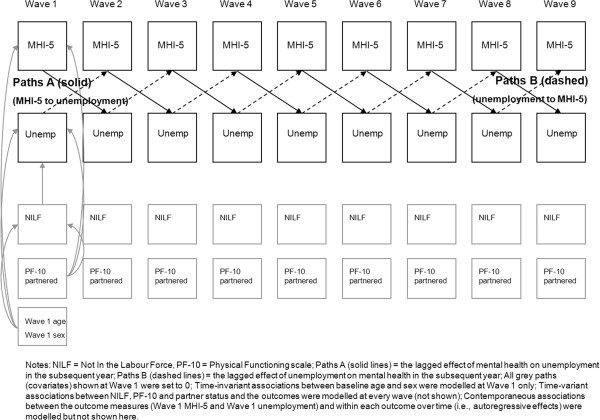
Method: Data were from working-age respondents (20 to 55 years at baseline) who completed nine waves of the Household, Income and Labour Dynamics in Australia (HILDA) Survey (N=7176). Cross-lagged path analyses were used to test the lagged and concurrent associations between unemployment and mental health over time, adjusting for sociodemographic characteristics.
Results: Mental health was shown to be both a consequence of and risk factor for unemployment. Thus, the poorer mental health observed amongst people who are not working is attributable to both the impact of unemployment and existing mental health problems. While the strength of these two effects was similar for women, the results for men suggested that the effect of unemployment on subsequent mental health was weaker than the effect of mental health on subsequent risk of unemployment.
Conclusion: Disentangling the reciprocal links between mental health and workforce participation is central to the development and success of clinical goals and health and social policies that aim to promote either aspect. This study demonstrates that both effects are important and supports concurrent responses to prevent a cycle of disadvantage and entrenched social exclusion.
Figures
References
-
- Mental Health Council of Australia. Let’s get to work – A National Mental Health Employment Strategy for Australia. Canberra: Mental Health Council of Australia; 2007.
-
- Australian Health Ministers. Fourth National Mental Health Plan - An agenda for collaborative government action in mental health 2009–2014. Canberra: Commonwealth of Australia; 2009.
-
- Fryer D. Employment deprivation and personal agency during unemployment: A critical discussion of Jahoda's explanation of the psychological effects of unemployment. Soc Behav. 1986;1(1):3–23.
Publication types
MeSH terms
LinkOut - more resources
Full Text Sources
Other Literature Sources
Medical
