


Predictors of long-term survival among first-ever ischemic and hemorrhagic stroke in a Brazilian stroke cohort
- PMID: 23706067
- PMCID: PMC3680045
- DOI: 10.1186/1471-2377-13-51
Predictors of long-term survival among first-ever ischemic and hemorrhagic stroke in a Brazilian stroke cohort
Abstract
Background: Few studies have examined both ischemic and hemorrhagic stroke to identify prognostic factors associated to long-term stroke survival. We investigated long-term survival and predictors that could adversely influence ischemic and hemorrhagic first-ever stroke prognosis.
Methods: We prospectively ascertained 665 consecutive first-ever ischemic and hemorrhagic stroke cases from "The Study of Stroke Mortality and Morbidity" (The EMMA Study) in a community hospital in São Paulo, Brazil. We evaluated cardiovascular risk factors and sociodemographic characteristics (age, gender, race and educational level).
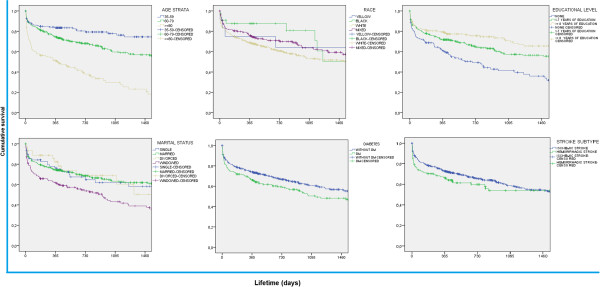
Results: We found a lower survival rate among hemorrhagic cases compared to ischemic stroke cases at the end of 4 years of follow-up (52% vs. 44%, p = 0.04). The risk of death was two times higher among people with ischemic stroke without formal education. Also, we found consistently higher risk of death for diabetics with ischemic stroke (HR = 1.45; 95% CI = 1.07-1.97) compared to no diabetics. As expected, age equally influenced on the high risk of poor survival, regardless of stroke subtype.
Conclusions: For ischemic stroke, the lack of formal education and diabetes were significant independent predictors of poor long-term survival.
Figures
References
-
- O’Donnell MJ, Xavier D, Liu L, Zhang H, Chin SL, Rao-Melacini Rangarajan S, Islam S, Pais P, McQueen MJ, Mondo C, Damasceno A, Lopez-Jaramillo P, Hankey GJ, Dans AL, Yusoff K, Truelsen T, Diener HC, Sacco RL, Ryglewicz D, Czlonkowska A, Weimar C, Wang X, Yusuf S. INTERSTROKE investigators. INTERSTROKE investigators. Risk factors for ischaemic and intracerebral haemorrhagic stroke in 22 countries (the INTERSTROKE study): a case–control study. The Lancet. 2010;376(9735):112–123. doi: 10.1016/S0140-6736(10)60834-3. - DOI - PubMed
-
- Saposnik G, Hill MD, O’Donnell M, Fang J, Hachinski V, Kapral MK. Registry of the Canadian Stroke Network for the Stroke Outcome Research Canada (SORCan) Working Group. Variables associated with 7-day, 30-day, and 1-year fatality after ischemic stroke. Stroke. 2008;39(8):2318–2324. doi: 10.1161/STROKEAHA.107.510362. - DOI - PubMed
-
- Slot KB, Berge E, Dorman P, Lewis S, Dennis M, Sandercock P. Oxfordshire Community Stroke Project, the International Stroke Trial (UK); Lothian Stroke Register. Impact of functional status at six months on long term survival in patients with ischaemic stroke: prospective cohort studies. BMJ. 2008;336(7640):376–379. doi: 10.1136/bmj.39456.688333.BE. - DOI - PMC - PubMed
Publication types
MeSH terms
LinkOut - more resources
Full Text Sources
Other Literature Sources
Medical
