


Personality and risk of Alzheimer's disease: new data and meta-analysis
- PMID: 23706517
- PMCID: PMC3783589
- DOI: 10.1016/j.jalz.2013.03.002
Personality and risk of Alzheimer's disease: new data and meta-analysis
Abstract
Background: We examine whether broad factors and specific facets of personality are associated with increased risk of incident Alzheimer's disease (AD) in a long-run longitudinal study and a meta-analysis of published studies.
Methods: Participants (n = 1671) were monitored for up to 22 years from a baseline personality assessment. The meta-analysis pooled results from up to five prospective studies (n = 5054).
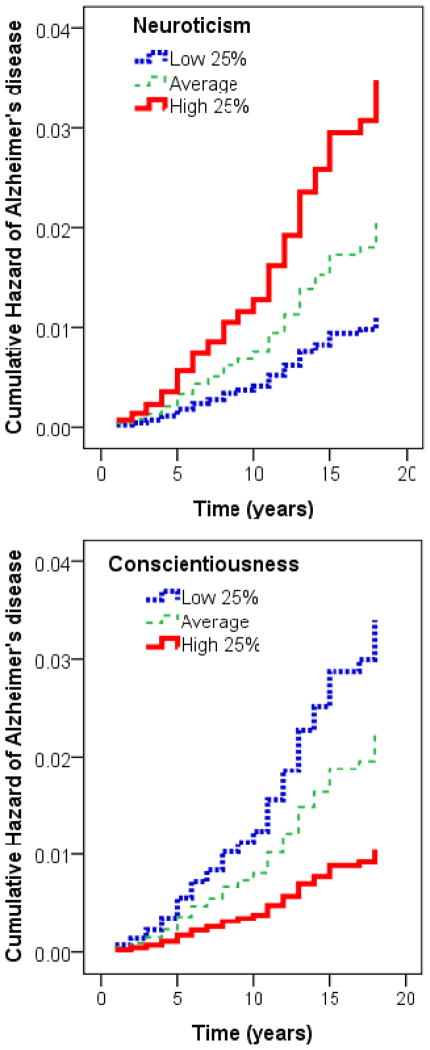
Results: Individuals with scores in the top quartile of neuroticism (hazard ratio = 3.1; 95% confidence interval = 1.6-6.0) or the lowest quartile of conscientiousness (hazard ratio = 3.3; 95% confidence interval = 1.4-7.4) had a threefold increased risk of incident AD. Among the components of these traits, self-discipline and depression had the strongest associations with incident AD. The meta-analysis confirmed the associations of neuroticism (P = 2 × 10(-9)) and conscientiousness (P = 2 × 10(-6)), along with weaker effects for openness and agreeableness (P < .05).
Conclusions: The current study and meta-analysis indicate that personality traits are associated with increased risk of AD, with effect sizes similar to those of well-established clinical and lifestyle risk factors.
Keywords: APOE; Alzheimer's disease; Anxiety; Conscientiousness; Dementia; Depression; Meta-analysis; Neuroticism; Observational prospective study; Order; Self-discipline.
Copyright © 2014 The Alzheimer's Association. All rights reserved.
Conflict of interest statement
The authors have no financial or other conflict of interest to declare.
Figures
References
-
- Alzheimer’s Association. 2012 Alzheimer’s disease facts and figures. Alzheimers Dement. 2012;8(2):131–68. - PubMed
-
- Alzheimer’s Disease International. World Alzheimer Report 2011: The benefits of early diagnosis and intervention. 2011.
-
- Daviglus ML, Plassman BL, Pirzada A, Bell CC, Bowen PE, Burke JR, et al. Risk factors and preventive interventions for Alzheimer disease: state of the science. Arch Neurol. 2011;68(9):1185–90. - PubMed
-
- Costa PT, Jr, McCrae RR. Revised NEO Personality Inventory (NEO-PI-R) and NEO Five-Factor Inventory (NEO-FFI) professional manual. Odessa, FL: Psychological Assessment Resources; 1992.
Publication types
MeSH terms
Grants and funding
LinkOut - more resources
Full Text Sources
Other Literature Sources
Medical
Miscellaneous
