


Effects of non-pharmacological pain treatments on brain states
- PMID: 23706958
- PMCID: PMC3759647
- DOI: 10.1016/j.clinph.2013.04.009
Effects of non-pharmacological pain treatments on brain states
Abstract
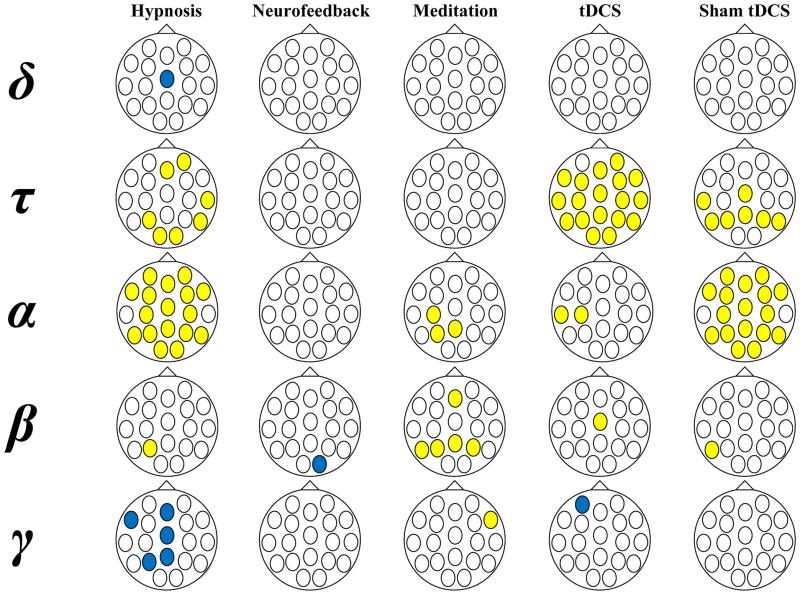
Objective: To (1) evaluate the effects of a single session of four non-pharmacological pain interventions, relative to a sham tDCS procedure, on pain and electroencephalogram- (EEG-) assessed brain oscillations, and (2) determine the extent to which procedure-related changes in pain intensity are associated with changes in brain oscillations.
Methods: 30 individuals with spinal cord injury and chronic pain were given an EEG and administered measures of pain before and after five procedures (hypnosis, meditation, transcranial direct current stimulation [tDCS], neurofeedback, and a control sham tDCS procedure).
Results: Each procedure was associated with a different pattern of changes in brain activity, and all active procedures were significantly different from the control procedure in at least three bandwidths. Very weak and mostly non-significant associations were found between changes in EEG-assessed brain activity and pain.
Conclusions: Different non-pharmacological pain treatments have distinctive effects on brain oscillation patterns. However, changes in EEG-assessed brain oscillations are not significantly associated with changes in pain, and therefore such changes do not appear useful for explaining the benefits of these treatments.
Significance: The results provide new findings regarding the unique effects of four non-pharmacological treatments on pain and brain activity.
Keywords: Brain states; Chronic pain; Electroencephalography; Non-pharmacological treatments; Spinal cord injury.
Copyright © 2013 International Federation of Clinical Neurophysiology. Published by Elsevier Ireland Ltd. All rights reserved.
Conflict of interest statement
Leslie Sherlin is a principle owner of Nova Tech EEG, Inc., which provides QEEG analysis services and distributes QEEG equipment and analysis software tools. He is also the chief science officer for Neurotopia, Inc. where he develops hardware and software platforms for cognitive and neurofeedback training in athlete populations. Finally he is a provider of QEEG analysis and neurofeedback services and is a principle owner at Arizona Brain Performance Center. The other authors declare no conflicts of interest.
Figures
References
-
- Bromm B, Lorenz J. Neurophysiological evaluation of pain. Electroencephalogr Clin Neurophysiol. 1998;107:227–53. - PubMed
-
- Brunoni AR, Valiengo L, Baccaro A, Zando TA, de Oliveira JF, Goulaart A, et al. The Sertraline vs electrical current therapy for treating depression clinical study: Results from a factoraial, randomized, controlled trial. JAMA Psychiatry. doi: 10.1001/2013.jamapsychiatry.32. in press. - DOI - PubMed
Publication types
MeSH terms
Grants and funding
LinkOut - more resources
Full Text Sources
Other Literature Sources
Medical
