. 2013 Jul 11;31(32):3268-73.
doi: 10.1016/j.vaccine.2013.05.023. Epub 2013 May 22.

Virus-like particle vaccine protects against H3N2 canine influenza virus in dog

Affiliations

Virus-like particle vaccine protects against H3N2 canine influenza virus in dog

Dong-Hun Lee et al. Vaccine. .

Abstract

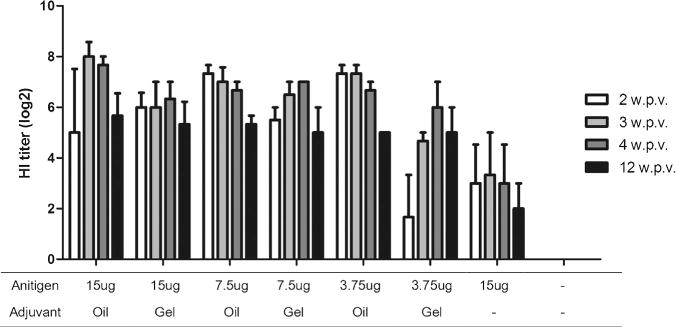
In the present study, virus-like particles (VLPs) were evaluated as a candidate veterinary vaccine against canine influenza virus (CIV) subtype H3N2. Specific pathogen-free (SPF) beagle dogs received a single injection of a VLP vaccine containing hemagglutinin (HA) and M1 protein of CIV H3N2 (H3 HA VLP). The vaccine was tested at 3 different doses with an adjuvant and 1 dose without an adjuvant. To evaluate the immunogenicity and protective efficacy of the H3 HA VLP vaccine, we performed hemagglutination inhibition tests to determine serological immune responses and conducted challenge studies using SPF beagle dogs. The addition of Montanide ISA 25 adjuvant significantly increased the immunogenicity of the H3 HA VLP vaccine. The experimental infection study showed that a single dose of H3 HA VLP vaccine induced protection against wild-type virus challenge in dogs. These results provide support for continued development of the VLP as an animal vaccine against influenza virus.


Figures

Fig. 1
Fig. 1
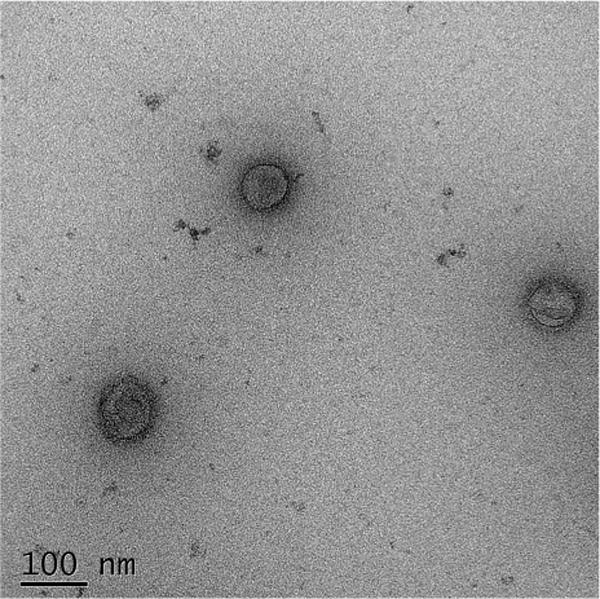
Negative staining transmission electron microscopy examination of purified CIV H3 HA VLP. The bar represents 100 nm.
Fig. 2
Fig. 2
Mean serum hemagglutination inhibition (HI) titers induced in beagle dogs after a single dose of CIV H3 HA VLP vaccine with Montanide ISA 25 VG (oil) or aluminum hydroxide (gel) adjuvant. A total of 21 beagles (3 per group) were intramuscularly immunized with VLP vaccine containing the hemagglutinin of CIV H3N2. HI titers against the homologous antigen were determined 2, 3, 4, and 12 weeks after vaccination.
Fig. 3
Fig. 3
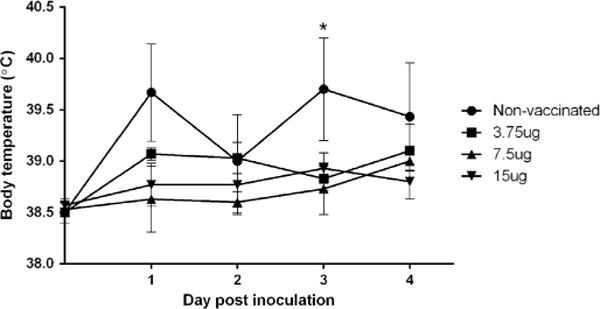
Body temperature of vaccinated and non-vaccinated dogs recorded for 4 days following intranasal challenge with CIV H3N2. Data are expressed as the mean ± SE. *p<0.05 by ANOVA with Dunnett’s post hoc test compared with vaccinated groups.
Fig. 4
Fig. 4
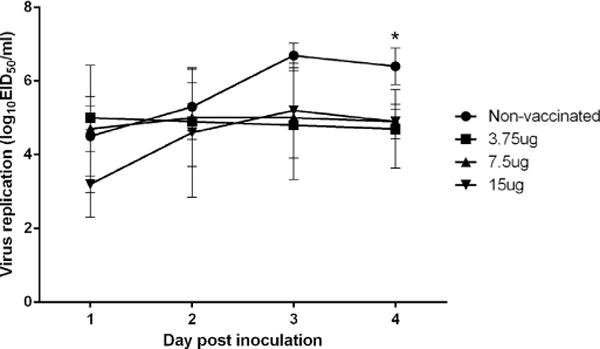
Quantification of virus in the nasal swab samples. To determine viral shedding in the respiratory tract, nasal swab samples were collected at 1, 2, 3, and 4 days post inoculation and suspended in 1 mL of phosphate-buffered saline. CIV RNA was quantified by matrix gene-based real-time reverse transcriptase polymerase chain reaction. The log10EID50 equivalents were determined with the use of rRT-PCR. *p < 0.05 by ANOVA with Dunnett’s post hoc test compared with vaccinated groups.
Fig. 5
Fig. 5
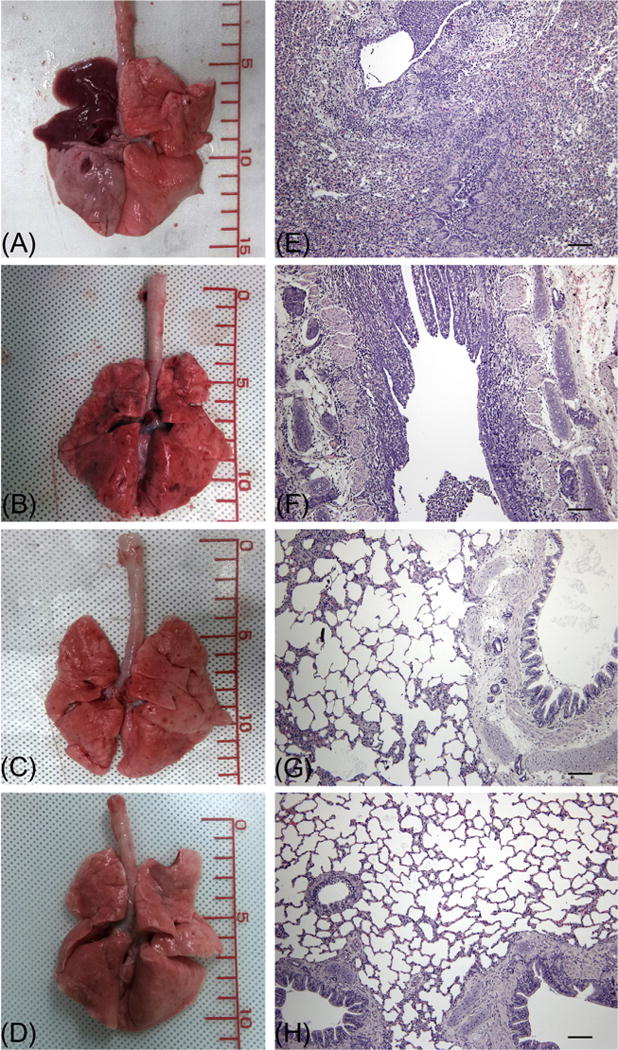
Gross and histopathologic changes in the lungs infected with CIV. Gross lesion and hematoxylin-and-eosin-stained lung sections (scale bar= 100 μm) from dogs at 4 days post infection are shown. (A) and (E), unvaccinated dog. (B) and (F), dog vaccinated with 3.75 μg of CIV H3 HA VLP. (C) and (G), dog vaccinated with 7.5 μg of CIV H3 HA VLP. (D) and (H), dog vaccinated with 15 μg of CIV H3 HA VLP.

References

    1. Crawford PC, Dubovi EJ, Castleman WL, Stephenson I, Gibbs EP, Chen L, et al. Transmission of equine influenza virus to dogs. Science. 2005;310:482–5. - PubMed
    1. Payungporn S, Crawford PC, Kouo TS, Chen LM, Pompey J, Castleman WL, et al. Influenza A virus (H3N8) in dogs with respiratory disease, Florida. Emerg Infect Dis. 2008;14:902–8. - PMC - PubMed
    1. Li S, Shi Z, Jiao P, Zhang G, Zhong Z, Tian W, et al. Avian-origin H3N2 canine influenza A viruses in Southern China. Infect Genet Evol: J Mol Epidemiol Evol Genet Infect Dis. 2010;10:1286–8. - PMC - PubMed
    1. Teng Q, Zhang X, Xu D, Zhou J, Dai X, Chen Z, et al. Characterization of an H3N2 canine influenza virus isolated from Tibetan mastiffs in China. Vet Microbiol. 2012 - PubMed
    1. Song D, Lee C, Kang B, Jung K, Oh T, Kim H, et al. Experimental infection of dogs with avian-origin canine influenza A virus (H3N2) Emerg Infect Dis. 2009;15:56–8. - PMC - PubMed

Publication types

MeSH terms

Substances