


Transcript specificity in BDNF-regulated protein synthesis
- PMID: 23707639
- PMCID: PMC3795894
- DOI: 10.1016/j.neuropharm.2013.05.004
Transcript specificity in BDNF-regulated protein synthesis
Abstract
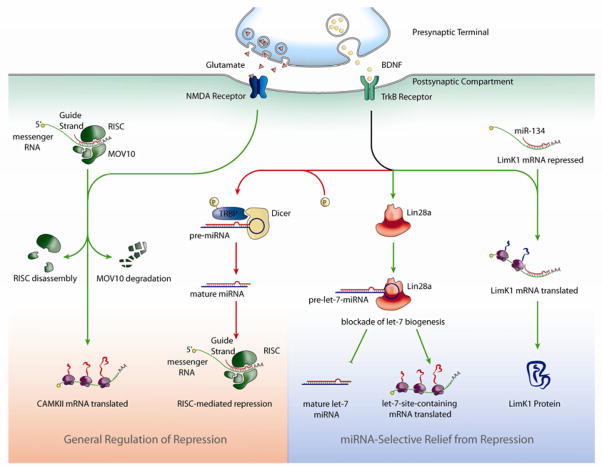
Brain-derived neurotrophic factor (BDNF) is a critical activity-dependent modulator of gene expression, which can regulate both transcription and translation. Several functions of BDNF, including the induction of dendrite outgrowth and long-term synaptic plasticity, are known to depend, in particular, upon the ability of BDNF to regulate protein synthesis. Although BDNF modestly increases total neuronal protein synthesis, substantial evidence indicates that BDNF induces the translation of only a small subset of expressed mRNAs and demonstrates an extraordinary degree of transcript specificity. The mechanism by which BDNF selectively upregulates the translation of only a discrete group of mRNAs is of intrinsic importance to its trophic function in promoting neuronal growth and plasticity, and is the focus of this review. This article is part of the Special Issue entitled 'BDNF Regulation of Synaptic Structure, Function, and Plasticity'.
Keywords: BDNF; Let-7; Lin28; Post-transcriptional regulators; Protein synthesis; RNA-binding proteins; Synaptic plasticity; microRNAs.
Copyright © 2013 Elsevier Ltd. All rights reserved.
Figures
References
-
- Aakalu G, Smith WB, Nguyen N, Jiang C, Schuman EM. Dynamic visualization of local protein synthesis in hippocampal neurons. Neuron. 2001;30:489–502. - PubMed
-
- Abrahante JE, Daul AL, Li M, Volk ML, Tennessen JM, Miller EA, Rougvie AE. The Caenorhabditis elegans hunchback-like gene lin-57/hbl-1 controls developmental time and is regulated by microRNAs. Developmental cell. 2003;4:625–637. - PubMed
-
- Alder J, Thakker-Varia S, Crozier RA, Shaheen A, Plummer MR, Black IB. Early presynaptic and late postsynaptic components contribute independently to brain-derived neurotrophic factor-induced synaptic plasticity. The Journal of neuroscience: the official journal of the Society for Neuroscience. 2005;25:3080–3085. - PMC - PubMed
-
- Ambros V, Horvitz HR. Heterochronic mutants of the nematode Caenorhabditis elegans. Science. 1984;226:409–416. - PubMed
-
- Ashraf SI, McLoon AL, Sclarsic SM, Kunes S. Synaptic protein synthesis associated with memory is regulated by the RISC pathway in Drosophila. Cell. 2006;124:191–205. - PubMed
Publication types
MeSH terms
Substances
Grants and funding
LinkOut - more resources
Full Text Sources
Other Literature Sources
Molecular Biology Databases
Research Materials
