


Specifying the nonspecific components of acupuncture analgesia
- PMID: 23707680
- PMCID: PMC3981538
- DOI: 10.1016/j.pain.2013.05.008
Specifying the nonspecific components of acupuncture analgesia
Abstract
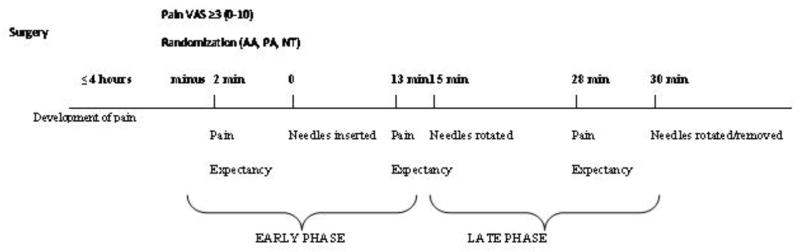
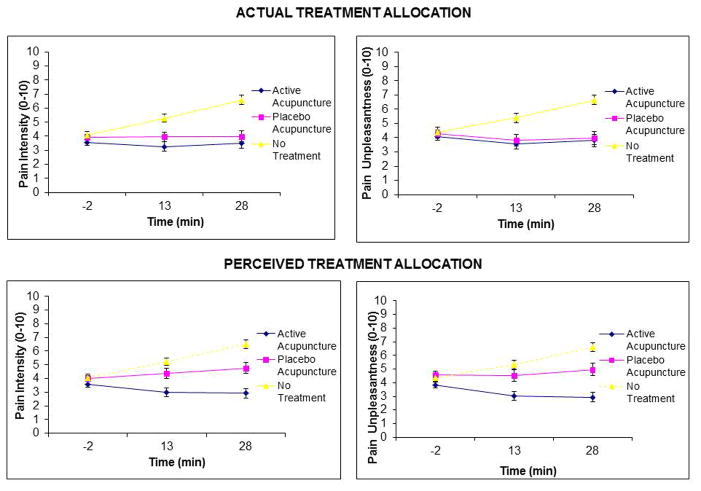
It is well known that acupuncture has pain-relieving effects, but the contribution of specific and especially nonspecific factors to acupuncture analgesia is less clear. One hundred one patients who developed pain of ≥ 3 on a visual analog scale (VAS, 0 to 10) after third molar surgery were randomized to receive active acupuncture, placebo acupuncture, or no treatment for 30 min with acupuncture needles with potential for double-blinding. Patients' perception of the treatment (active or placebo) and expected pain levels (VAS) were assessed before and halfway through the treatment. Looking at actual treatment allocation, there was no specific effect of active acupuncture (P=.240), but there was a large and significant nonspecific effect of placebo acupuncture (P<.001), which increased over time. Interestingly, however, looking at perceived treatment allocation, there was a significant effect of acupuncture (P<.001), indicating that patients who believed they received active acupuncture had significantly lower pain levels than those who believed they received placebo acupuncture. Expected pain levels accounted for significant and progressively larger amounts of the variance in pain ratings after both active and placebo acupuncture (up to 69.8%). This is the first study to show that under optimized blinding conditions, nonspecific factors such as patients' perception of and expectations toward treatment are central to the efficacy of acupuncture analgesia and that these factors may contribute to self-reinforcing effects in acupuncture treatment. To obtain an effect of acupuncture in clinical practice, it may therefore be important to incorporate and optimize these factors.
Keywords: Acupuncture analgesia; Expectation; Nonspecific; Perception; Placebo analgesia.
Copyright © 2013 International Association for the Study of Pain. Published by Elsevier B.V. All rights reserved.
Conflict of interest statement
The authors declare no conflicts of interest.
Figures
References
-
- Amanzio M, Pollo A, Maggi G, Benedetti F. Response variability to analgesics: a role for non-specific activation of endogenous opioids. Pain. 2001;90:205–215. - PubMed
-
- Ballegaard S, Karpatschoff B, Holck JA, Meyer CN, Trojaborg W. Acupuncture in angina pectoris: do psycho-social and neurophysiological factors relate to the effect? Acupunct Electrother Res. 1995;20:101–116. - PubMed
-
- Bausell RB, Lao L, Bergman S, Lee WL, Berman BM. Is acupuncture analgesia an expectancy effect? Preliminary evidence based on participants’ perceived assignments in two placebo-controlled trials. Eval Health Prof. 2005;28:9–26. - PubMed
-
- Benedetti F. Mechanisms of placebo and placebo-related effects across diseases and treatments. Annu Rev Pharmacol Toxicol. 2008;48:33–60. - PubMed
-
- Berk SN, Moore ME, Resnick JH. Psychosocial factors as mediators of acupuncture therapy. J Consult Clin Psychol. 1977;45:612–619. - PubMed
Publication types
MeSH terms
Substances
Grants and funding
LinkOut - more resources
Full Text Sources
Other Literature Sources
