


Review
doi: 10.3390/molecules18066173.
Asymmetric palladium-catalysed intramolecular Wacker-type cyclisations of unsaturated alcohols and amino alcohols
Affiliations
- PMID: 23708231
- PMCID: PMC6270647
- DOI: 10.3390/molecules18066173
Item in Clipboard
Review
Asymmetric palladium-catalysed intramolecular Wacker-type cyclisations of unsaturated alcohols and amino alcohols
Molecules.
.
Abstract
The palladium (II)-catalysed reactions of alkenols and aminoalkenols such as oxycarbonylations or bicyclisations are powerful methods for the construction of oxygen and nitrogen-containing heterocyclic compounds. This review highlights recent progress in the development of the asymmetric palladium(II)-catalysed Wacker-type cyclisations of unsaturated polyols and aminoalcohols. The scope, limitations, and applications of these reactions are presented.
Figures

Palladium-catalysed intramolecular Wacker-type cyclisations of unsaturated alcohols and amino alcohols.

Pd(II)-catalysed Wacker-type oxidative heterocyclisations.

AsymmetricPd(II)-catalysed Wacker-type cyclisation of allylphenol 1a using (S,S)-boxax ligands.

Pd(II)-catalysed asymmetric aerobic oxidative cyclisation of allylphenol 3.
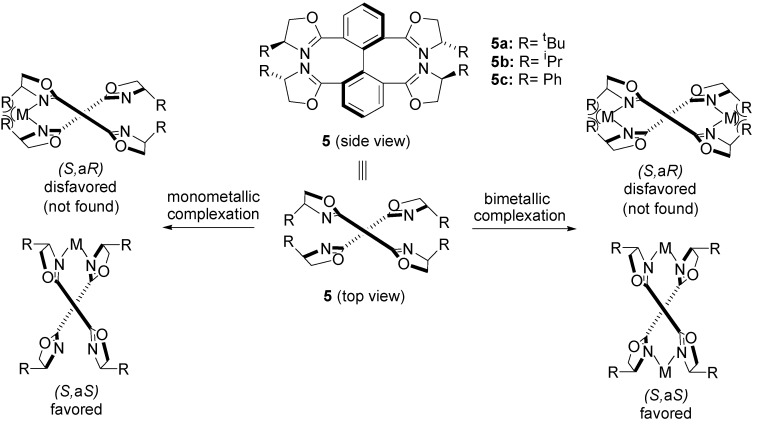
Model figures of diastereomeric monometallic and bimetallic complexes with tetraoxazoline ligands.

Asymmetric intramolecular Wacker-type cyclisation of 1 using tetraoxazoline 5c-Pd(OCOCF3)2 catalyst.
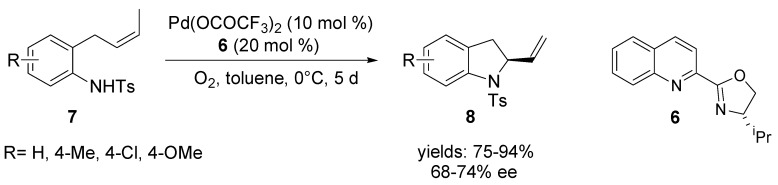
Aza-Wacker-type cyclisation reaction of o-allylanilines 7.

PdII-SPRIX-catalysed cyclisation reaction of alkenyl alcohols 11, 2-alkenyl-1,3-diketones 13 and 4-alkenoic acids 15.

PdII-SPRIX-catalysed cyclisation reaction of alkenyl alcohols 11, 2-alkenyl-1,3-diketones 13 and 4-alkenoic acids 15.

Asymmetric domino Wacker-Heck reaction of alkenyl phenol 17 and methyl vinyl ketone 18 using (S,S)-Bn-boxax ligand.

Asymmetric intramolecular domino Wacker-Heck reaction of dialkenyl alcohol 20 using spiro bis(isoxazoline) and spiro (isoxazole-isoxazoline) ligands.

Asymmetric domino Wacker-Heck bicyclisation of 2-allylanilide substrates using (−)-sparteine.

Asymmetric domino Wacker-Heck reaction in the synthesis of pyrrolizines/ pyrroloindoles using (M,S,S)-iPr-SPRIX ligand 9c.
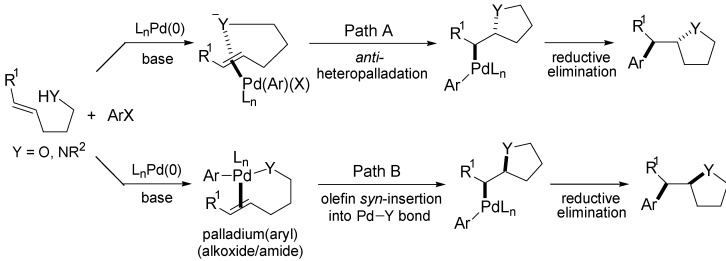
Mechanism of palladium-catalysed carboetherification and carboamination reactions.

Asymmetric palladium-catalysed carboamination reaction for the synthesis of enantiomerically enriched pyrrolidines using (R)-Siphos-PE ligand.

Synthesis of (–)-tylophorine.

Synthesis of (+)-aphanorphine.

Asymmetric carboamination reaction of N-allyl urea derivatives with 1-bromo-4-tert-butylbenzene using (S)-Siphos-PE ligand.
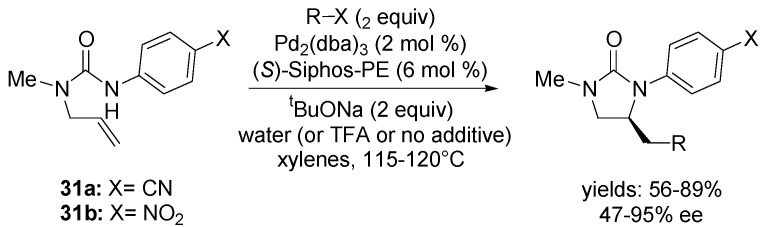
Asymmetric carboamination reaction of substrates 31a,b with different aryl halides using (S)-Siphos-PE ligand.
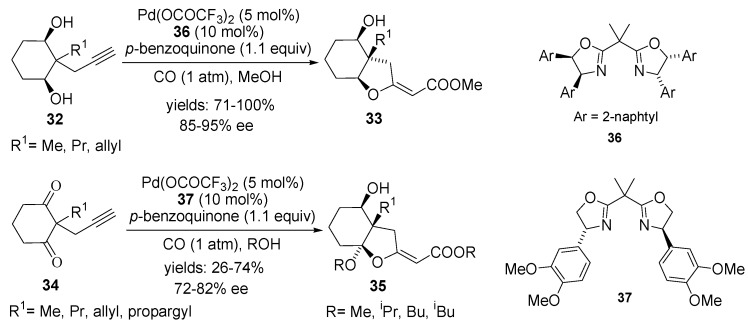
Asymmetric cyclisation-carbonylation of meso-2-alkyl-2-propargyl-1,3-cyclohexane-diols 32 and -1,3-diones 34 using Pd(II)-[box] catalysts.
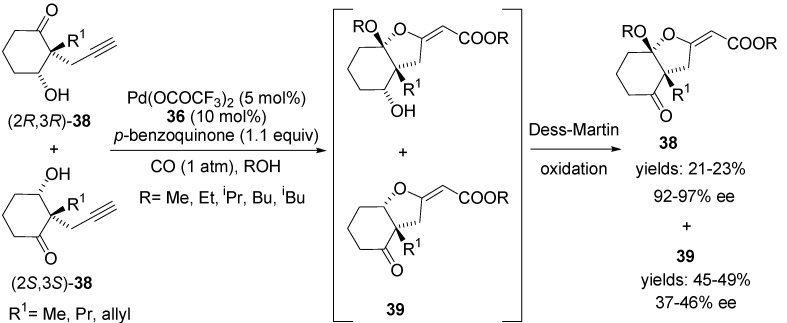
Parallel kinetic resolution of propargyl ketols 38 using Pd(II)-[box] catalyst.

Asymmetric domino reaction of alkenes 41–42 and phenyl ethers 45 employing (S,S)-Bn-boxax.
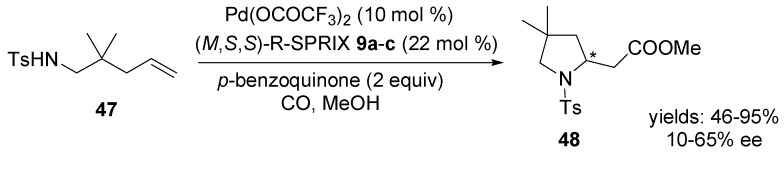
Asymmetric aminocarbonylation of N-(2,2-dimethylpent-4-enyl)-p-toluenesulfonamide 47 using Pd(II)-[SPRIX] catalysts.

Kinetic resolution of alkene-1,3-diols (±)-49 in an asymmetric Pd(II)-catalysed oxycarbonylation.
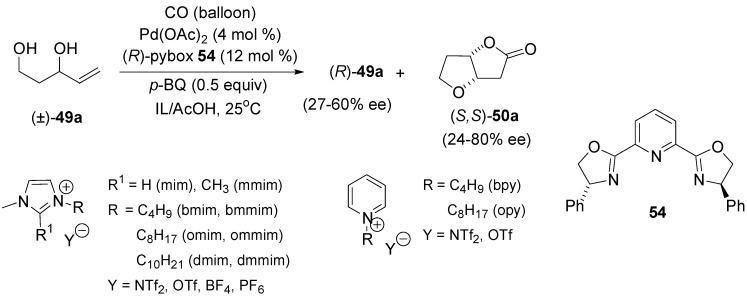
Kinetic resolution of pent-4-ene-1,3-diol (±)-49a by Pd(II)-catalysed oxycarbonylation in ionic liquids.

Palladium(II)-catalysed oxycarbonylation of meso-diols 55 and 57, and pseudo-C2-symmetric enitol 56.

Kinetic resolution of N-protected 1-aminopent-4-ene-3-ols (±)-63 in the Pd(II)-catalysed amidocarbonylation and Pd(II)-catalysed amidocarbonylation of alkenylureas 65.
References
-
- Tsuji J. Palladium Reagents and Catalysis. John Wiley & Sons Ltd.; Chichester, UK/Hoboken, NJ, USA: 2004.
-
- Malleron J.-L., Fiaud J.-C., Legros J.-Y. Handbook of Palladium-Catalyzed Organic Reactions. Academic Press; London, UK: 1997.
Publication types
MeSH terms
Substances
LinkOut - more resources
Full Text Sources
Other Literature Sources
