. 2014 May 1;33(18):2286-94.
doi: 10.1038/onc.2013.190. Epub 2013 May 27.

Concomitant loss of EAF2/U19 and Pten synergistically promotes prostate carcinogenesis in the mouse model

Affiliations

Concomitant loss of EAF2/U19 and Pten synergistically promotes prostate carcinogenesis in the mouse model

J Ai et al. Oncogene. .

Abstract

Multiple genetic alterations are associated with prostate carcinogenesis. Tumor-suppressor genes phosphatase and tensin homolog deleted on chromosome 10 (Pten) and androgen upregulated gene 19 (U19), which encodes ELL-associated factor 2 (EAF2), are frequently inactivated or downregulated in advanced prostate cancers. Previous studies showed that EAF2 knockout caused tumors in multiple organs and prostatic intraepithelial neoplasia (PIN) in mice. However, EAF2-knockout mice did not develop prostate cancer even at 2 years of age. To further define the roles of EAF2 in prostate carcinogenesis, we crossed the Pten+/- and EAF2+/- mice in the C57/BL6 background to generate EAF2-/-Pten+/-, Pten+/-, EAF2-/- and wild-type mice. The prostates from virgin male mice with the above four genotypes were analyzed at 7 weeks, 19 weeks and 12 months of age. Concomitant loss of EAF2 function and inactivation of one Pten allele induced spontaneous prostate cancer in 33% of the mice. Prostatic tissues from intact EAF2-/- Pten+/- mice exhibited higher levels of phospho-Akt, -p44/42 and microvessel density. Moreover, phospho-Akt remained high after castration. Consistently, there was a synergistic increase in prostate epithelial proliferation in both intact and castrated EAF2-/-Pten+/- mice. Using laser-capture microdissection coupled with real-time reverse transcription-PCR, we confirmed that co-downregulation of EAF2 and Pten occurred in >50% clinical prostate cancer specimens with Gleason scores of 8-9 (n=11), which is associated with poor prognosis. The above findings together demonstrated synergistic functional interactions and clinical relevance of concurrent EAF2 and Pten downregulation in prostate carcinogenesis.


Conflict of interest statement

CONFLICT OF INTEREST

The authors declare no conflict of interest.

Figures
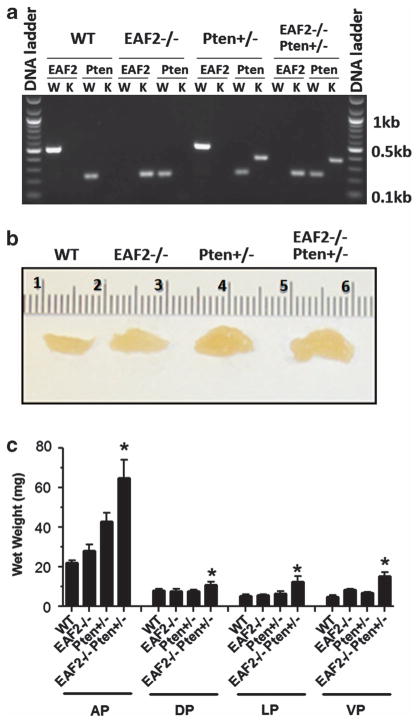
Figure 1
Figure 1
Increased prostate growth in EAF2−/− Pten +/− mice. (a) Representative genotyping PCR results for each genotype. W, wild-type. K, knockout. (b) Representative morphology of 12-month-old mouse anterior prostate with indicated genotypes. (c) Wet weight of 12-month-old mouse prostates with indicated genotypes (nine mice per group). *P<0.05 compared with other groups.
Figure 2
Figure 2
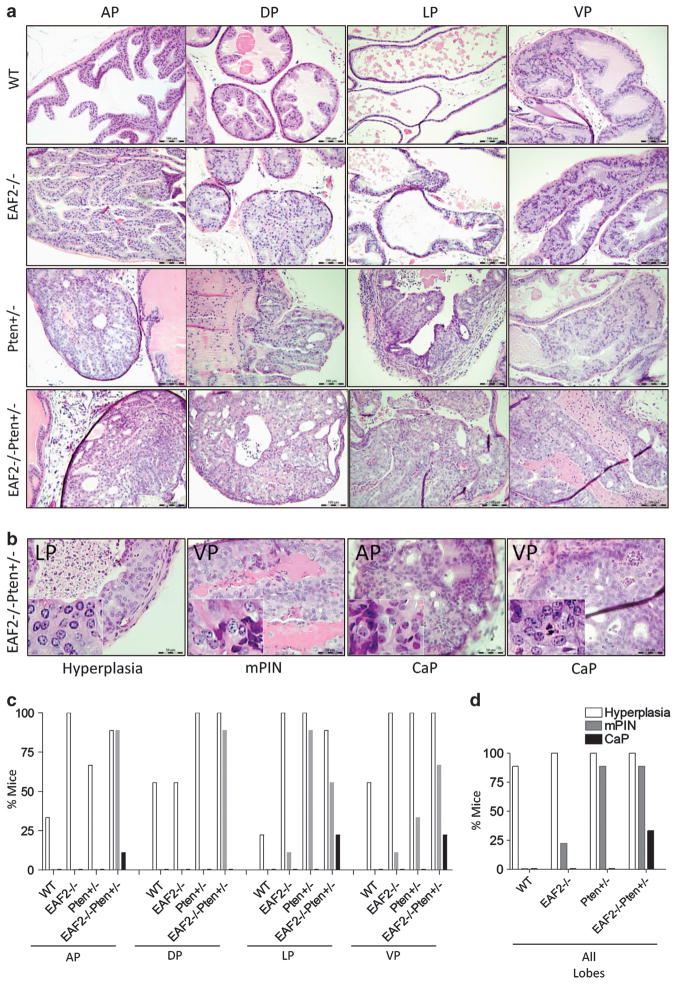
Histological changes of prostates in EAF2−/−, Pten +/− and EAF2−/− Pten +/− mice. (a) Hematoxylin and eosin (H&E) staining of AP, DP, LP and VP prostates of wild-type, EAF2−/−, Pten +/− and EAF2−/− Pten +/− at 12 months. (b) H&E staining of epithelial hyperplasia in the LP, high-grade PIN in the VP, early carcinomas in the AP and VP in the EAF2−/− Pten +/− mice. (c) Incidence rate of the indicated phenotype in different prostate lobes from mice with indicated genotypes (nine mice per group). (d) Percentage of mice that displayed the indicated histological phenotype in prostates with indicated genotypes (nine mice per group). Original magnification × 20. Scale bars represent 100 μm.
Figure 3
Figure 3
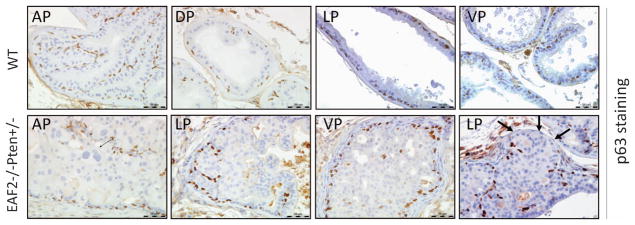
p63 staining of high-grade PIN/early carcinoma lesions in EAF2−/− Pten +/− mouse prostate at 12 months. p63 staining of high-grade PIN in AP and LP, VP and cancer in LP in wild-type and EAF2−/− Pten +/− mouse prostates. Original magnification × 40. Scale bars represent 50 μm. Arrows indicate loss of p63 staining.
Figure 4
Figure 4
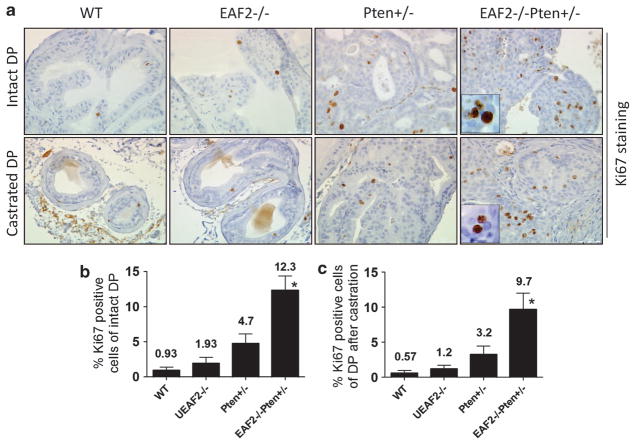
Enhanced epithelial cell proliferation in both intact and castrated EAF2−/− Pten +/− mouse prostate. (a) Representative Ki67 staining of the DP from intact or castrated wild-type, EAF2−/−, Pten +/− and EAF2−/− Pten +/− mice. Prostate tissues were collected 2 weeks after castration. (b) Quantitative analysis of Ki67-positive cells of the DP from intact mice. (c) Quantitative analysis of Ki67-positive cells of the DP from castrated mice. Results are presented as Ki67-positive cells per 1000 epithelial cells (mean±s.d.). Nine mice were used for intact mice for each genotype. Four mice were used for castrated mice for each genotype. *P<0.05, when compared with other groups. Original magnification ×40. Scale bars represent 50 μm.
Figure 5
Figure 5
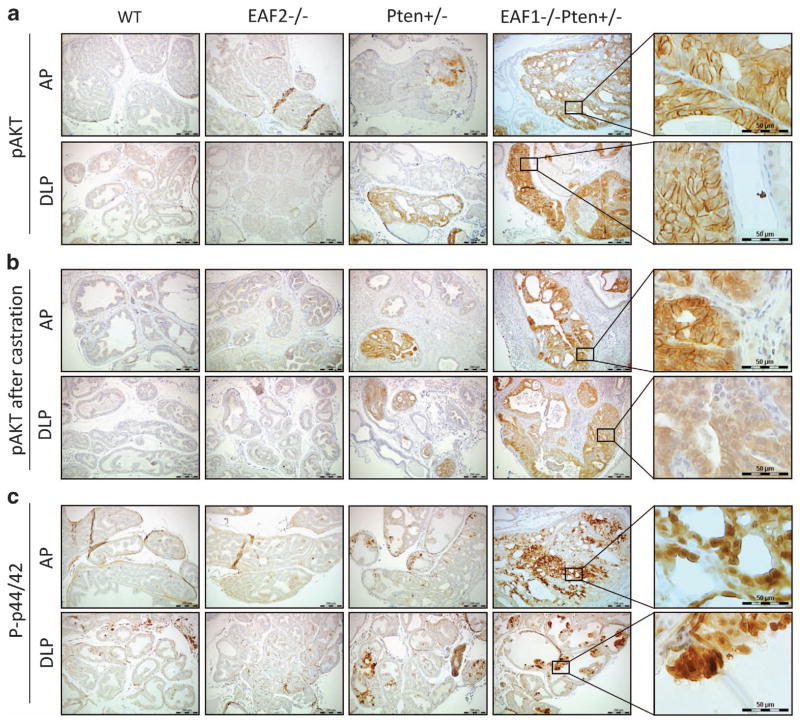
Synergistic activation of Akt and p44/42 signaling pathways in prostate epithelial cells of EAF2−/− Pten +/− mice. (a) Representative pAkt staining in AP and dorsal-lateral prostate (DLP) from intact mice with indicated genotype. (b) Representative pAkt staining in the AP and DLP from castrated mice with indicated genotype. (c) Representative phosphorylated p44/42 staining in the AP and DLP from intact mice with indicated genotype. Orignal magnification ×10, inset ×40. Scale bars represent 200 μm in ×10 and 50 μm in ×40.
Figure 6
Figure 6
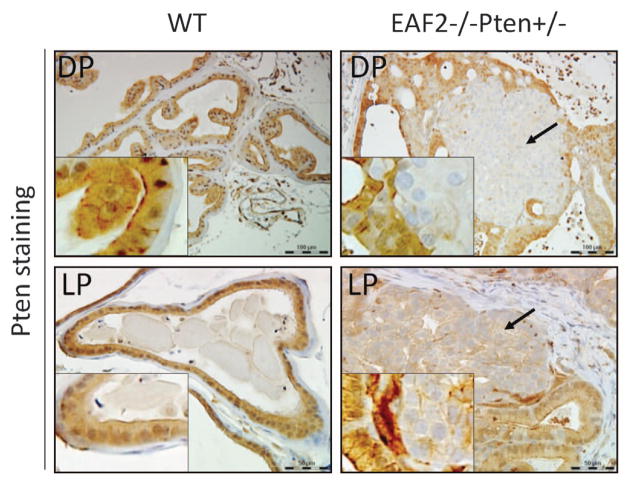
Loss of Pten expression in prostate epithelial cells of EAF2−/− Pten +/− mice. Immunostaining of Pten was performed for indicated prostatic lobes of wild-type or EAF2−/− Pten +/− mouse prostates. Arrows indicates reduced or diminished Pten staining. Original magnification × 20 and ×40. Scale bars represent 100 μm in upper panel and 50 μm in lower panel.
Figure 7
Figure 7
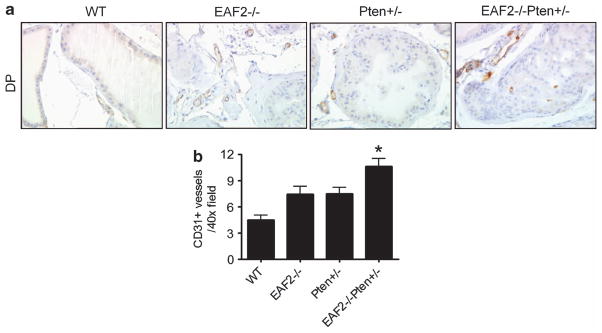
Elevated CD31 + blood vessel density in EAF2−/− Pten +/− mouse prostate. (a) CD31 immunostaining of vessels in prostate dorsal lobes from wild-type, EAF2−/−, Pten +/− and EAF2−/− Pten +/− mice at age 12 months. Original magnification ×40. Scale bars represent 50 μm. (b) Quantification of CD31-positive vessels in the prostate. Data represent of nine mice per group (*P<0.05).
Figure 8
Figure 8
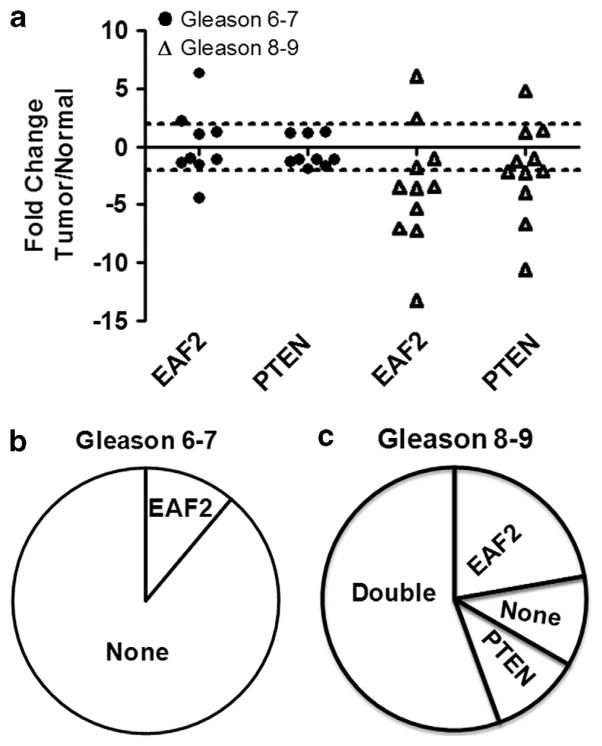
Concurrent downregulation of EAF2 and Pten in human prostate cancer specimens with higher Gleason score. Treatment naïve fresh frozen human prostate samples were laser-capture microdissected and real-time PCR was performed on nine samples with Gleason grade 6–7, and 11 samples with Gleason grade 8–9. Gene expression of epithelial cells from the areas of cancer and normal adjacent tissue was analyzed by real-time reverse transcription–PCR. (a) EAF2 and PTEN are co-downregulated in prostate cancer epithelia Gleason grade 8 or higher (6/11). A change is defined as an increase or decrease of more than twofold. Fold change was determined by dividing tumor by normal Ct. Each point on the graph shows the fold change of one patient sample. The dotted line shows the cut off defined in our study as differentially regulated tumor compared with normal. (b) Percent of prostate cancer specimens with downregulation of EAF2 (1/9), but not Pten (0/9) in lower Gleason score samples. (c) Percent of prostate cancer specimens with co-downregulation (6/11) of EAF2 and Pten in higher lower Gleason score samples. A Fisher’s exact test was used to determine whether co-downregulation was significant in 6/11 high-Gleason-grade samples compared with lower-Gleason-grade samples (P = 0.018).

References

    1. Jemal A, Siegel R, Xu J, Ward E. Cancer Statistics, 2010. CA Cancer J Clin. 2010;60:277–300. - PubMed
    1. Shen MM, Abate-Shen C. Molecular genetics of prostate cancer: new prospects for old challenges. Genes Dev. 2010;24:1967–2000. - PMC - PubMed
    1. Kim MJ, Cardiff RD, Desai N, Banach-Petrosky WA, Parsons R, Shen MM, et al. Cooperativity of Nkx3. 1 and Pten loss of function in a mouse model of prostate carcinogenesis. Proc Natl Acad Sci USA. 2002;99:2884–2889. - PMC - PubMed
    1. Xiao W, Zhang Q, Jiang F, Pins M, Kozlowski JM, Wang Z. Suppression of prostate tumor growth by U19, a novel testosterone-regulated apoptosis inducer. Cancer Res. 2003;63:4698–4704. - PubMed
    1. Xiao W, Zhang Q, Habermacher G, Yang X, Zhang AY, Cai X, et al. U19/Eaf2 knockout causes lung adenocarcinoma, B-cell lymphoma, hepatocellular carcinoma and prostatic intraepithelial neoplasia. Oncogene. 2008;27:1536–1544. - PMC - PubMed

Publication types

MeSH terms