


Visual nesting of stimuli affects rhesus monkeys' (Macaca mulatta) quantity judgments in a bisection task
- PMID: 23709063
- PMCID: PMC3735653
- DOI: 10.3758/s13414-013-0474-5
Visual nesting of stimuli affects rhesus monkeys' (Macaca mulatta) quantity judgments in a bisection task
Abstract
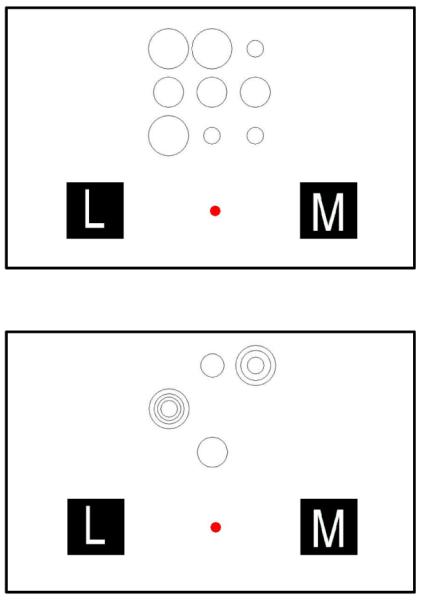
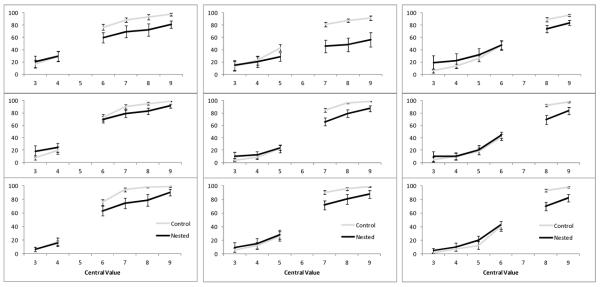
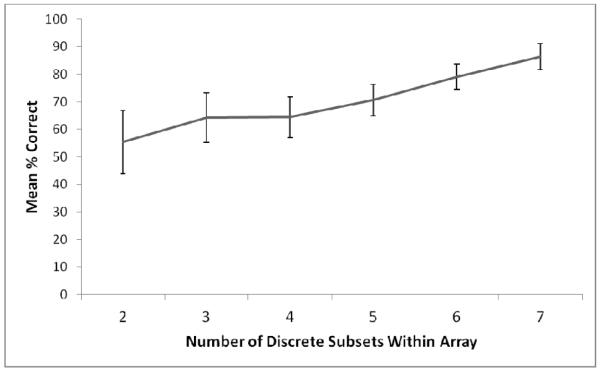
Nonhuman animals are highly proficient at judging relative quantities presented in a variety of formats, including visual, auditory, and even cross-modal formats. Performance typically is constrained by the ratio between sets, as would be expected under Weber's law and as is described in the approximate number system (ANS) hypothesis. In most cases, tests are designed to avoid any perceptual confusion for animals regarding the stimulus sets, but despite this, animals show some of the perceptual biases that humans show based on organization of stimuli. Here, we demonstrate an additional perceptual bias that emerges from the illusion of nested sets. When arrays of circles were presented on a computer screen and were to be classified as larger than or smaller than an established central value, rhesus monkeys (Macaca mulatta) underestimated quantities when circles were nested within each other. This matched a previous report with adult humans (Chesney & Gelman, Attention, Perception, & Psychophysics 24:1104-1113, 2012), indicating that macaques, like humans, show the pattern of biased perception predicted by ANS estimation. Although some macaques overcame this perceptual bias, demonstrating that they could come to view nested stimuli as individual elements to be included in the estimates of quantity used for classifying arrays, the majority of the monkeys showed the bias of underestimating nested arrays throughout the experiment.
Figures
References
-
- Abramson JZ, Hernandez-Lloreda V, Call J, Colmenares F. Relative quantity judgments in South American sea lions (Otaria flavescens) Animal Cognition. 2011;14:695–706. DOI 10.1007/s10071-011-0404-7. - PubMed
-
- Addessi E, Crescimbene L, Visalberghi E. Food and quantity token discrimination in capuchin monkeys (Cebus apella) Animal Cognition. 2008;11:275–282. doi:10.1007/s10071-007-0111-6. - PubMed
-
- Agrillo C, Dadda M, Serena G, Bisazza A. Do fish count? Spontaneous discrimination of quantity in female mosquitofish. Animal Cognition. 2008;11:495–503. doi:10.1007/s10071-008-0140-9. - PubMed
-
- Agrillo C, Piffer L, Bisazza A. Number versus continuous quantity in numerosity judgments by fish. Cognition. 2011;119:281–287. doi:10.1016/j.cognition.2010.10.022. - PubMed
-
- Anderson US, Stoinski TS, Bloomsmith MA, Maple TS. Relative numerousness judgment and summation in young, middle-aged, and old adult orangutans (Pongo pygmaeus abelii and Pongo pygmaeus pygmaeus) Journal of Comparative Psychology. 2007;121:1–11. doi:10.1037/0735-7036.121.1.1. - PubMed
Publication types
MeSH terms
Grants and funding
LinkOut - more resources
Full Text Sources
Other Literature Sources
