. 2013 Jul 12;288(28):20758-67.
doi: 10.1074/jbc.M113.476226. Epub 2013 May 24.

Two salt bridges differentially contribute to the maintenance of cystic fibrosis transmembrane conductance regulator (CFTR) channel function

Affiliations

Two salt bridges differentially contribute to the maintenance of cystic fibrosis transmembrane conductance regulator (CFTR) channel function

Guiying Cui et al. J Biol Chem. .

Abstract

Previous studies have identified two salt bridges in human CFTR chloride ion channels, Arg(352)-Asp(993) and Arg(347)-Asp(924), that are required for normal channel function. In the present study, we determined how the two salt bridges cooperate to maintain the open pore architecture of CFTR. Our data suggest that Arg(347) not only interacts with Asp(924) but also interacts with Asp(993). The tripartite interaction Arg(347)-Asp(924)-Asp(993) mainly contributes to maintaining a stable s2 open subconductance state. The Arg(352)-Asp(993) salt bridge, in contrast, is involved in stabilizing both the s2 and full (f) open conductance states, with the main contribution being to the f state. The s1 subconductance state does not require either salt bridge. In confirmation of the role of Arg(352) and Asp(993), channels bearing cysteines at these sites could be latched into a full open state using the bifunctional cross-linker 1,2-ethanediyl bismethanethiosulfonate, but only when applied in the open state. Channels remained latched open even after washout of ATP. The results suggest that these interacting residues contribute differently to stabilizing the open pore in different phases of the gating cycle.

Keywords: ABC Transporter; CFTR; Gating; MTS Reagents; Oocyte; Pore; Salt Bridge; Xenopus.


Figures
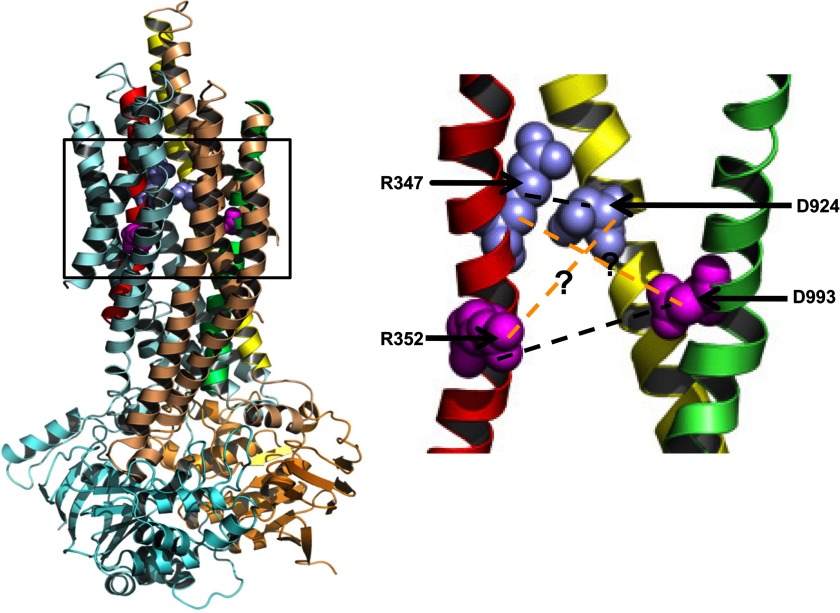
FIGURE 1.
FIGURE 1.
CFTR homology model indicating two salt bridges, using the homology model from the Riordan group (5). Left, the whole CFTR homology model with frame indicating the segment shown enlarged at the right. Right, close-up view of the residue pairs Arg347-Asp924 and Arg352-Asp993. Pale cyan, TMD1; light brown, TMD2; cyan, NBD1; light orange, NBD2. The TM domains involved in these salt bridges are colored as follows: TM6 (red), TM8 (yellow), and TM9 (green). The previously described Arg352 (TM6)-Asp993 (TM9) salt bridge and the Arg347 (TM6)-Asp924 (TM8) salt bridge in CFTR are shown connected with dark dashed lines. The predicted interaction between Arg347 and Asp993 is depicted with orange dashed lines.
FIGURE 2.
FIGURE 2.
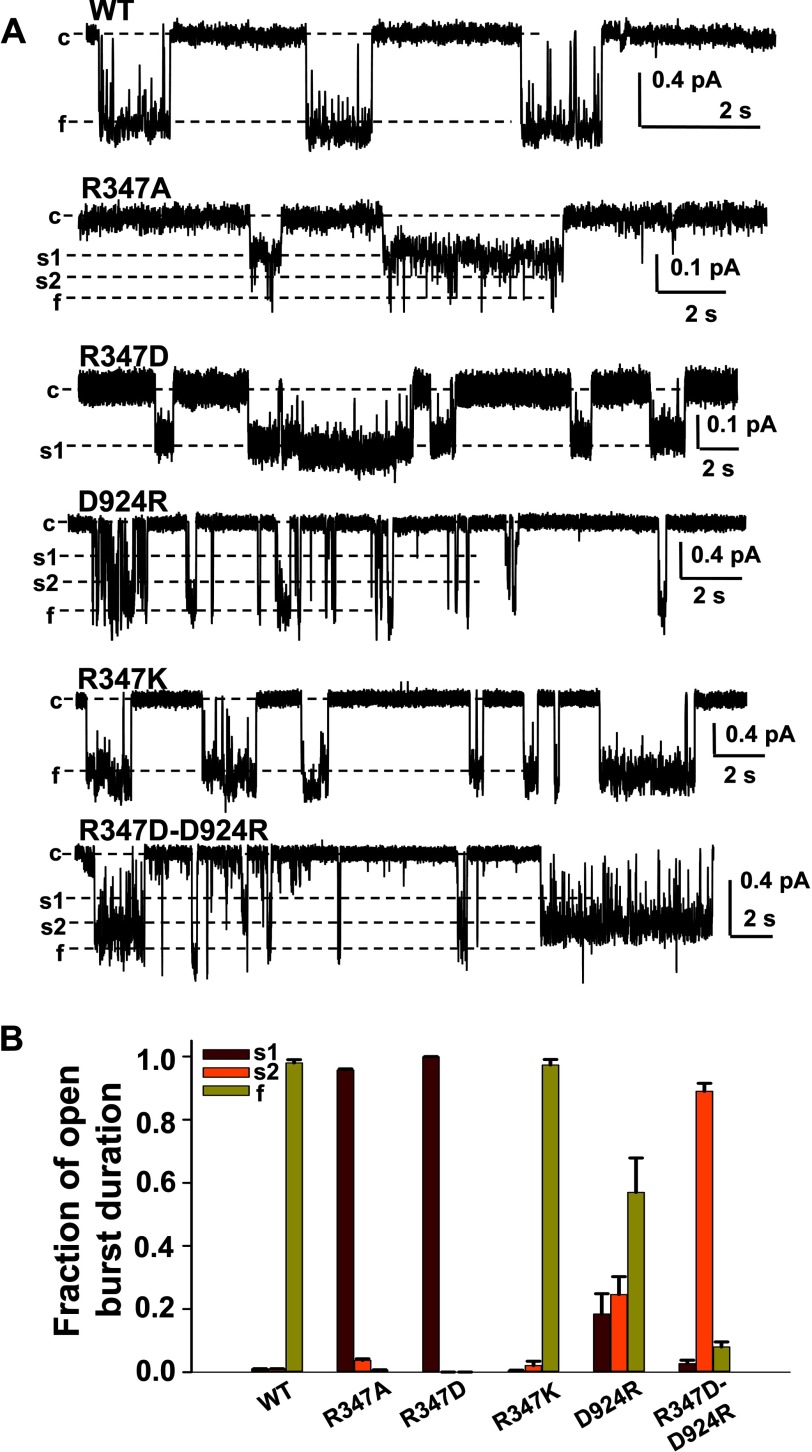
Arg347 forms a salt bridge with Asp924. A, representative current samples of WT-, R347A-, R347D-, D924R-, R347K-, and R347D/D924R-CFTR were recorded from excised inside-out patch from Xenopus oocytes with 150 mm Cl symmetrical solution in the presence of 1 mm Mg-ATP and 50 nm PKA at VM = −100 mV (n = 4–6 for each mutant). c, closed state; s1, subconductance state 1; s2, subconductance state 2; f, full open state. B, mean fraction of open burst duration is plotted for each state of the six CFTR mutants. For each of the open conductance states, s1 is shown in purple, s2 in orange, and f in light green. Error bars, S.E.
FIGURE 3.
FIGURE 3.
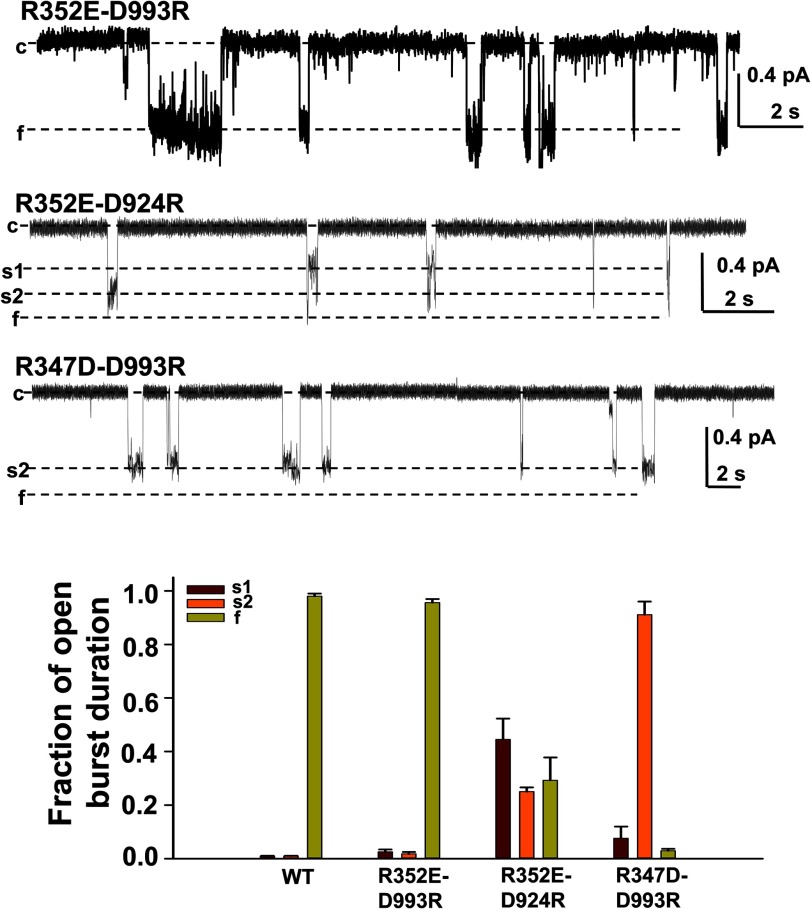
Asp993 is a salt bridge partner of Arg352 as well as of Arg347. A, representative current samples of R352E/D993R-, R352E/D924R-, and R347D/D993R-CFTR recorded from excised inside-out patches with the same conditions as Fig. 2 (n = 3–6 for each mutant). B, mean fraction of open burst duration is plotted for each state of three CFTR mutants, for each of the open conductance states: s1 (purple), s2 (orange), and f (light green). Error bars, S.E.
FIGURE 4.
FIGURE 4.
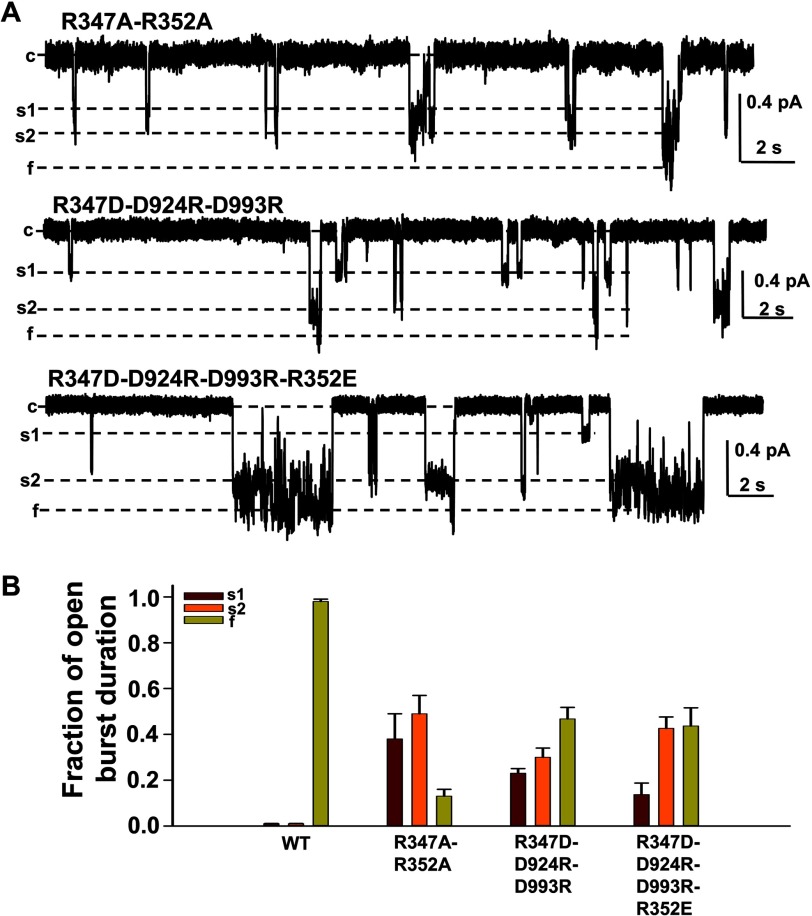
The triangular salt bridge Arg347-Asp924-Asp993 and salt bridge Arg352-Asp993 cooperate together to stabilize the CFTR open pore in a normal architecture. Representative current samples of R347A/R352A-, R347D/D924R/D993R-, and R347D/D924R/D993R/R352E-CFTR were recorded under the same conditions as in Fig. 3 (n = 5–6 for each mutant) (A). The mean fraction of open burst duration for each state of three CFTR mutants is shown in B. For all mutants, s1 is shown in dark red, s2 in orange, and f in light green. Error bars, S.E.
FIGURE 5.
FIGURE 5.
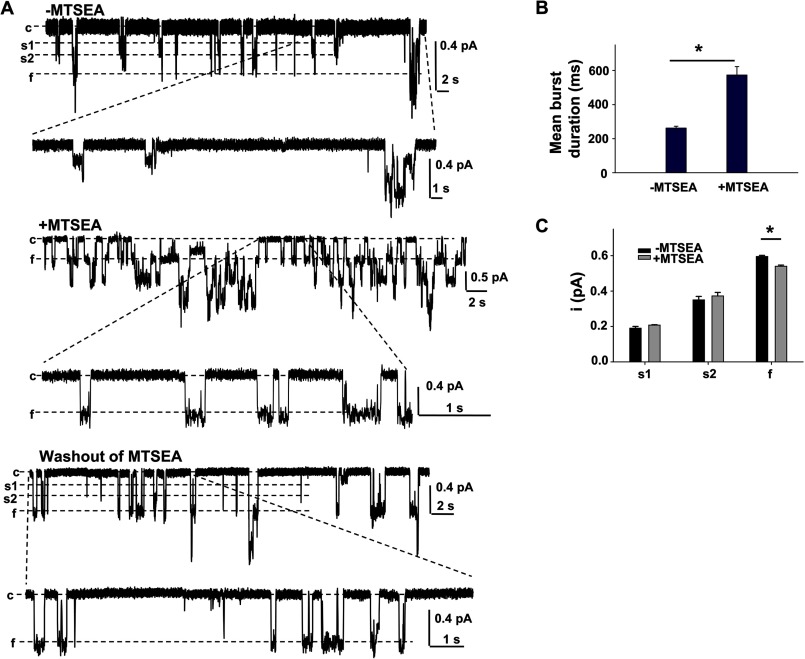
Deposition of positive charge at R352C improved stability of the open state. A, sample traces from R352C-CFTR recorded from one patch under control conditions (top trace, ATP + PKA) and in the presence of 100 μm MTSEA+ (middle trace, ATP + PKA + MTSEA+) and then after washout with a large volume of intracellular solution and the subsequent addition of ATP and PKA alone (bottom trace, ATP + PKA) in excised inside-out membrane patches. Sections of each of the three traces are also shown at expanded temporal resolution. All traces were recorded at VM = −100 mV. B, comparison of mean burst duration of R352C in the absence of MTSEA+ (ATP + PKA only) (−MTSEA) and in the presence of MTSEA+ with ATP + PKA (+MTSEA). C, comparison of single channel amplitudes of the three open states of R352C-CFTR with or without 100 μm MTSEA+. Single channel amplitudes of the s1 and s2 subconductance states remained unchanged, whereas the single channel amplitude of the f conductance state was significantly decreased after covalent modification with MTSEA+ (n = 5). Error bars, S.E.
FIGURE 7.
FIGURE 7.
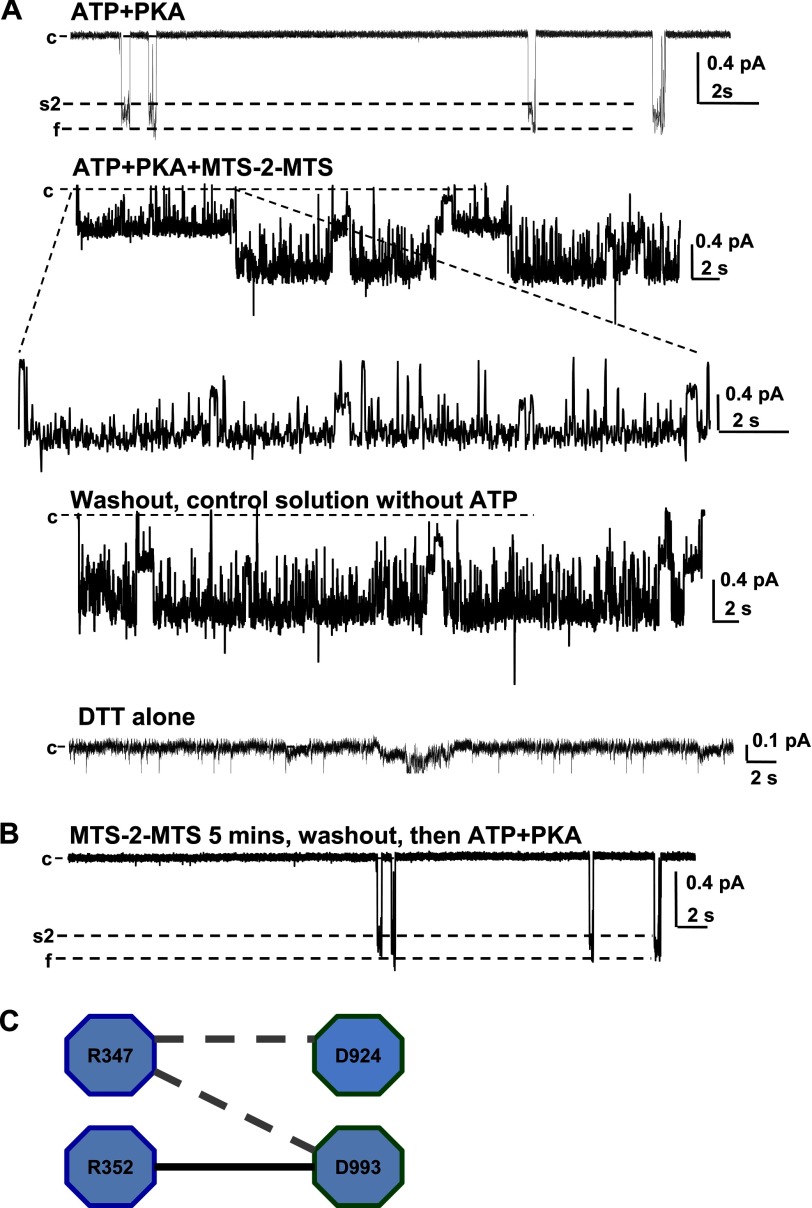
MTS-2-MTS can latch open CFTR when applied to open channels. A, effects of 100 μm MTS-2-MTS on R352C-D993C-CFTR. The data shown were recorded from one excised, inside-out patch under control conditions (first trace, ATP + PKA), in the presence of 100 μm MTS-2-MTS (second trace, ATP + PKA + MTS-2-MTS), in control conditions again (fourth trace), and in control conditions with DTT (fifth trace); the third trace presents part of the second trace at expanded temporal resolution, as indicated (n = 4). B, MTS-2-MTS failed to functionally modify R352C/D993C-CFTR when applied when the channel was in the closed state. The patch was incubated in control medium free of ATP and PKA, with 100 μm MTS-2-MTS, for >5 min, and then washed out with control solution, followed by exposure to ATP and PKA alone (representative of n = 5 patches with similar results). C, a schematic model of the salt bridges (dashed gray line, the triangular salt bridge contributing to the s2 state; black line, Arg352-Asp993 salt bridge contributing to the f state). Error bars, S.E.
FIGURE 6.
FIGURE 6.
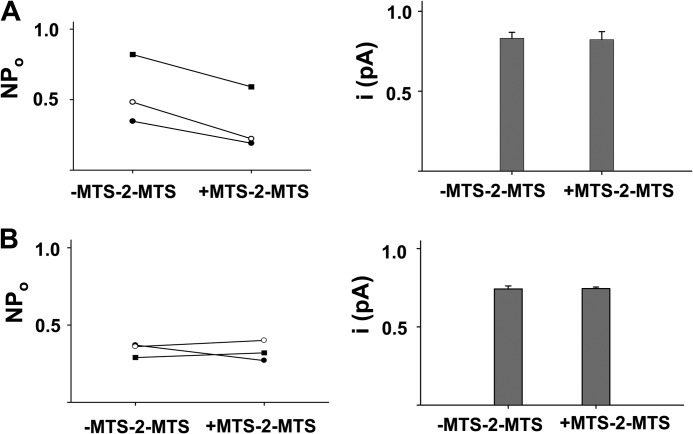
Effects of 100 μm MTS-2-MTS on WT-CFTR (A) and Cys-less V510A-CFTR (B) at VM = −100 mV. A, MTS-2-MTS decreased NPo but had no effect on single channel amplitude of WT-CFTR. B, the cross-linker had no effect on either NPo or single channel amplitude of Cys-less V510A-CFTR. Error bars, S.E.

References

    1. Mornon J. P., Lehn P., Callebaut I. (2009) Molecular models of the open and closed states of the whole human CFTR protein. Cell. Mol. Life Sci. 66, 3469–3486 - PMC - PubMed
    1. Mornon J. P., Lehn P., Callebaut I. (2008) Atomic model of human cystic fibrosis transmembrane conductance regulator. Membrane-spanning domains and coupling interfaces. Cell. Mol. Life Sci. 65, 2594–2612 - PMC - PubMed
    1. Alexander C., Ivetac A., Liu X., Norimatsu Y., Serrano J. R., Landstrom A., Sansom M., Dawson D. C. (2009) Cystic fibrosis transmembrane conductance regulator. Using differential reactivity toward channel-permeant and channel-impermeant thiol-reactive probes to test a molecular model for the pore. Biochemistry 48, 10078–10088 - PMC - PubMed
    1. Riordan J. R., Rommens J. M., Kerem B., Alon N., Rozmahel R., Grzelczak Z., Zielenski J., Lok S., Plavsic N., Chou J. L. (1989) Identification of the cystic fibrosis gene. Cloning and characterization of complementary DNA. Science 245, 1066–1073 - PubMed
    1. Serohijos A. W., Hegedus T., Aleksandrov A. A., He L., Cui L., Dokholyan N. V., Riordan J. R. (2008) Phenylalanine-508 mediates a cytoplasmic-membrane domain contact in the CFTR 3D structure crucial to assembly and channel function. Proc. Natl. Acad. Sci. U.S.A. 105, 3256–3261 - PMC - PubMed

Publication types

MeSH terms

LinkOut - more resources