


Ambient fine particulate matter alters cerebral hemodynamics in the elderly
- PMID: 23709640
- PMCID: PMC3722046
- DOI: 10.1161/STROKEAHA.111.000395
Ambient fine particulate matter alters cerebral hemodynamics in the elderly
Abstract
Background and purpose: Short-term elevations in fine particulate matter air pollution (PM2.5) are associated with increased risk of acute cerebrovascular events. Evidence from the peripheral circulation suggests that vascular dysfunction may be a central mechanism. However, the effects of PM2.5 on cerebrovascular function and hemodynamics are unknown.
Methods: We used transcranial Doppler ultrasound to measure beat-to-beat blood flow velocity in the middle cerebral artery at rest and in response to changes in end-tidal CO2 (cerebral vasoreactivity) and arterial blood pressure (cerebral autoregulation) in 482 participants from the Maintenance of Balance, Independent Living, Intellect, and Zest in the Elderly (MOBILIZE) of Boston study. We used linear mixed effects models with random subject intercepts to evaluate the association between cerebrovascular hemodynamic parameters and mean PM2.5 levels 1 to 28 days earlier adjusting for age, race, medical history, meteorologic covariates, day of week, temporal trends, and season.
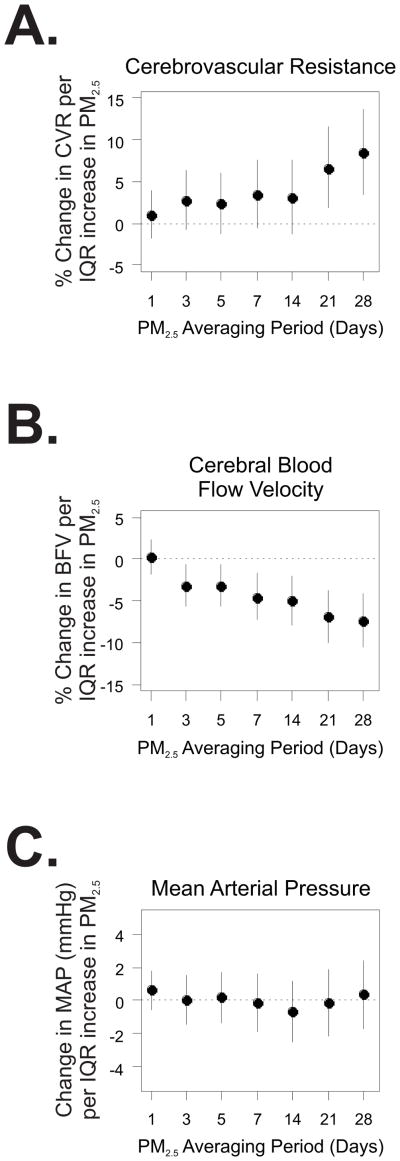
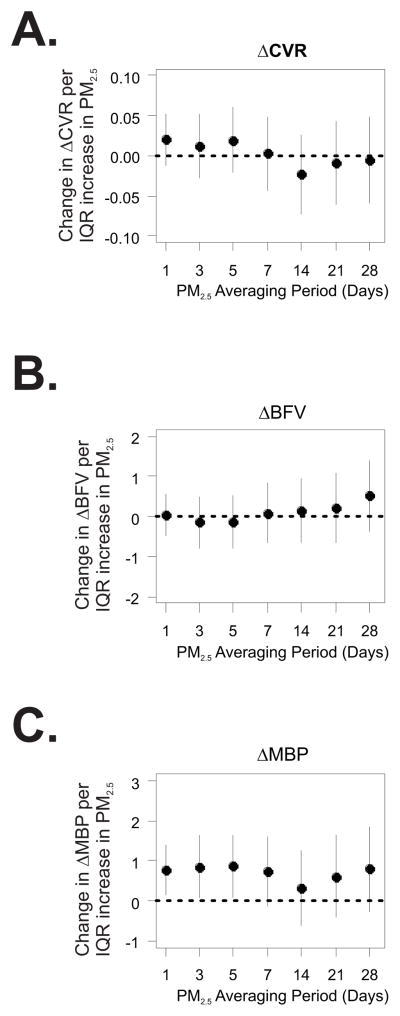
Results: An interquartile range increase (3.0 µg/m(3)) in mean PM2.5 levels during the previous 28 days was associated with an 8.6% (95% confidence interval, 3.7%-13.8%; P<0.001) higher cerebral vascular resistance and a 7.5% (95% confidence interval, 4.2%-10.6%; P<0.001) lower blood flow velocity at rest. Measures of cerebral vasoreactivity and autoregulation were not associated with PM2.5 levels.
Conclusions: In this cohort of community-dwelling seniors, exposure to PM2.5 was associated with higher resting cerebrovascular resistance and lower cerebral blood flow velocity. If replicated, these findings suggest that alterations in cerebrovascular hemodynamics may underlie the increased risk of particle-related acute cerebrovascular events.
Keywords: air pollution; cerebrovascular; elderly; epidemiology; transcranial Doppler.
Figures
References
-
- Brook RD, Rajagopalan S, Pope CA, 3rd, Brook JR, Bhatnagar A, Diez-Roux AV, et al. Particulate matter air pollution and cardiovascular disease: An update to the scientific statement from the american heart association. Circulation. 2010;121:2331–2378. - PubMed
-
- Brook RD, Brook JR, Urch B, Vincent R, Rajagopalan S, Silverman F. Inhalation of fine particulate air pollution and ozone causes acute arterial vasoconstriction in healthy adults. Circulation. 2002;105:1534–1536. - PubMed
-
- Zanobetti A, Canner MJ, Stone PH, Schwartz J, Sher D, Eagan-Bengston E, et al. Ambient pollution and blood pressure in cardiac rehabilitation patients. Circulation. 2004;110:2184–2189. - PubMed
-
- O’Neill MS, Veves A, Zanobetti A, Sarnat JA, Gold DR, Economides PA, et al. Diabetes enhances vulnerability to particulate air pollution-associated impairment in vascular reactivity and endothelial function. Circulation. 2005;111:2913–2920. - PubMed
-
- Briet M, Collin C, Laurent S, Tan A, Azizi M, Agharazii M, et al. Endothelial function and chronic exposure to air pollution in normal male subjects. Hypertension. 2007;50:970–976. - PubMed
Publication types
MeSH terms
Substances
Grants and funding
- P01 ES009825/ES/NIEHS NIH HHS/United States
- R00 ES015774/ES/NIEHS NIH HHS/United States
- P30 ES000002/ES/NIEHS NIH HHS/United States
- P01 AG004390/AG/NIA NIH HHS/United States
- AG030967/AG/NIA NIH HHS/United States
- T32 AG023480/AG/NIA NIH HHS/United States
- R37 AG025037/AG/NIA NIH HHS/United States
- ES015774/ES/NIEHS NIH HHS/United States
- K23 AG030967/AG/NIA NIH HHS/United States
- R01 AG025037/AG/NIA NIH HHS/United States
- AG004390/AG/NIA NIH HHS/United States
- AG025037/AG/NIA NIH HHS/United States
- ES000002/ES/NIEHS NIH HHS/United States
- ES009825/ES/NIEHS NIH HHS/United States
- K99 ES015774/ES/NIEHS NIH HHS/United States
LinkOut - more resources
Full Text Sources
Other Literature Sources
Medical
