. 2013 Jul 1;191(1):52-9.
doi: 10.4049/jimmunol.1300802. Epub 2013 May 24.

Mixed proteasomes function to increase viral peptide diversity and broaden antiviral CD8+ T cell responses

Affiliations

Mixed proteasomes function to increase viral peptide diversity and broaden antiviral CD8+ T cell responses

Damien Zanker et al. J Immunol. .

Abstract

The three proteasome subunits with proteolytic activity are encoded by standard or immunoproteasome genes. Many proteasomes expressed by normal cells and cells exposed to cytokines are "mixed", that is, contain both standard and immunoproteasome subunits. Using a panel of 38 defined influenza A virus-derived epitopes recognized by C57BL/6 mouse CD8(+) T cells, we used mice with targeted disruption of β1i, β2i, or β5i/β2i genes to examine the contribution of mixed proteasomes to the immunodominance hierarchy of antiviral CD8(+) T cells. We show that each immunoproteasome subunit has large effects on the primary and recall immunodominance hierarchies due to modulating both the available T cell repertoire and generation of individual epitopes as determined both biochemically and kinetically in Ag presentation assays. These findings indicate that mixed proteasomes function to enhance the diversity of peptides and support a broad CD8(+) T cell response.


Figures
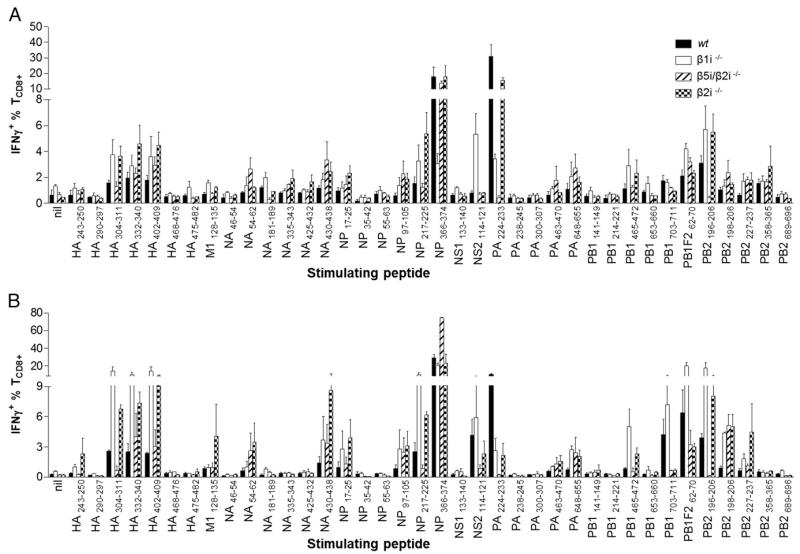
FIGURE 1
FIGURE 1
Loss of immunoproteasome subunits results in change of IAV ID hierarchy. β1i−/−, β5i/β2i−/−, β2i−/−, and wt mice were infected with IAV and assessed for (A) primary or (B) secondary immune responses 7 d after infection. Intraperitoneal exudates (local site of infection) were taken and TCD8+ responses measured using synthetic peptides to known IAV epitopes in an ICS assay for IFN-γ. Six mice per strain were collected individually. Data are pooled from two independent experiments.
FIGURE 2
FIGURE 2
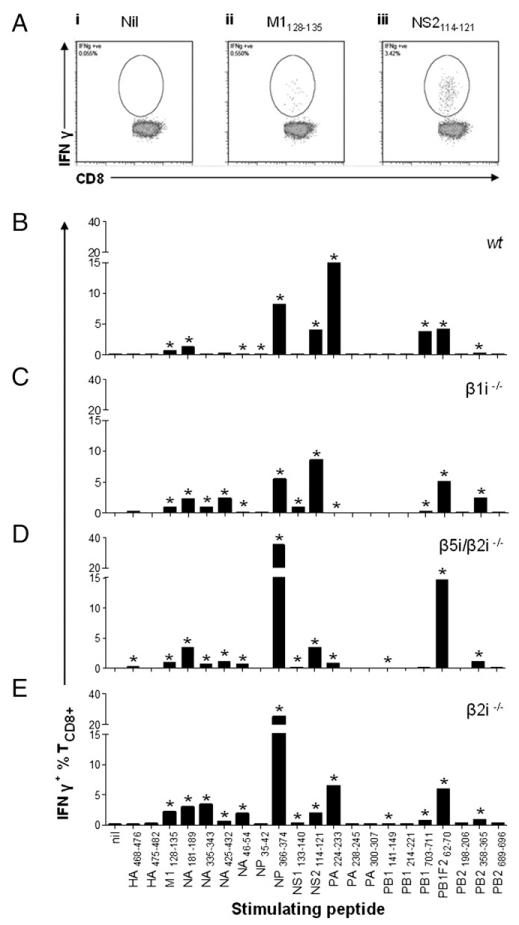
Diverse IAV responses from in vitro–expanded polyspecific IAV TCD8+ cultures derived from wt and immunoproteasome-deficient mice. (A) Representative FACS plots of subdominant TCD8+ responses from in vitro–propagated TCD8+ cultures used in Fig. 2, showing (Ai) Nil peptide, (Aii) M1128-135 peptide (baseline level subdominant response), and (Aiii)) NS2114-121 (subdominant response). (B) Wild-type, (C) β1i−/−, (D) β5i/β2i−/−, and (E) β2i−/− mice were immunized with 107 PFU PR8 i.p. Thirty days later, spleens were isolated and TCD8+ restimulated using host-strain BMDCs infected with PR8 at 10 MOI. Following 10 d culture, responses were measured using synthetic peptides to known IAV epitopes in an ICS assay measuring the production of IFN-γ. Asterisks denote when definitive TCD8+ responses were observed for the defined epitope.
FIGURE 3
FIGURE 3
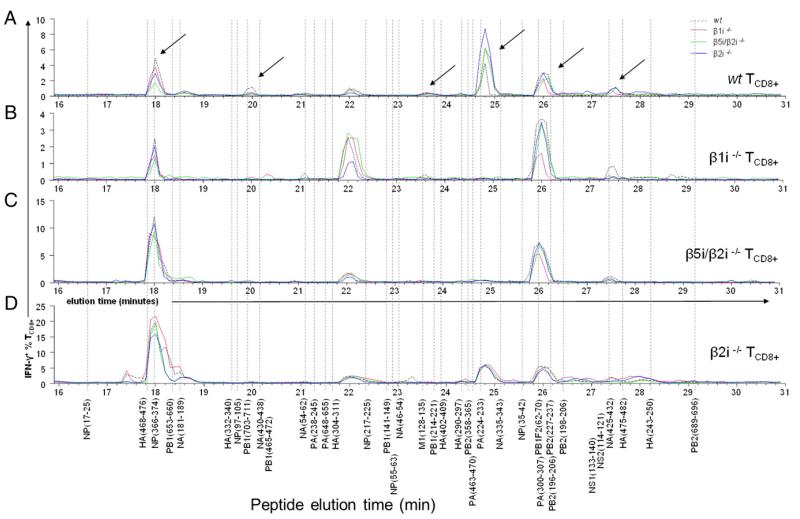
IAV-specific TCD8+ demonstrate altered IAV epitope processing by BMDCs expressing mixed proteasome. Polyspecific IAV-specific TCD8+ cultures raised from (A) wt, (B) β1i−/−, (C) β5i/β2i−/−, and (D) β2i−/− mice were restimulated using eluted HPLC fractions derived from IAV-infected BMDCs from wt (black dash), β1i−/− (pink), β5i/β2i−/− (green), or β2i−/− (dark blue) mice and assessed for the production of IFN-γ in an ICS assay. Elution time points of known synthetic IAV peptides are shown by a dotted line and the peptides are indicated below. Arrows indicate areas of interest for further investigation using monospecific IAV TCD8+ cultures.
FIGURE 4
FIGURE 4
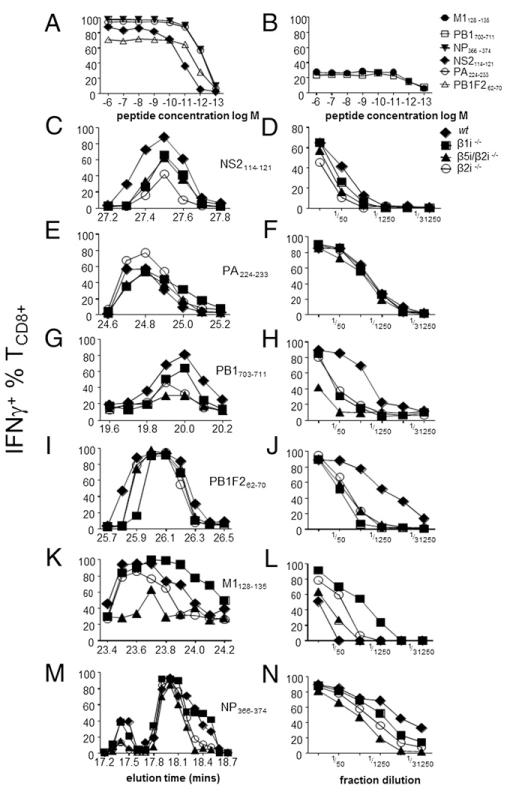
Individual immunoproteasome subunits are critical for generation of IAV TCD8+ epitopes. (A and B) Monospecific TCD8+ cultures raised against known IAV-derived epitopes. Ten-day TCD8+ cultures were measured for purity using a titration of synthetic peptide in an ICS assay for IFN-γ. (C) NS2114–121, (E) PA224–233, (G) PB1703–711, (I) Pβ1F262–70, (K) M1128–135, and (M) NP366–374 cultures were assessed for IFN-γ production following incubation with RP-HPLC fractions of IAV-infected BMDCs from wt (◆), β1i−/− (■), β5i/β2i−/− (▲), or β2i−/− (○) mice. Peak fractions for (D) NS2114–121, (F) PA224–233, (H) Pβ1703–711, (J) Pβ1F262–70, (L) M1128–135, and (N) NP366–374 were further diluted to estimate relative peptide abundance.
FIGURE 5
FIGURE 5
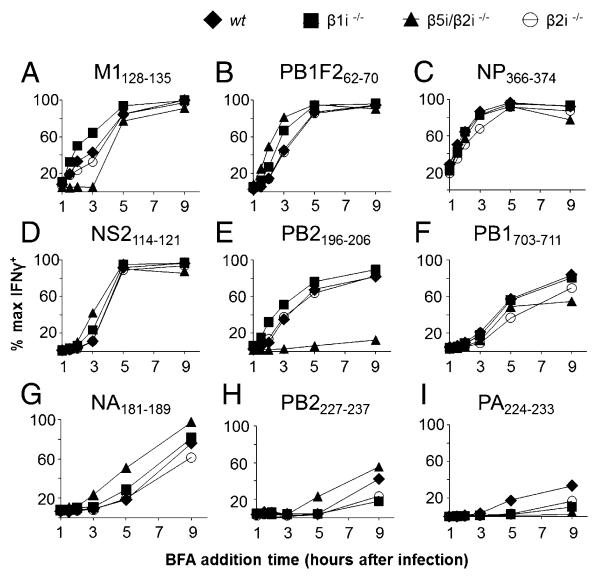
The Ag presentation of specific epitopes is altered by APCs with different protein degradation machinery. BMDCs from β1i−/− (■), β5i/β2i−/− (▲), β2i−/− (○), and wt (◆) mice were infected with IAV at an MOI of 10. Following 60 min infection (indicated as 1 h in the figures), cells were washed and incubated with monospecific TCD8+ cultures specific to defined IAV epitopes, (A) M1128–135, (B) PB1F262–70, (C) NP366-374, (D) NS2114–121, (E) PB2196–206, (F) PB1703–711, (G) NA181–189, (H) PB2227–237, and (I) PA224–233. BFA was added for a total of 4 h at the indicated time points and recognition of naturally presented peptide was measured using ICS assay for IFN-γ.

References

    1. Chen W, Calvo PA, Malide D, Gibbs J, Schubert U, Bacik I, Basta S, O’Neill R, Schickli J, Palese P, et al. A novel influenza A virus mitochondrial protein that induces cell death. Nat. Med. 2001;7:1306–1312. - PubMed
    1. Zhong W, Reche PA, Lai CC, Reinhold B, Reinherz EL. Genome-wide characterization of a viral cytotoxic T lymphocyte epitope repertoire. J. Biol. Chem. 2003;278:45135–45144. - PubMed
    1. Treanor JJ, Campbell JD, Zangwill KM, Rowe T, Wolff M. Safety and immunogenicity of an inactivated subvirion influenza A (H5N1) vaccine. N. Engl. J. Med. 2006;354:1343–1351. - PubMed
    1. Groettrup M, Soza A, Kuckelkorn U, Kloetzel PM. Peptide antigen production by the proteasome: complexity provides efficiency. Immunol. 1996;17:429–435. - PubMed
    1. Chen W, Norbury CC, Cho Y, Yewdell JW, Bennink JR. Immunoproteasomes shape immunodominance hierarchies of antiviral CD8+ T cells at the levels of T cell repertoire and presentation of viral antigens. J. Exp. Med. 2001;193:1319–1326. - PMC - PubMed

Publication types

MeSH terms

Substances