. 2013:2013:708464.
doi: 10.1155/2013/708464. Epub 2013 Apr 22.

In Vivo Immunomodulation and Lipid Peroxidation Activities Contributed to Chemoprevention Effects of Fermented Mung Bean against Breast Cancer

Affiliations

In Vivo Immunomodulation and Lipid Peroxidation Activities Contributed to Chemoprevention Effects of Fermented Mung Bean against Breast Cancer

Swee Keong Yeap et al. Evid Based Complement Alternat Med. 2013.

Abstract

Mung bean has been reported to have antioxidant, cytotoxic, and immunomodulatory effects in vitro. Fermented products are reported to have enhanced immunomodulation and cancer chemopreventive effects. In this study, fermented mung bean treatments in vivo were studied by monitoring tumor development, spleen immunity, serum cytokine (interleukin 2 and interferon gamma) levels, and spleen/tumor antioxidant levels after injection with low and high risk 4T1 breast cancer cells. Pretreatment with fermented mung bean was associated with delayed tumor formation in low risk mice. Furthermore, this treatment was connected with higher serum anticancer cytokine levels, spleen T cell populations, splenocyte cytotoxicity, and spleen/tumor antioxidant levels. Histopathological evaluation of fermented mung bean treated tumor revealed lower event of mitotic division. On the other hand, antioxidant and nitric oxide levels that were significantly increased in the untreated mice were inhibited in the fermented mung bean treated groups. These results suggested that fermented mung bean has potential cancer chemoprevention effects through the stimulation of immunity, lipid peroxidation, and anti-inflammation.


Figures
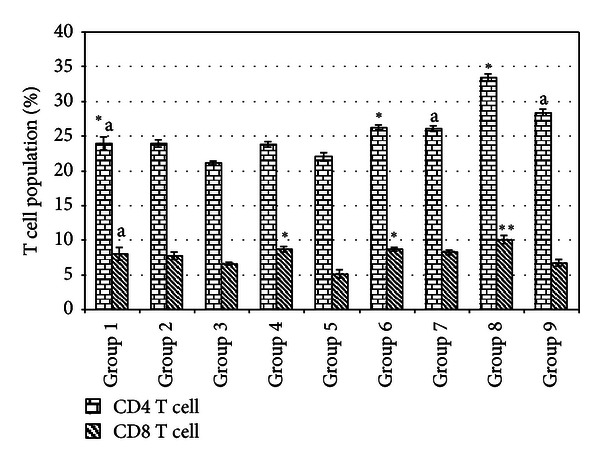
Figure 1
Figure 1
CD4 and CD8 immunophenotyping of spleen from different treatment groups on day 21 after 4T1 cell inoculation. Each value represents the means ± S.D. for three mice in triplicate each. The differences between the control or treated group and untreated group were determined by one-way ANOVA (*for low risk groups while afor high risk groups; P ≤ 0.05). Group 1: normal mice; Group 2: untreated 1 × 10⁴ 4T1 cell (low risk) inoculated mice; Group 3: untreated 1 × 10⁶ 4T1 cell (high risk) mice; Group 4: tamoxifen (1 mg/kg b.w.) treated 1 × 10⁴ 4T1 cell (low risk) inoculated mice; Group 5: tamoxifen (1 mg/kg b.w.) treated 1 × 10⁶ 4T1 cell (high risk) inoculated mice; Group 6: fermented mung bean (200 mg/kg b.w.) treated 1 × 10⁴ 4T1 cell (low risk) inoculated mice; Group 7: fermented mung bean (200 mg/kg b.w.) treated 1 × 10⁶ 4T1 cell (high risk) inoculated mice; Group 8: fermented mung bean (1000 mg/kg b.w.) treated 1 × 10⁴ 4T1 cell (low risk) inoculated mice; Group 9: fermented mung bean (1000 mg/kg b.w.) treated 1 × 10⁶ 4T1 cell (high risk) inoculated mice.
Figure 2
Figure 2
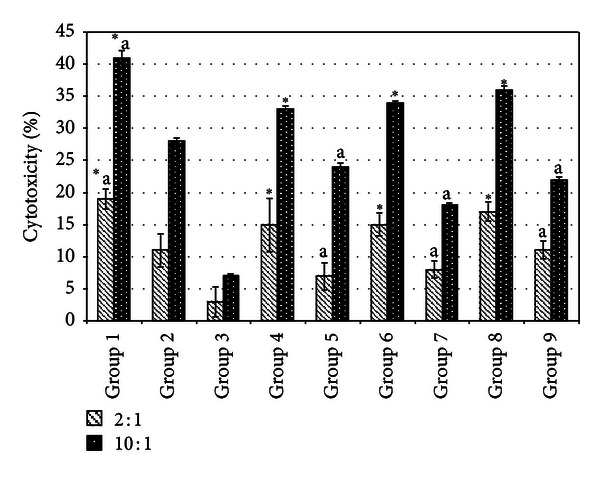
Cytotoxicity level of splenocyte on Yac-1 at E : T ratio of 2 : 1 and 10 : 1 from different treatment groups on day 21 after 4T1 cell inoculation. Each value represents the means ± S.D. for three mice in triplicate each. The differences between the control or treated group and untreated group were determined by one-way ANOVA (*for low risk groups while afor high risk groups; P ≤ 0.05). Group 1: normal mice; Group 2: untreated 1 × 10⁴ 4T1 cell (low risk) inoculated mice; Group 3: untreated 1 × 10⁶ 4T1 cell (high risk) mice; Group 4: tamoxifen (1 mg/kg b.w.) treated 1 × 10⁴ 4T1 cell (low risk) inoculated mice; Group 5: Tamoxifen (1 mg/kg b.w.) treated 1 × 10⁶ 4T1 cell (high risk) inoculated mice; Group 6: fermented mung bean (200 mg/kg b.w.) treated 1 × 10⁴ 4T1 cell (low risk) inoculated mice; Group 7: fermented mung bean (200 mg/kg b.w.) treated 1 × 10⁶ 4T1 cell (high risk) inoculated mice; Group 8: fermented mung bean (1000 mg/kg b.w.) treated 1 × 10⁴ 4T1 cell (low risk) inoculated mice; Group 9: fermented mung bean (1000 mg/kg b.w.) treated 1 × 10⁶ 4T1 cell (high risk) inoculated mice.
Figure 3
Figure 3
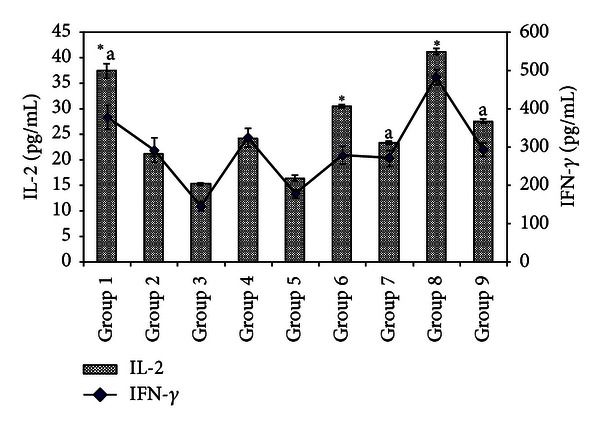
Serum levels of IL-2 and IFN-γ (pg/mL) from different treatment groups on day 21 after 4T1 cell inoculation. Each value represents the means ± S.D. for three mice in triplicate each. The differences between the control or treated group and untreated group were determined by one-way ANOVA (*for low risk groups while afor high risk groups; P ≤ 0.05). Group 1: normal mice; Group 2: untreated 1 × 10⁴ 4T1 cell (low risk) inoculated mice; Group 3: untreated 1 × 10⁶ 4T1 cell (high risk) mice; Group 4: tamoxifen (1 mg/kg b.w.) treated 1 × 10⁴ 4T1 cell (low risk) inoculated mice; Group 5: Tamoxifen (1 mg/kg b.w.) treated 1 × 10⁶ 4T1 cell (high risk) inoculated mice; Group 6: fermented mung bean (200 mg/kg b.w.) treated 1 × 10⁴ 4T1 cell (low risk) inoculated mice; Group 7: fermented mung bean (200 mg/kg b.w.) treated 1 × 10⁶ 4T1 cell (high risk) inoculated mice; Group 8: fermented mung bean (1000 mg/kg b.w.) treated 1 × 10⁴ 4T1 cell (low risk) inoculated mice; Group 9: fermented mung bean (1000 mg/kg b.w.) treated 1 × 10⁶ 4T1 cell (high risk) inoculated mice.
Figure 4
Figure 4
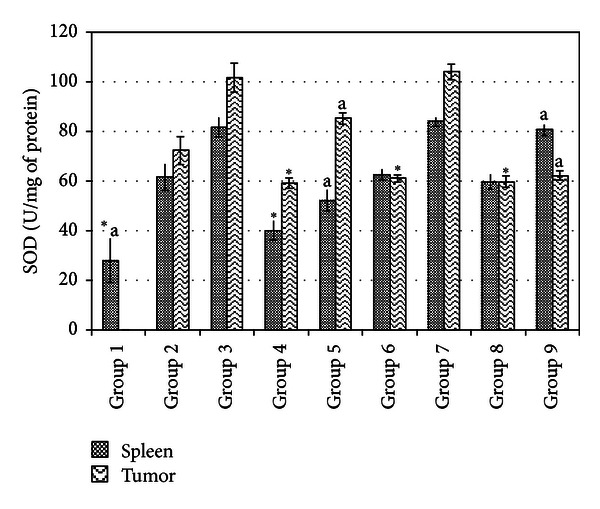
SOD level of tumor and spleen homogenate from different treatment groups on day 21 after 4T1 cell inoculation. Each value represents the means ± S.D. for three mice in triplicate each. The differences between the control or treated group and untreated group were determined by one-way ANOVA (*for low risk groups while afor high risk groups; P ≤ 0.05). Group 1: normal mice; Group 2: untreated 1 × 10⁴ 4T1 cell (low risk) inoculated mice; Group 3: untreated 1 × 10⁶ 4T1 cell (high risk) mice; Group 4: tamoxifen (1 mg/kg b.w.) treated 1 × 10⁴ 4T1 cell (low risk) inoculated mice; Group 5: Tamoxifen (1 mg/kg b.w.) treated 1 × 10⁶ 4T1 cell (high risk) inoculated mice; Group 6: fermented mung bean (200 mg/kg b.w.) treated 1 × 10⁴ 4T1 cell (low risk) inoculated mice; Group 7: fermented mung bean (200 mg/kg b.w.) treated 1 × 10⁶ 4T1 cell (high risk) inoculated mice; Group 8: fermented mung bean (1000 mg/kg b.w.) treated 1 × 10⁴ 4T1 cell (low risk) inoculated mice; Group 9: fermented mung bean (1000 mg/kg b.w.) treated 1 × 10⁶ 4T1 cell (high risk) inoculated mice.
Figure 5
Figure 5
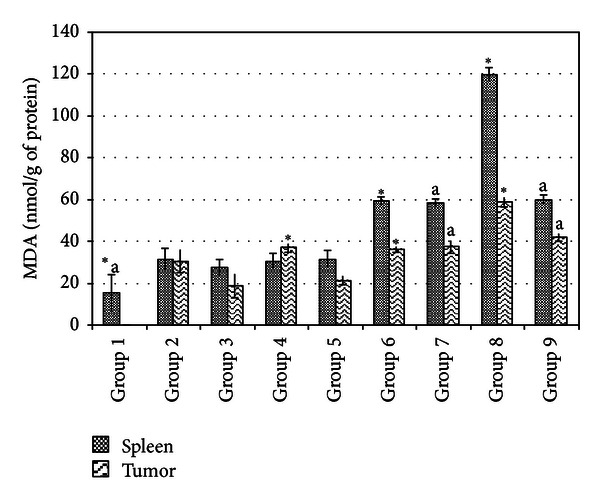
MDA level of tumor and spleen homogenate from different treatment groups on day 21 after 4T1 cell inoculation. Each value represents the means ± S.D. for three mice in triplicate each. The differences between the control or treated group and untreated group were determined by one-way ANOVA (*for low risk groups while afor high risk groups; P ≤ 0.05). Group 1: normal mice; Group 2: untreated 1 × 10⁴ 4T1 cell (low risk) inoculated mice; Group 3: untreated 1 × 10⁶ 4T1 cell (high risk) mice; Group 4: tamoxifen (1 mg/kg b.w.) treated 1 × 10⁴ 4T1 cell (low risk) inoculated mice; Group 5: Tamoxifen (1 mg/kg b.w.) treated 1 × 10⁶ 4T1 cell (high risk) inoculated mice; Group 6: fermented mung bean (200 mg/kg b.w.) treated 1 × 10⁴ 4T1 cell (low risk) inoculated mice; Group 7: fermented mung bean (200 mg/kg b.w.) treated 1 × 10⁶ 4T1 cell (high risk) inoculated mice; Group 8: fermented mung bean (1000 mg/kg b.w.) treated 1 × 10⁴ 4T1 cell (low risk) inoculated mice; Group 9: fermented mung bean (1000 mg/kg b.w.) treated 1 × 10⁶ 4T1 cell (high risk) inoculated mice.
Figure 6
Figure 6
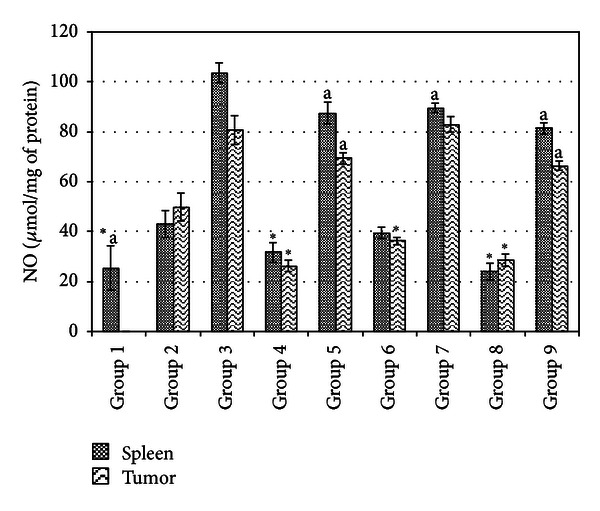
NO level of tumor and spleen homogenate from different treatment groups on day 21 following 4T1 cell inoculation. Each value represents the means ± S.D. for three mice in triplicate each. The differences between the control or treated group and untreated group were determined by one-way ANOVA (*for low risk groups while afor high risk groups; P ≤ 0.05). Group 1: normal mice; Group 2: untreated 1 × 10⁴ 4T1 cell (low risk) inoculated mice; Group 3: untreated 1 × 10⁶ 4T1 cell (high risk) mice; Group 4: tamoxifen (1 mg/kg b.w.) treated 1 × 10⁴ 4T1 cell (low risk) inoculated mice; Group 5: Tamoxifen (1 mg/kg b.w.) treated 1 × 10⁶ 4T1 cell (high risk) inoculated mice; Group 6: fermented mung bean (200 mg/kg b.w.) treated 1 × 10⁴ 4T1 cell (low risk) inoculated mice; Group 7: fermented mung bean (200 mg/kg b.w.) treated 1 × 10⁶ 4T1 cell (high risk) inoculated mice; Group 8: fermented mung bean (1000 mg/kg b.w.) treated 1 × 10⁴ 4T1 cell (low risk) inoculated mice; Group 9: fermented mung bean (1000 mg/kg b.w.) treated 1 × 10⁶ 4T1 cell (high risk) inoculated mice.
Figure 7
Figure 7
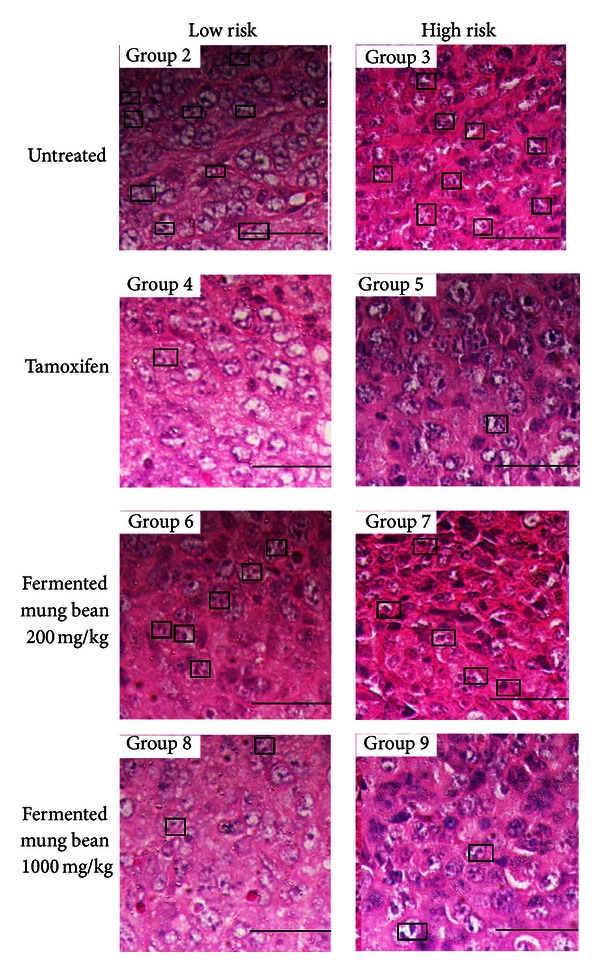
Histological emergence of the 4T1 tumor from Group 2 to Group 9. Boxes indicate cells under mitotic division. Black bars signify 200 μm (magnification 40x). Group 2: untreated 1 × 10⁴ 4T1 cell (low risk) inoculated mice; Group 3: untreated 1 × 10⁶ 4T1 cell (high risk) mice; Group 4: tamoxifen (1 mg/kg b.w.) treated 1 × 10⁴ 4T1 cell (low risk) inoculated mice; Group 5: Tamoxifen (1 mg/kg b.w.) treated 1 × 10⁶ 4T1 cell (high risk) inoculated mice; Group 6: fermented mung bean (200 mg/kg b.w.) treated 1 × 10⁴ 4T1 cell (low risk) inoculated mice; Group 7: fermented mung bean (200 mg/kg b.w.) treated 1 × 10⁶ 4T1 cell (high risk) inoculated mice; Group 8: fermented mung bean (1000 mg/kg b.w.) treated 1 × 10⁴ 4T1 cell (low risk) inoculated mice; Group 9: fermented mung bean (1000 mg/kg b.w.) treated 1 × 10⁶ 4T1 cell (high risk) inoculated mice.

References

    1. Nelson NJ. Migrant studies aid the search for factors linked to breast cancer risk. Journal of the National Cancer Institute. 2006;98(7):436–438. - PubMed
    1. Luk SU, Lee TKW, Liu J, et al. Chemopreventive effect of PSP through targeting of prostate cancer stem cell-like population. PLoS ONE. 2011;6(5) article e19804 - PMC - PubMed
    1. Law SV, Abu Bakar F, Mat Hashim D, Abdul Hamid A. Popular fermented foods and beverages in Southeast Asia. International Food Research Journal. 2011;18(2):475–484.
    1. de Moreno de LeBlanc A, Matar C, LeBlanc N, Perdigón G. Effects of milk fermented by Lactobacillus helveticus R389 on a murine breast cancer model. Breast Cancer Research. 2005;7(4):R477–R486. - PMC - PubMed
    1. Wongekalak LO, Sakulsom P, Jirasripongpun K, Hongsprabhas P. Potential use of antioxidative mungbean protein hydrolysate as an anticancer asiatic acid carrier. Food Research International. 2011;44(3):812–817.