


Phenazine production enhances extracellular DNA release via hydrogen peroxide generation in Pseudomonas aeruginosa
- PMID: 23710274
- PMCID: PMC3656008
- DOI: 10.4161/cib.23570
Phenazine production enhances extracellular DNA release via hydrogen peroxide generation in Pseudomonas aeruginosa
Abstract
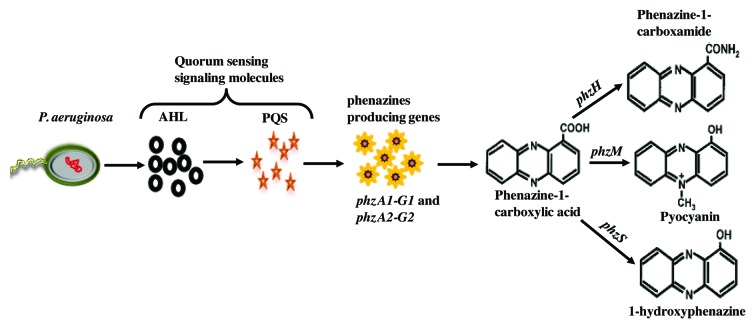
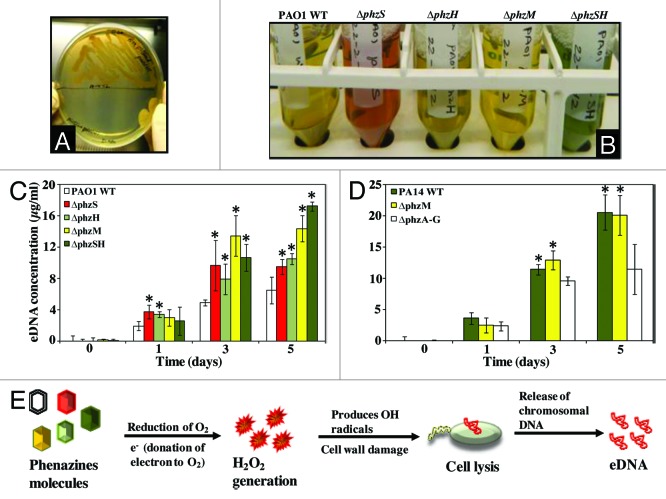
In Pseudomonas aeruginosa eDNA is a crucial component essential for biofilm formation and stability. In this study we report that release of eDNA is influenced by the production of phenazine in P. aeruginosa. A ∆phzA-G mutant of P. aeruginosa PA14 deficient in phenazine production generated significantly less eDNA in comparison with the phenazine producing strains. The relationship between eDNA release and phenazine production is bridged via hydrogen peroxide (H2O2) generation and subsequent H2O2 mediated cell lysis and ultimately release of chromosomal DNA into the extracellular environment as eDNA.
Keywords: Pseudomonas aeruginosa; extracellular DNA; hydrogen peroxide; phenazines.
Figures
Similar articles
-
Pyocyanin promotes extracellular DNA release in Pseudomonas aeruginosa.PLoS One. 2012;7(10):e46718. doi: 10.1371/journal.pone.0046718. Epub 2012 Oct 8. PLoS One. 2012. PMID: 23056420 Free PMC article.
-
Release mechanisms and molecular interactions of Pseudomonas aeruginosa extracellular DNA.Appl Microbiol Biotechnol. 2020 Aug;104(15):6549-6564. doi: 10.1007/s00253-020-10687-9. Epub 2020 Jun 4. Appl Microbiol Biotechnol. 2020. PMID: 32500267 Review.
-
The Phenazine 2-Hydroxy-Phenazine-1-Carboxylic Acid Promotes Extracellular DNA Release and Has Broad Transcriptomic Consequences in Pseudomonas chlororaphis 30-84.PLoS One. 2016 Jan 26;11(1):e0148003. doi: 10.1371/journal.pone.0148003. eCollection 2016. PLoS One. 2016. PMID: 26812402 Free PMC article.
-
Propolis Affects Pseudomonas aeruginosa Growth, Biofilm Formation, eDNA Release and Phenazine Production: Potential Involvement of Polyphenols.Microorganisms. 2020 Feb 12;8(2):243. doi: 10.3390/microorganisms8020243. Microorganisms. 2020. PMID: 32059431 Free PMC article.
-
Extracellular DNA in biofilms.Int J Artif Organs. 2011 Sep;34(9):824-31. doi: 10.5301/ijao.5000051. Int J Artif Organs. 2011. PMID: 22094562 Review.
Cited by
-
Phenazine virulence factor binding to extracellular DNA is important for Pseudomonas aeruginosa biofilm formation.Sci Rep. 2015 Feb 11;5:8398. doi: 10.1038/srep08398. Sci Rep. 2015. PMID: 25669133 Free PMC article.
-
Wheat microbiome bacteria can reduce virulence of a plant pathogenic fungus by altering histone acetylation.Nat Commun. 2018 Aug 24;9(1):3429. doi: 10.1038/s41467-018-05683-7. Nat Commun. 2018. PMID: 30143616 Free PMC article.
-
BrlR from Pseudomonas aeruginosa is a receptor for both cyclic di-GMP and pyocyanin.Nat Commun. 2018 Jul 2;9(1):2563. doi: 10.1038/s41467-018-05004-y. Nat Commun. 2018. PMID: 29967320 Free PMC article.
-
Can Biofilm Be Reversed Through Quorum Sensing in Pseudomonas aeruginosa?Front Microbiol. 2019 Jul 23;10:1582. doi: 10.3389/fmicb.2019.01582. eCollection 2019. Front Microbiol. 2019. PMID: 31396166 Free PMC article.
-
Influence of calcium in extracellular DNA mediated bacterial aggregation and biofilm formation.PLoS One. 2014 Mar 20;9(3):e91935. doi: 10.1371/journal.pone.0091935. eCollection 2014. PLoS One. 2014. PMID: 24651318 Free PMC article.
References
-
- Flemming HC, Wingender J. The biofilm matrix. Nat Rev Microbiol. 2010;8:623–33. - PubMed
LinkOut - more resources
Full Text Sources
Other Literature Sources
