


The clinical obesity maintenance model: an integration of psychological constructs including mood, emotional regulation, disordered overeating, habitual cluster behaviours, health literacy and cognitive function
- PMID: 23710346
- PMCID: PMC3654353
- DOI: 10.1155/2013/240128
The clinical obesity maintenance model: an integration of psychological constructs including mood, emotional regulation, disordered overeating, habitual cluster behaviours, health literacy and cognitive function
Abstract
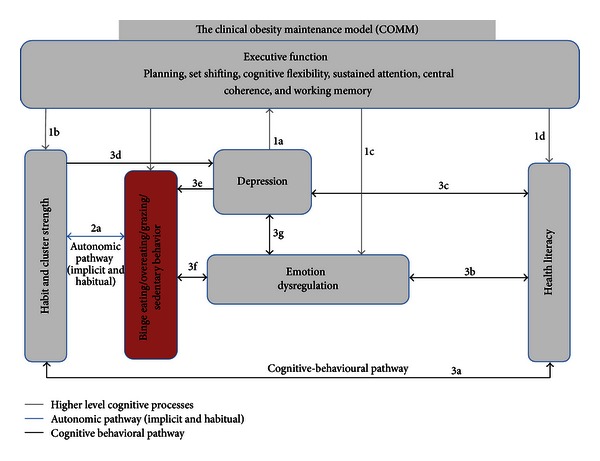
Psychological distress and deficits in executive functioning are likely to be important barriers to effective weight loss maintenance. The purpose of this paper is twofold. First, in the light of recent evidence in the fields of neuropsychology and obesity, particularly on the deficits in the executive function in overweight and obese individuals, a conceptual and theoretical framework of obesity maintenance is introduced by way of a clinical obesity maintenance model (COMM). It is argued that psychological variables, that of habitual cluster Behaviors, emotional dysregulation, mood, and health literacy, interact with executive functioning and impact on the overeating/binge eating behaviors of obese individuals. Second, cognizant of this model, it is argued that the focus of obesity management should be extended to include a broader range of maintaining mechanisms, including but not limited to cognitive deficits. Finally, a discussion on potential future directions in research and practice using the COMM is provided.
Figures
References
-
- Bray GA, Bouchard C, James WPT. Handbook of Obesity. New York, NY, USA: Marcel Dekker; 1998.
-
- Word Health Organization. 2004, http://www.who.int/mediacentre/factsheets/fs311/en/
-
- Perri MG, Corsica JA. Improving the maintenance of weight lost in behavioral treatment of obesity. In: Wadden TA, Stunkard AJ, editors. Handbook of Obesity Treatment. New York, NY, US: 2002. pp. 357–379.
-
- Wadden TA, Osei S. The treatment of obesity: an overview. In: Wadden TA, Stunkard AJ, editors. Handbook of Obesity Treatment. New York, NY, USA: Guilford Press; 2002. pp. 229–248.
-
- Klein S, Burke LE, Bray GA, et al. Clinical implications of obesity with specific focus on cardiovascular disease: a statement for professionals from the American Heart Association Council on Nutrition, Physical Activity, and Metabolism. Circulation. 2004;110(18):2952–2967. - PubMed
Publication types
MeSH terms
LinkOut - more resources
Full Text Sources
Other Literature Sources
Medical
