Potentially inappropriate prescribing and adverse health outcomes in community dwelling older patients
- PMID: 23711082
- PMCID: PMC3895361
- DOI: 10.1111/bcp.12161
Potentially inappropriate prescribing and adverse health outcomes in community dwelling older patients
Abstract
Aims: This study aimed to determine the association between potentially inappropriate prescribing (PIP) and health related outcomes [adverse drug events (ADEs), health related quality of life (HRQOL) and hospital accident and emergency (A&E) visits] in older community dwelling patients.
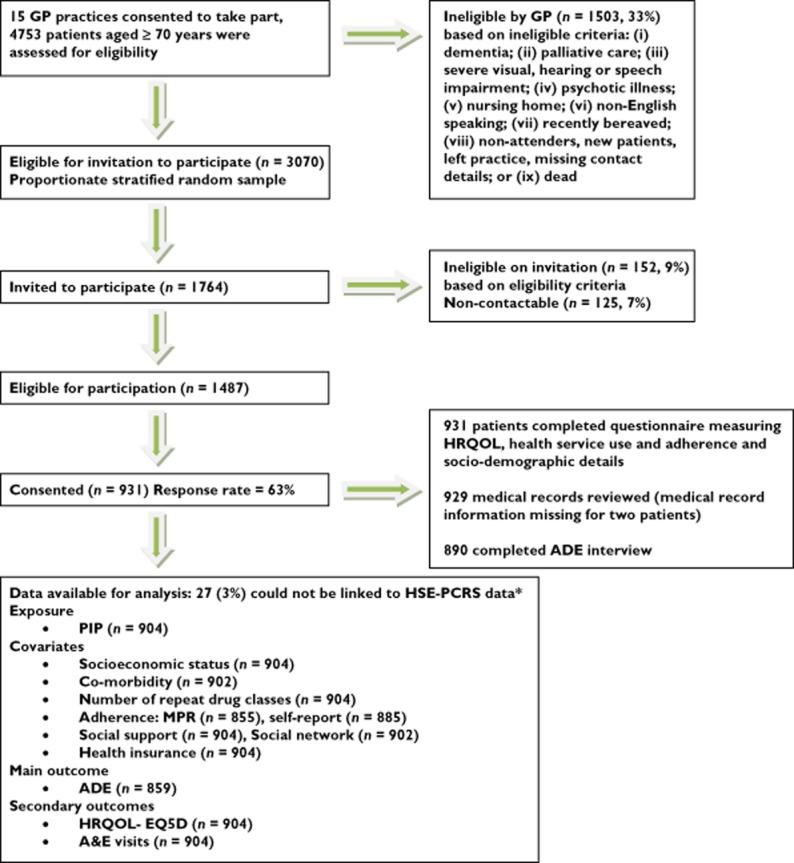
Methods: A retrospective cohort study of 931 community dwelling patients aged ≥70 years in 15 general practices in Ireland in 2010. PIP was defined by the Screening Tool of Older Person's Prescriptions (STOPP). ADEs were measured by patient self-report and medical record for the previous 6 months and reviewed by two independent clinicians. HRQOL was measured by the EQ-5D. A&E visits were measured by patients' medical records and self-report. Multilevel logistic, linear and Poisson regression examined how ADEs, HRQOL and A&E visits varied by PIP after adjusting for patient and practice level covariates: socioeconomic status, co-morbidity, number of drug classes and adherence.
Results: The overall prevalence of PIP was 42% (n = 377). Patients with ≥2 PIP indicators were twice as likely to have an ADE (adjusted OR 2.21; 95% CI 1.02, 4.83, P < 0.05), have a significantly lower mean HRQOL utility (adjusted coefficient -0.09, SE 0.02, P < 0.001) and nearly a two-fold increased risk in the expected rate of A&E visits (adjusted IRR 1.85; 95% CI 1.32, 2.58, P < 0.001). The number of drug classes and adherence were also significantly associated with these same adverse health outcomes.
Conclusions: Reducing PIP in primary care may help lower the burden of ADEs, its associated health care use and costs and enhance quality of life in older patients.
Keywords: HRQOL; STOPP; adverse drug events; health care use; older populations; potentially inappropriate prescribing.
© 2013 The British Pharmacological Society.
Figures
References
-
- Spinewine A, Schmader KE, Barber N, Hughes C, Lapane KL, Swine C, Hanlon JT. Appropriate prescribing in elderly people: how well can it be measured and optimised? Lancet. 2007;370:173–184. - PubMed
-
- Gurwitz JH, Field TS, Harrold LR, Rothschild J, Debellis K, Seger AC, Cadoret C, Fish LS, Garber L, Kelleher M, Bates DW. Incidence and preventability of adverse drug events among older persons in the ambulatory setting. JAMA. 2003;289:1107–1116. - PubMed
-
- Budnitz DS, Lovegrove MC, Shehab N, Richards CL. Emergency hospitalizations for adverse drug events in older Americans. N Engl J Med. 2011;365:2002–2012. - PubMed
-
- Fick DM, Cooper JW, Wade WE, Waller JL, Maclean JR, Beers MH. Updating the beers criteria for potentially inappropriate medication use in older adults: results of a US consensus panel of experts. Arch Intern Med. 2003;163:2716–2724. - PubMed
Publication types
MeSH terms
LinkOut - more resources
Full Text Sources
Other Literature Sources
Medical