


Technology-based interventions for mental health in tertiary students: systematic review
- PMID: 23711740
- PMCID: PMC3668609
- DOI: 10.2196/jmir.2639
Technology-based interventions for mental health in tertiary students: systematic review
Abstract
Background: Mental disorders are responsible for a high level of disability burden in students attending university. However, many universities have limited resources available to support student mental health. Technology-based interventions may be highly relevant to university populations. Previous reviews have targeted substance use and eating disorders in tertiary students. However, the effectiveness of technology-based interventions for other mental disorders and related issues has not been reviewed.
Objective: To systematically review published randomized trials of technology-based interventions evaluated in a university setting for disorders other than substance use and eating disorders.
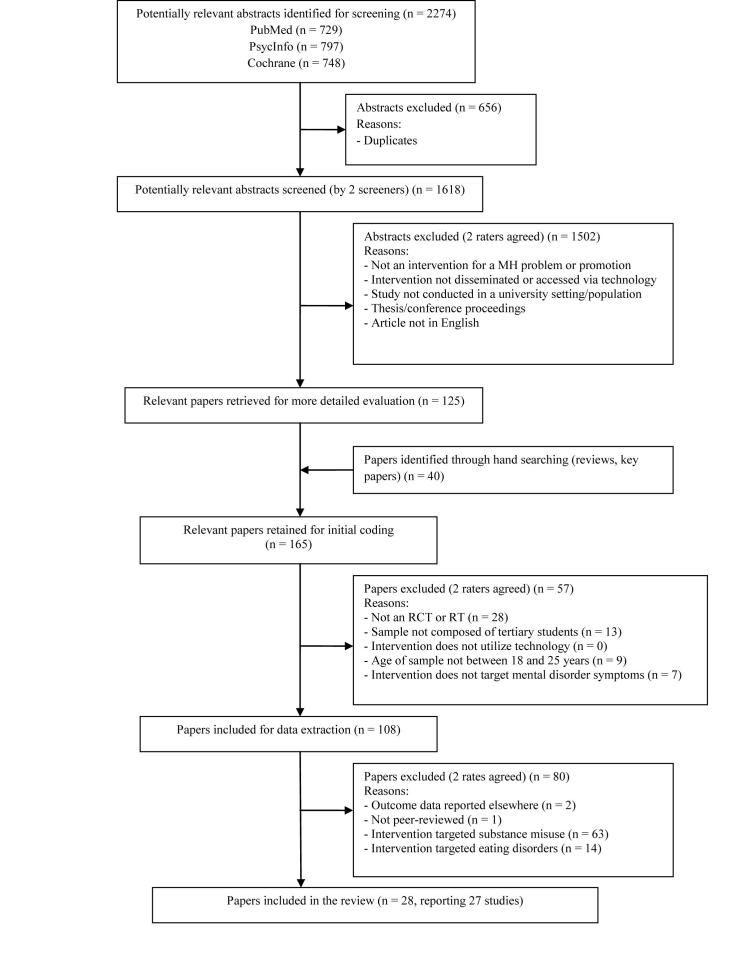
Methods: The PubMed, PsycInfo, and Cochrane Central Register of Controlled Trials databases were searched using keywords, phrases, and MeSH terms. Retrieved abstracts (n=1618) were double screened and coded. Included studies met the following criteria: (1) the study was a randomized trial or a randomized controlled trial, (2) the sample was composed of students attending a tertiary institution, (3) the intervention was delivered by or accessed using a technological device or process, (4) the age range of the sample was between 18 and 25 years, and (5) the intervention was designed to improve, reduce, or change symptoms relating to a mental disorder.
Results: A total of 27 studies met inclusion criteria for the present review. Most of the studies (24/27, 89%) employed interventions targeting anxiety symptoms or disorders or stress, although almost one-third (7/24, 29%) targeted both depression and anxiety. There were a total of 51 technology-based interventions employed across the 27 studies. Overall, approximately half (24/51, 47%) were associated with at least 1 significant positive outcome compared with the control at postintervention. However, 29% (15/51) failed to find a significant effect. Effect sizes were calculated for the 18 of 51 interventions that provided sufficient data. Median effect size was 0.54 (range -0.07 to 3.04) for 8 interventions targeting depression and anxiety symptoms and 0.84 (range -0.07 to 2.66) for 10 interventions targeting anxiety symptoms and disorders. Internet-based technology (typically involving cognitive behavioral therapy) was the most commonly employed medium, being employed in 16 of 27 studies and approximately half of the 51 technology-based interventions (25/51, 49%). Distal and universal preventive interventions were the most common type of intervention. Some methodological problems were evident in the studies, with randomization methods either inadequate or inadequately described, few studies specifying a primary outcome, and most of the studies failing to undertake or report appropriate intent-to-treat analyses.
Conclusions: The findings of this review indicate that although technological interventions targeting certain mental health and related problems offer promise for students in university settings, more high quality trials that fully report randomization methods, outcome data, and data analysis methods are needed.
Keywords: intervention; mental health; students; systematic review; technology; universities.
Conflict of interest statement
Conflicts of Interest: KG is a co-developer of MoodGYM, which was evaluated as part of 2 [39,42] of the included trials.
References
-
- Compas BE, Wagner BM, Slavin LA, Vannatta K. A prospective study of life events, social support, and psychological symptomatology during the transition from high school to college. Am J Community Psychol. 1986 Jun;14(3):241–57. - PubMed
Publication types
MeSH terms
LinkOut - more resources
Full Text Sources
Other Literature Sources
Medical
Miscellaneous
