


The marine nitrogen cycle: recent discoveries, uncertainties and the potential relevance of climate change
- PMID: 23713119
- PMCID: PMC3682741
- DOI: 10.1098/rstb.2013.0121
The marine nitrogen cycle: recent discoveries, uncertainties and the potential relevance of climate change
Abstract
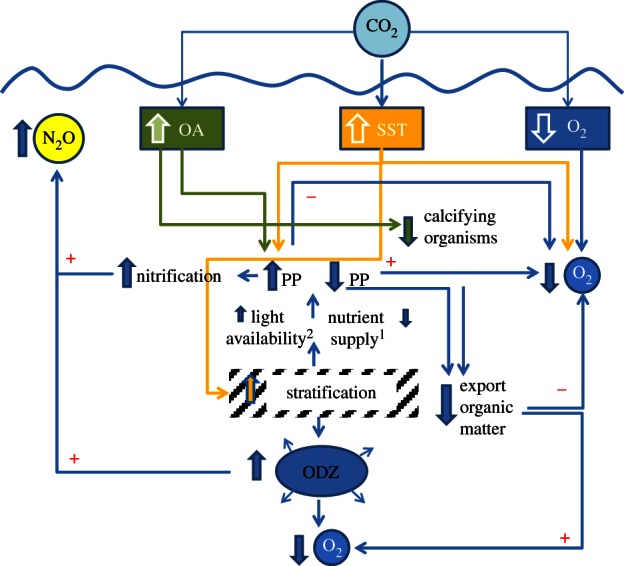
The ocean's nitrogen cycle is driven by complex microbial transformations, including nitrogen fixation, assimilation, nitrification, anammox and denitrification. Dinitrogen is the most abundant form of nitrogen in sea water but only accessible by nitrogen-fixing microbes. Denitrification and nitrification are both regulated by oxygen concentrations and potentially produce nitrous oxide (N2O), a climate-relevant atmospheric trace gas. The world's oceans, including the coastal areas and upwelling areas, contribute about 30 per cent to the atmospheric N2O budget and are, therefore, a major source of this gas to the atmosphere. Human activities now add more nitrogen to the environment than is naturally fixed. More than half of the nitrogen reaches the coastal ocean via river input and atmospheric deposition, of which the latter affects even remote oceanic regions. A nitrogen budget for the coastal and open ocean, where inputs and outputs match rather well, is presented. Furthermore, predicted climate change will impact the expansion of the oceans' oxygen minimum zones, the productivity of surface waters and presumably other microbial processes, with unpredictable consequences for the cycling of nitrogen. Nitrogen cycling is closely intertwined with that of carbon, phosphorous and other biologically important elements via biological stoichiometric requirements. This linkage implies that human alterations of nitrogen cycling are likely to have major consequences for other biogeochemical processes and ecosystem functions and services.
Keywords: budget; nitrogen; ocean.
Figures


References
-
- Canfield DE, Glazer AN, Falkowski PG. 2010. The evolution and future of earth's nitrogen cycle. Science 330, 192–196 10.1126/science.1186120 (doi:10.1126/science.1186120) - DOI - PubMed
-
- Codispoti LA, Brandes JA, Christensen JP, Devol AH, Naqvi SWA, Paerl HW, Yoshinari T. 2001. The oceanic fixed nitrogen and nitrous oxide budgets: moving targets as we enter the anthropocene? Sci. Marina 65, 85–105 10.3989/scimar.2001.65s285 (doi:10.3989/scimar.2001.65s285) - DOI
-
- Gruber N, Galloway JN. 2008. An Earth-system perspective of the global nitrogen cycle. Nature 451, 293–296 10.1038/nature06592 (doi:10.1038/nature06592) - DOI - PubMed
-
- Risgaard-Petersen N. 2006. Evidence for complete denitrification in a benthic foraminifer. Nature 443, 94–96 10.1038/nature05070 (doi:10.1038/nature05070) - DOI - PubMed
Publication types
MeSH terms
Substances
LinkOut - more resources
Full Text Sources
Other Literature Sources
Medical
