


Understanding the relative contributions of direct environmental effects and passive genotype-environment correlations in the association between familial risk factors and child disruptive behavior disorders
- PMID: 23714724
- PMCID: PMC3883935
- DOI: 10.1017/S0033291713001086
Understanding the relative contributions of direct environmental effects and passive genotype-environment correlations in the association between familial risk factors and child disruptive behavior disorders
Abstract
Background: Previous work reports an association between familial risk factors stemming from parental characteristics and offspring disruptive behavior disorders (DBDs). This association may reflect (a) the direct effects of familial environment and (b) a passive gene-environment correlation (r(GE)), wherein the parents provide both the genes and the environment. The current study examined the contributions of direct environmental influences and passive r(GE) by comparing the effects of familial risk factors on child DBDs in genetically related (biological) and non-related (adoptive) families.
Method: Participants were 402 adoptive and 204 biological families. Familial environment was defined as maternal and paternal maladaptive parenting and antisociality, marital conflict and divorce; offspring DBDs included attention deficit hyperactivity disorder (ADHD), conduct disorder (CD) and oppositional defiant disorder (ODD). Mixed-level regressions estimated the main effects of familial environment, adoption status and the familial environment by adoption status interaction term, which tested for the presence of passive r(GE).
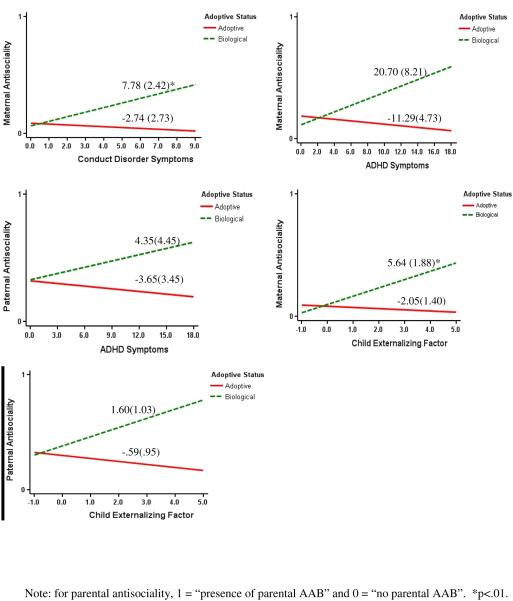
Results: There was a main effect of maternal and paternal maladaptive parenting and marital discord on child DBDs, indicating a direct environmental effect. There was no direct environmental effect of maternal or paternal antisociality, but maternal and paternal antisociality had stronger associations with child DBDs in biological families than adoptive families, indicating the presence of a passive r(GE).
Conclusions: Many familial risk factors affected children equally across genetically related and non-related families, providing evidence for direct environmental effects. The relationship of parental antisociality and offspring DBDs was best explained by a passive r(GE), where a general vulnerability toward externalizing psychopathology is passed down by the parents to the children.
Figures
References
-
- Braungartrieker J, Rende RD, Plomin R, Defries JC, Fulker DW. Genetic mediation of longitudinal associations between family environment and childhood behavior problems. Development and Psychopathology. 1995;7:233–245.
-
- Burt SA. Rethinking environmental contributions to child and adolescent psychopathology: A meta-analysis of shared environmental influences. Psychological Bulletin. 2009;135:608–637. - PubMed
-
- Burt SA, Krueger RF, McGue M, Iacono WG. Parent-child conflict and the comorbidity among childhood externalizing disorders. Archives of General Psychiatry. 2003;60:505–513. - PubMed
Publication types
MeSH terms
Grants and funding
LinkOut - more resources
Full Text Sources
Other Literature Sources
