Comment
. 2013 May-Jun;4(3):153-5.
doi: 10.4161/nucl.24999. Epub 2013 May 15.

When untethered, something silent inside comes

Affiliations
Comment

When untethered, something silent inside comes

Joan C Ritland Politz et al. Nucleus. 2013 May-Jun.

Abstract

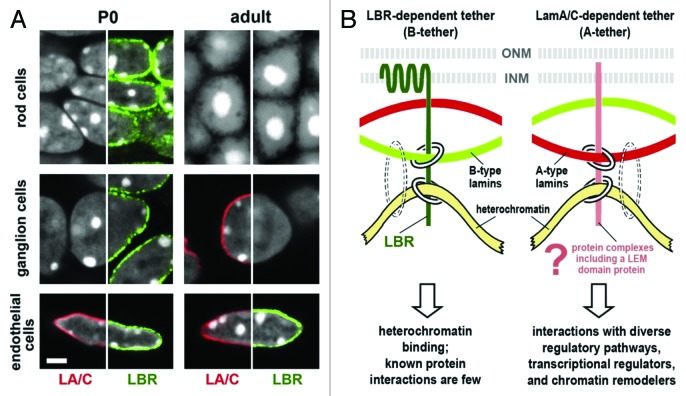
Heterochromatin usually is sequestered near the periphery and the nucleoli in mammalian nuclei. However, in terminally differentiated retinal rod cells of nocturnal mammals, heterochromatin instead accumulates in the interior, to give a so-called inside-out nuclear architecture. Solovei et al. now reports that in most cells, the lamin B receptor mediates peripheral localization early during development and that lamin A/C then takes over this tethering function during terminal differentiation. Furthermore, they show that the unique architecture of the nocturnal animal rod cell is caused by the absence of both tethers and can be phenocopied in LBR/lamin A/C double knockouts.

Keywords: heterochromatin; muscle development; nuclear organization; nuclear periphery; terminal differentiation.


Figures
None
Figure 1. Heterochromatin clusters internally in the absence of peripheral tethers. (A) Temporal expression of LBR and lamin A/C in mouse retinal tissues. Tissues were stained simultaneously for lamin A/C (LA/C, red), LBR (green) and DNA (white, DAPI staining, where heterochromatin stains brightest). The distribution of one peripheral stain combined with DAPI is shown in each half-panel. Rod and ganglion cells express only LBR at stage P0; in adult tissue, ganglion cells have switched to lamin A/C (middle row) while rod cells uniquely express neither tether protein and exhibit the inverted nuclear architecture (top row). Endothelial cells express LBR and lamin A/C at both stages of development (bottom row). Scale bar = 2 µm. (B) Models for lamin A/C and LBR tethering of peripheral heterochromatin. Chromatin/DNA binding by lamins is indicated by dotted circles to show that lamins are not sufficient for heterochromatin tethering. From Solovei et al. with permission from Elsevier.

Comment on

References

    1. Rajapakse I, Groudine M. On emerging nuclear order. J Cell Biol. 2011;192:711–21. doi: 10.1083/jcb.201010129. - DOI - PMC - PubMed
    1. Butin-Israeli V, Adam SA, Goldman AE, Goldman RD. Nuclear lamin functions and disease. Trends Genet. 2012;28:464–71. doi: 10.1016/j.tig.2012.06.001. - DOI - PMC - PubMed
    1. Solovei I, Kreysing M, Lanctôt C, Kösem S, Peichl L, Cremer T, et al. Nuclear architecture of rod photoreceptor cells adapts to vision in mammalian evolution. Cell. 2009;137:356–68. doi: 10.1016/j.cell.2009.01.052. - DOI - PubMed
    1. Solovei I, Wang AS, Thanisch K, Schmidt CS, Krebs S, Zwerger M, et al. LBR and lamin A/C sequentially tether peripheral heterochromatin and inversely regulate differentiation. Cell. 2013;152:584–98. doi: 10.1016/j.cell.2013.01.009. - DOI - PubMed
    1. Wakabayashi T, Mori T, Hirahara Y, Koike T, Kubota Y, Takamori Y, et al. Nuclear lamins are differentially expressed in retinal neurons of the adult rat retina. Histochem Cell Biol. 2011;136:427–36. doi: 10.1007/s00418-011-0853-8. - DOI - PubMed

MeSH terms

LinkOut - more resources
