. 2013 Jul;162(3):1669-80.
doi: 10.1104/pp.113.215673. Epub 2013 May 28.

The cotton transcription factor TCP14 functions in auxin-mediated epidermal cell differentiation and elongation

Affiliations

The cotton transcription factor TCP14 functions in auxin-mediated epidermal cell differentiation and elongation

Miao-Ying Wang et al. Plant Physiol. 2013 Jul.

Abstract

Plant-specific TEOSINTE-BRANCHED1/CYCLOIDEA/PCF (TCP) transcription factors play crucial roles in development, but their functional mechanisms remain largely unknown. Here, we characterized the cellular functions of the class I TCP transcription factor GhTCP14 from upland cotton (Gossypium hirsutum). GhTCP14 is expressed predominantly in fiber cells, especially at the initiation and elongation stages of development, and its expression increased in response to exogenous auxin. Induced heterologous overexpression of GhTCP14 in Arabidopsis (Arabidopsis thaliana) enhanced initiation and elongation of trichomes and root hairs. In addition, root gravitropism was severely affected, similar to mutant of the auxin efflux carrier PIN-FORMED2 (PIN2) gene. Examination of auxin distribution in GhTCP14-expressing Arabidopsis by observation of auxin-responsive reporters revealed substantial alterations in auxin distribution in sepal trichomes and root cortical regions. Consistent with these changes, expression of the auxin uptake carrier AUXIN1 (AUX1) was up-regulated and PIN2 expression was down-regulated in the GhTCP14-expressing plants. The association of GhTCP14 with auxin responses was also evidenced by the enhanced expression of auxin response gene IAA3, a gene in the AUXIN/INDOLE-3-ACETIC ACID (Aux/IAA) family. Electrophoretic mobility shift assays showed that GhTCP14 bound the promoters of PIN2, IAA3, and AUX1, and transactivation assays indicated that GhTCP14 had transcription activation activity. Taken together, these results demonstrate that GhTCP14 is a dual-function transcription factor able to positively or negatively regulate expression of auxin response and transporter genes, thus potentially acting as a crucial regulator in auxin-mediated differentiation and elongation of cotton fiber cells.


Figures
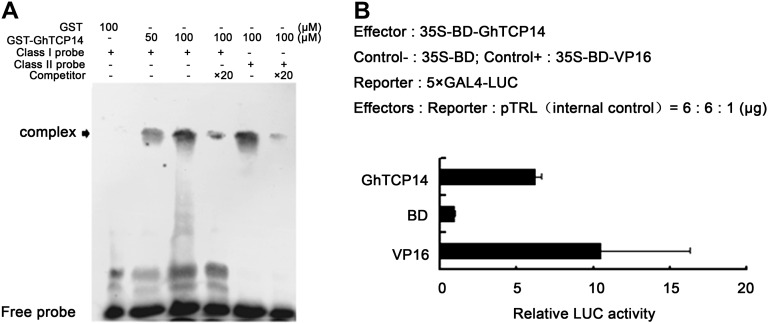
Figure 1.
Figure 1.
DNA-binding specificity and transcriptional activation activity of GhTCP14. A, Gel-shift assay. GhTCP14 proteins were incubated with biotin-labeled probes (class I probe: 2×TGGGTCCCACAT and class II probe: 2×TTGTGGGCCCCT) in the presence or absence of 20-fold excess of nonlabeled competitor. Arrow indicates the position of protein-DNA complexes. B, Transcriptional activation ability of GhTCP14 in Arabidopsis protoplasts. The GAL4 DNA-binding domain (BD) and BD-VP16 were used as negative or positive control, respectively. Error bars represent the sd of three biological replicates.
Figure 2.
Figure 2.
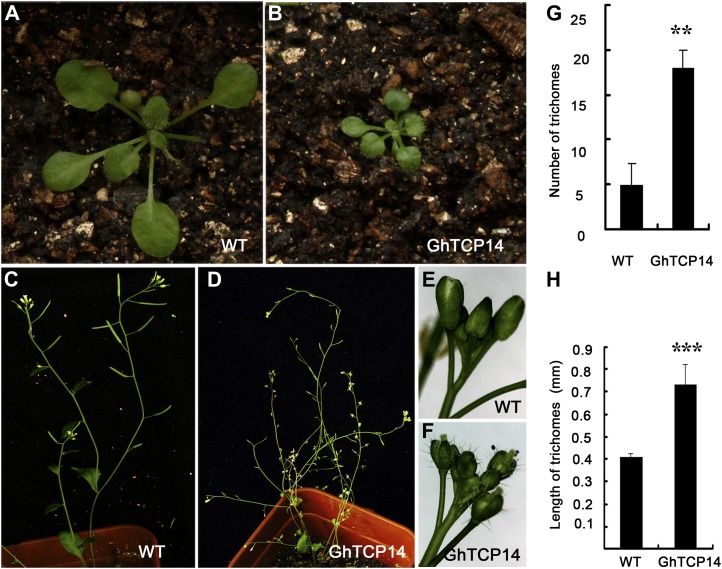
Phenotypes of transgenic Arabidopsis plants overexpressing GhTCP14 under 35S promoter. A and B, Three-week-old wild-type (A) and transgenic (B) seedlings. C and D, Six-week-old wild-type (C) and transgenic (D) plants. E and F, Trichomes on sepals of wild-type (E) and transgenic (F) plants. G and H, Quantitative analyses of the number (G) and length (H) of sepal trichomes. Error bars represent the sd of three biological replicates (n = 30 each). Asterisks denote values statistically different from the corresponding wild-type controls (** P < 0.01, *** P < 0.001). WT, Wild type. [See online article for color version of this figure.]
Figure 3.
Figure 3.
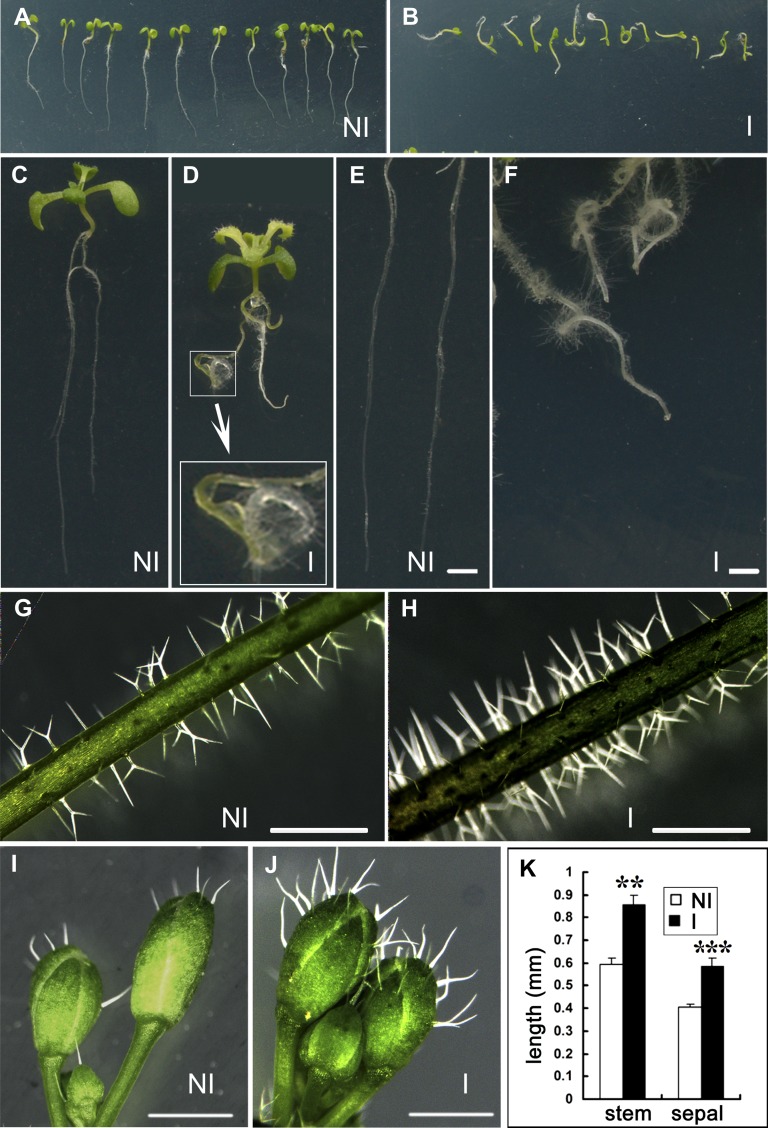
Phenotypes of pER8:GhTCP14 transgenic Arabidopsis plants. A and B, Seeds directly sown on noninducing (A) or inducing (B) medium with 10 µm estradiol and grown for 5 d. C and D, Four-day-old seedlings transferred to noninducing (C) or inducing (D) medium and grown for 7 d. E and F, Root hairs of plants grown under noninducing (E) or inducing (F) conditions. G to J, Trichomes on stems (G and H) and sepals (I and J) of plants grown under noninducing (G and I) or inducing (H and J) conditions. K, Quantitative analysis of trichome length. Error bars represent the sd of three biological repeats (n = 30 each). Asterisks denote values statistically different from the corresponding wild-type controls (** P < 0.01, *** P < 0.001). NI, Noninduced; I, induced. Bars = 1 mm. [See online article for color version of this figure.]
Figure 4.
Figure 4.
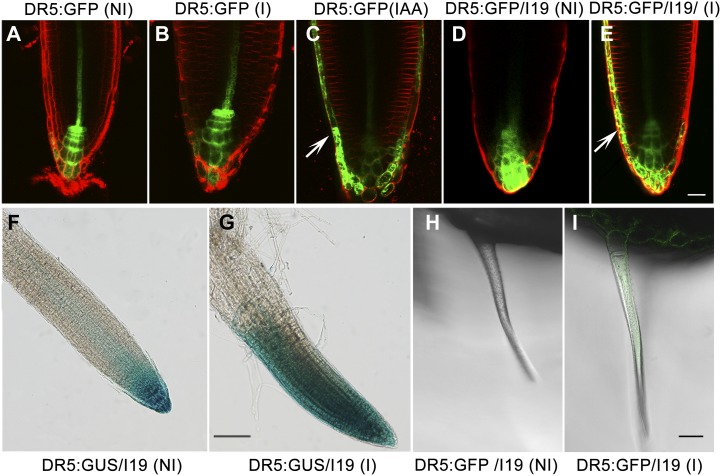
Effects of GhTCP14 on the expression of auxin-responsive reporter genes and auxin distribution. A to C, Root tips of DR5:GFP plants grown on noninducing medium (A), inducing medium (B), or medium containing 1 µm IAA (C). D and E, Root tips of DR5:GFP × pER8:GhTCP14 transgenic plants grown on noninducing (D) or inducing (E) medium. F and G, Root tips of DR5:GUS × pER8:GhTCP14 plants grown on noninducing (F) or inducing (G) medium. H and I, Sepal trichomes of DR5:GFP × pER8:GhTCP14 plants grown on noninducing (H) or inducing (I) medium. Arrows show fluorescent signals in the lateral root cap cells. NI, Noninduced; I, induced; I19, pER8:GhTCP14. Bars = 25 µm (A–E), 30 µm (F and G), and 100 µm (H and I). [See online article for color version of this figure.]
Figure 5.
Figure 5.
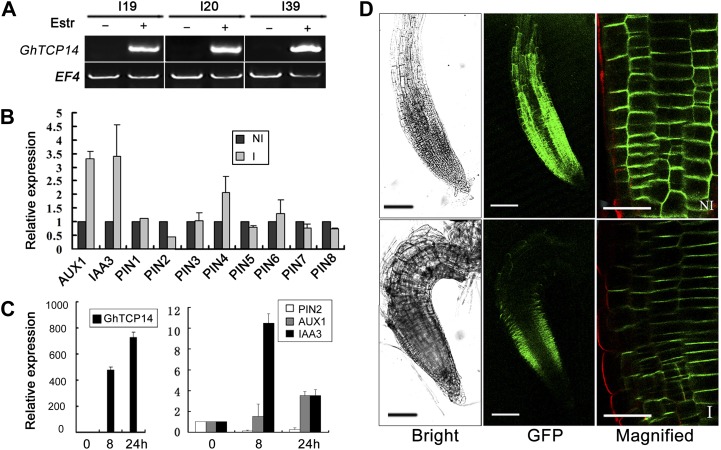
Effects of GhTCP14 on the expression of auxin-related genes. A, Induction of GhTCP14 expression in pER8:GhTCP14 transgenic lines (I19, I20, and I39) analyzed by RT-PCR. The elongation factor gene (EF4) was used as an internal control. B, Quantitative RT-PCR analysis of the expression of genes related to auxin transport or auxin response in pER8:GhTCP14 plants grown on noninducing (NI) or inducing (I) medium. C, Time curse expressions of GhTCP14 (left) and some auxin-related genes (right). Line I19 plants were grown in liquid medium and harvested at 8 or 24 h after supplementation with 10 µm estradiol. For B and C, Actin2 was used as an internal control. Error bars represent the sd of three biological replicates, and value of the noninduced plants was set to 1. D, Expression of PIN2-GFP under the PIN2 promoter in root tips of pER8:GhTCP14 plants grown on noninducing (top) or inducing (bottom) medium. Bars = 100 µm (left and middle) and 20 µm (right). [See online article for color version of this figure.]
Figure 6.
Figure 6.
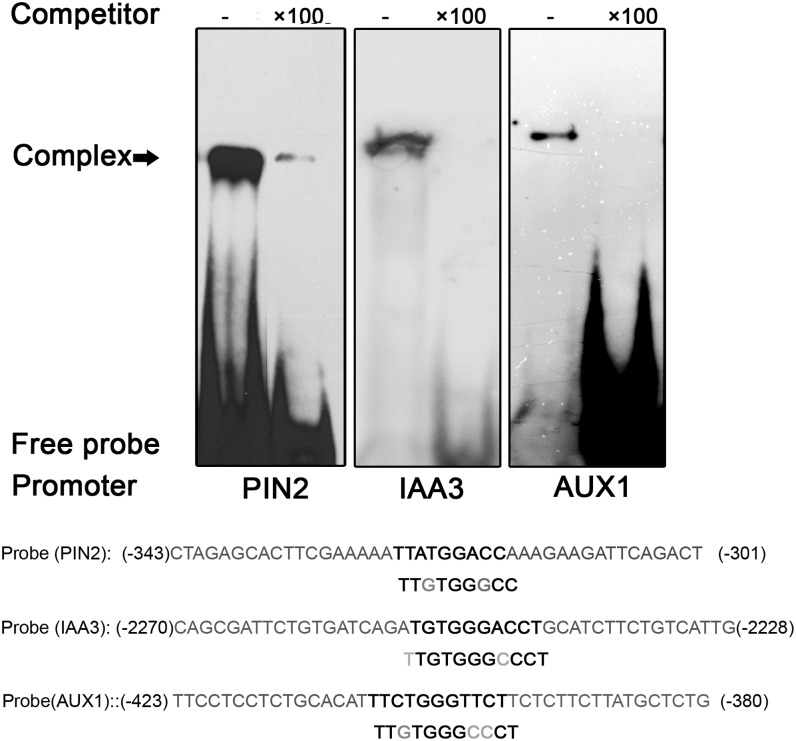
Binding of GhTCP14 to AUX1, PIN2, and IAA3 promoter sequences. EMSA analysis was conducted with the recombinant GhTCP14 proteins and DNA sequences containing the promoter region of PIN2, IAA3, and AUX1 genes, respectively. The promoter sequences used in EMSA are shown in the bottom portion of the figure. Numbers indicate positions relative to the translation start site of the corresponding gene. Putative TCP binding sequences are in bold.
Figure 7.
Figure 7.
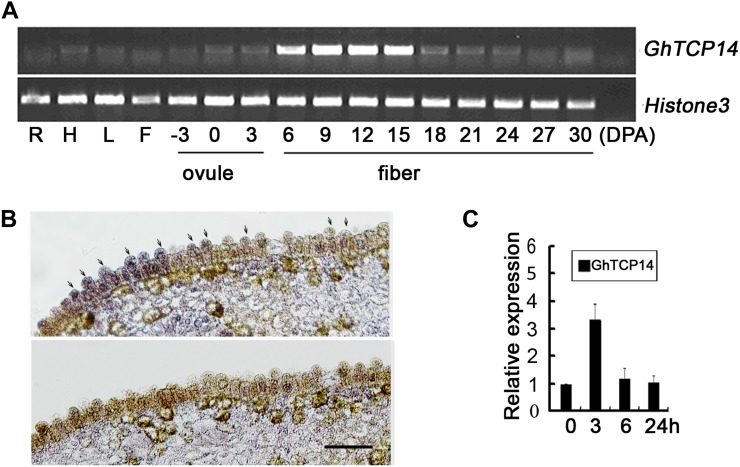
Expression of GhTCP14 in cotton. A, Transcript profile of GhTCP14 in cotton. R, Root; H, hypcotyl; L, leaf; F, flower. The developmental stages of ovule and fiber are indicated as DPA. The Histone3 gene was used as an internal control. B, In situ hybridization of GhTCP14 transcripts in the ovule (0 DPA) of cotton with antisense (top) and sense (bottom) probes. Arrows show hybridization signals in fiber initials. Bar = 100 µm. C, Expression of GhTCP14 induced by IAA. Quantitative RT-PCR analysis was conducted with the total RNAs extracted from 1-DPA cotton ovules with fiber initials. The value of untreated ovules was set to 1. Error bars represent the sd of three biological repeats. [See online article for color version of this figure.]
Figure 8.
Figure 8.
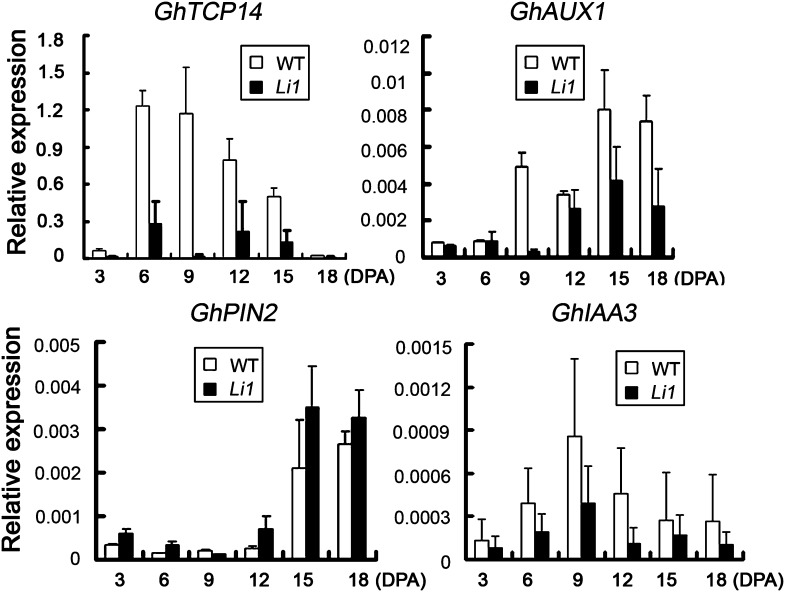
Expression of GhTCP14, GhAUX1, GhPIN2, and GhIAA3 genes in the wild type and Li1 mutant. Quantitative RT-PCR analysis was conducted with the total RNAs extracted from ovules (3 DPA) and fiber cells (6–18 DPA). The Histone3 gene was used as the internal control. Error bars represent the sd of three biological replicates.

References

    1. Basra AS, Malik CP. (1984) Development of the cotton fibre. Int Rev Cytol 87: 65–113
    1. Benjamins R, Scheres B. (2008) Auxin: the looping star in plant development. Annu Rev Plant Biol 59: 443–465 - PubMed
    1. Bennett MJ, Marchant A, Green HG, May ST, Ward SP, Millner PA, Walker AR, Schulz B, Feldmann KA. (1996) Arabidopsis AUX1 gene: a permease-like regulator of root gravitropism. Science 273: 948–950 - PubMed
    1. Cedroni ML, Cronn RC, Adams KL, Wilkins TA, Wendel JF. (2003) Evolution and expression of MYB genes in diploid and polyploid cotton. Plant Mol Biol 51: 313–325 - PubMed
    1. Cho M, Lee SH, Cho HT. (2007) P-glycoprotein4 displays auxin efflux transporter-like action in Arabidopsis root hair cells and tobacco cells. Plant Cell 19: 3930–3943 - PMC - PubMed

Publication types

MeSH terms

Associated data