Review
. 2013 Jun;140(12):2472-83.
doi: 10.1242/dev.093187.

How to make a functional β-cell

Affiliations
Review

How to make a functional β-cell

Felicia W Pagliuca et al. Development. 2013 Jun.

Abstract

Insulin-secreting pancreatic β-cells are essential regulators of mammalian metabolism. The absence of functional β-cells leads to hyperglycemia and diabetes, making patients dependent on exogenously supplied insulin. Recent insights into β-cell development, combined with the discovery of pluripotent stem cells, have led to an unprecedented opportunity to generate new β-cells for transplantation therapy and drug screening. Progress has also been made in converting terminally differentiated cell types into β-cells using transcriptional regulators identified as key players in normal development, and in identifying conditions that induce β-cell replication in vivo and in vitro. Here, we summarize what is currently known about how these strategies could be utilized to generate new β-cells and highlight how further study into the mechanisms governing later stages of differentiation and the acquisition of functional capabilities could inform this effort.

Keywords: Diabetes mellitus; Mammalian metabolism; β cell.


Figures
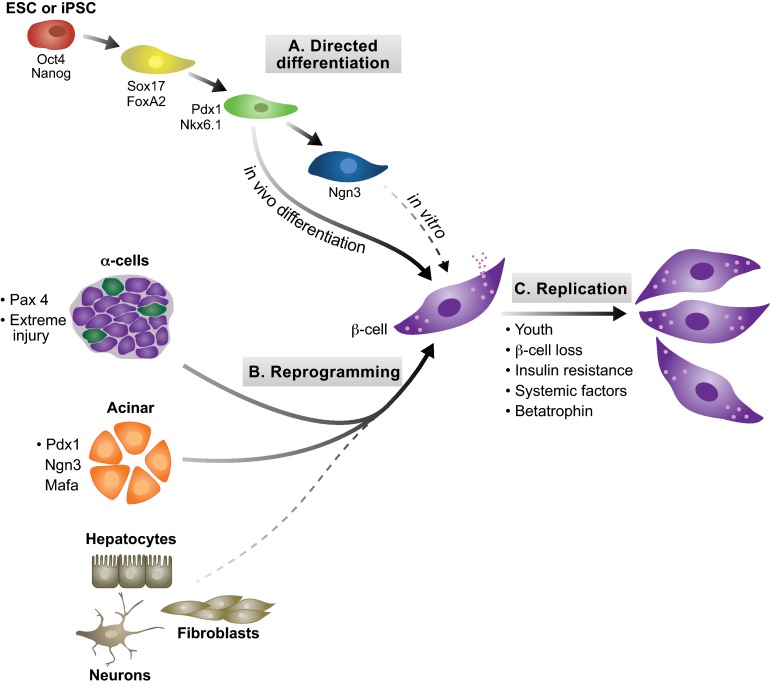
Fig. 1.
Fig. 1.
Strategies to generate new β-cells. (A) Directed differentiation using growth factors and small molecules can direct a pluripotent stem cell (red) through the stages of pancreatic differentiation in a manner that mimics normal development. Currently, functional β-cells can only be differentiated through an in vivo transplantation step, but deriving a bona fide β-cell fully in vitro (dashed line) is a major goal. A subset of important genes expressed at each stage is listed. (B) Reprogramming of terminally differentiated cell types, such as acinar or α-cells, can be used to generate β-cells in vivo, using the overexpression or injury strategies listed. Reprogramming other mature cell types, such as hepatocytes, fibroblasts or neurons, in vitro into β-cells (dashed line) remains to be achieved. (C) Inducing the replication of existing β-cells is the primary strategy for generating new endogenous β-cells. Replication may be recapitulated in vitro or induced in vivo with new small molecules or proteins based on the strategies listed.
Fig. 2.
Fig. 2.
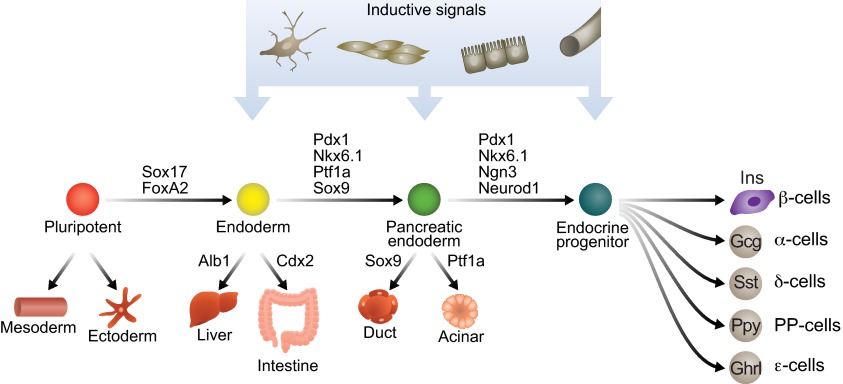
An overview of fate choices during normal β-cell development. Pluripotent cells first acquire the identity of one of three germ layers; pancreatic cells arise from the endodermal layer. A subset of endoderm is specified by Pdx1 expression to become pancreatic endoderm, which will subsequently differentiate to a pancreatic ductal, acinar or endocrine fate. Endocrine progenitors express Ngn3 and differentiate further into the five hormone-expressing cell types of the islet according, at least in part, to which other transcription factors are expressed. A subset of relevant transcription factors is listed. For a more extensive review, see Pan and Wright (Pan and Wright, 2011). Ins, insulin; Gcg, glucagon; Sst, somatostatin; Ppy, pancreatic polypeptide; Ghrl, ghrelin.
Fig. 3.
Fig. 3.
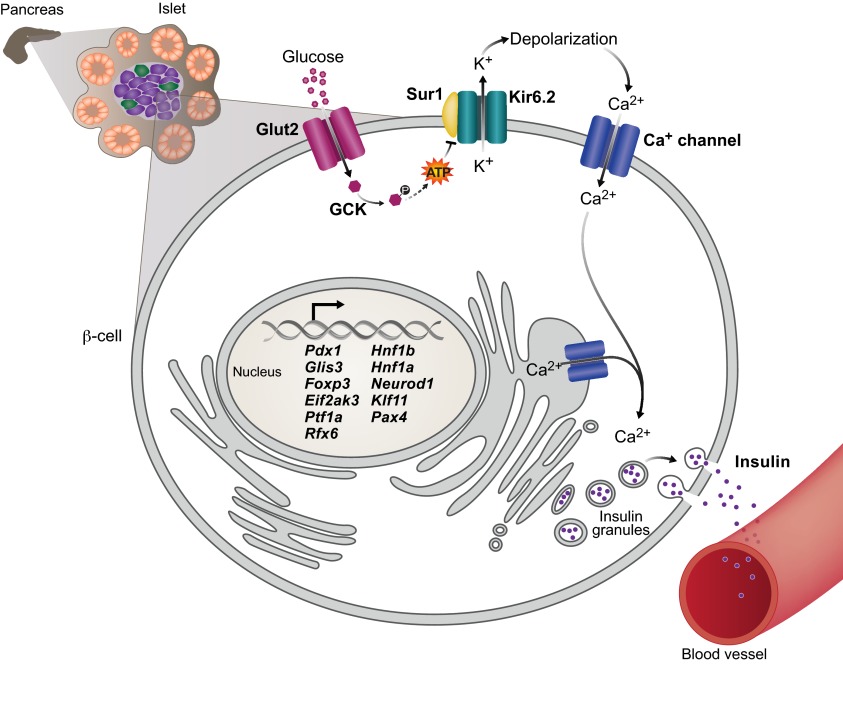
Functional β-cells respond to increasing glucose levels by increasing insulin secretion. In glucose-stimulated insulin secretion (GSIS), glucose is transported into the cell via glucose transporters [e.g. Glut1 (Slc2a1) or Glut2 (Slc2a2), pink], where it is phosphorylated by glucokinase (GCK) and converted into ATP by subsequent metabolic reactions. Rising ATP levels (e.g. rising ATP:ADP ratios) trigger the closure of potassium channels [Sur1 (Abcc8) and Kir6.2 (Kcnj11) subunits], membrane depolarization, and the opening of calcium channels (blue). The resultant rise in intracellular calcium levels triggers the exocytosis of insulin-containing granules and hence leads to increased insulin levels in adjacent blood vessels. Human genetic studies of maturity onset diabetes of the young (MODY) patients have identified a number of mutations that trigger diabetes, including those in genes encoding transcription factors (depicted in the nucleus) and components of the GSIS pathway indicated in this figure.
Fig. 4.
Fig. 4.
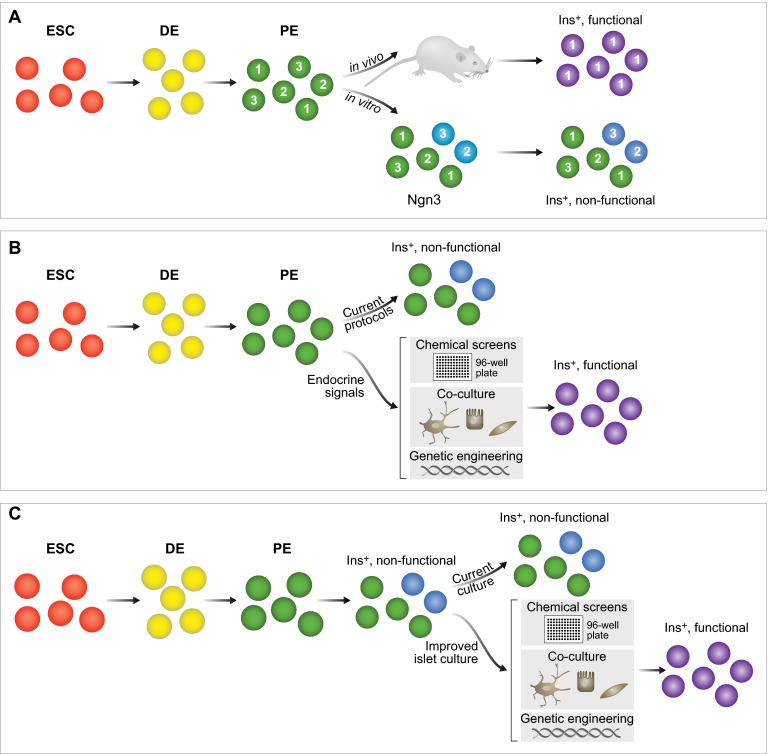
Identifying how to improve directed differentiation into β-cells. (A) Lineage tracing of ESC-derived pancreatic endoderm could reveal how heterogeneous this population is and which cells are competent to generate functional β-cells in vivo. Depicted is a hypothetical outcome whereby pancreatic progenitor cell type 1, but not types 2 or 3, generates functional β-cells in the graft. Types 2 and 3 may turn on insulin expression in vitro but may not be functional, and in vitro cues may be insufficient to direct further differentiation of the type 1 cells. (B) Chemical screening for novel small molecules or growth factors, co-culture with instructive cell types or genetic engineering strategies might be necessary to trigger the in vitro differentiation of pancreatic endoderm cells into functional endocrine cells that express the normal set of transcription factors. (C) Current islet culture conditions are not optimal for inducing the function of the insulin-positive cells made in the dish. Thus, in vitro derived cells might not be instructed to function in the absence of appropriate culture conditions. The identification of novel culture conditions will improve the chances of generating β-cells in vitro. DE, definitive endoderm; PE, pancreatic endoderm.

References

    1. Ang S. L., Rossant J. (1994). HNF-3 beta is essential for node and notochord formation in mouse development. Cell 78, 561-574 - PubMed
    1. Annes J. P., Ryu J. H., Lam K., Carolan P. J., Utz K., Hollister-Lock J., Arvanites A. C., Rubin L. L., Weir G., Melton D. A. (2012). Adenosine kinase inhibition selectively promotes rodent and porcine islet β-cell replication. Proc. Natl. Acad. Sci. USA 109, 3915-3920 - PMC - PubMed
    1. Apelqvist A., Ahlgren U., Edlund H. (1997). Sonic hedgehog directs specialised mesoderm differentiation in the intestine and pancreas. Curr. Biol. 7, 801-804 - PubMed
    1. Apelqvist A., Li H., Sommer L., Beatus P., Anderson D. J., Honjo T., Hrabe de Angelis M., Lendahl U., Edlund H. (1999). Notch signalling controls pancreatic cell differentiation. Nature 400, 877-881 - PubMed
    1. Araki R., Uda M., Hoki Y., Sunayama M., Nakamura M., Ando S., Sugiura M., Ideno H., Shimada A., Nifuji A., et al. (2013). Negligible immunogenicity of terminally differentiated cells derived from induced pluripotent or embryonic stem cells. Nature 494, 100-104 - PubMed

Publication types

MeSH terms