. 2013 Sep 1;208(5):720-7.
doi: 10.1093/infdis/jit240. Epub 2013 May 28.

Analysis of nontypeable haemophilus influenzae phase-variable genes during experimental human nasopharyngeal colonization

Affiliations

Analysis of nontypeable haemophilus influenzae phase-variable genes during experimental human nasopharyngeal colonization

Jessica Poole et al. J Infect Dis. .

Abstract

Background: Studies of nontypeable Haemophilus influenzae (NTHi) have demonstrated that a number of genes associated with infectivity have long repeat regions associated with phase variation in expression of the respective gene. The purpose of this study was to determine the genes that underwent phase variation during a 6-day period of experimental human nasopharyngeal colonization.

Methods: Strain NTHi 2019Str(R)1 was used to colonize the nasopharynx of human subjects in a study of experimental colonization. Thirteen phase-variable genes were analyzed in NTHi 2019Str(R)1. Samples of NTHi 2019Str(R)1 were cultured from subjects during the 6-day colonization period. We used capillary electrophoresis and Roche 454 pyrosequencing to determine the number of repeats in each gene from each sample.

Results: A significant number of samples switched licA and igaB from phase off in the inoculated strain to phase on during the 4-day period of observation. lex2A also showed variability as compared to baseline, but the differences were not significant. The remaining genes showed no evidence of phase variation.

Conclusions: Our studies suggest that the phase-on genotypes of licA and igaB are important for early human nasopharynx colonization. lex2A showed a trend from phase off to phase on, suggesting a potentially important role in the colonization process.

Keywords: Haemophilus influenzae; igaB; lex2A nasopharyngeal colonization; licA; phase variation.


Figures
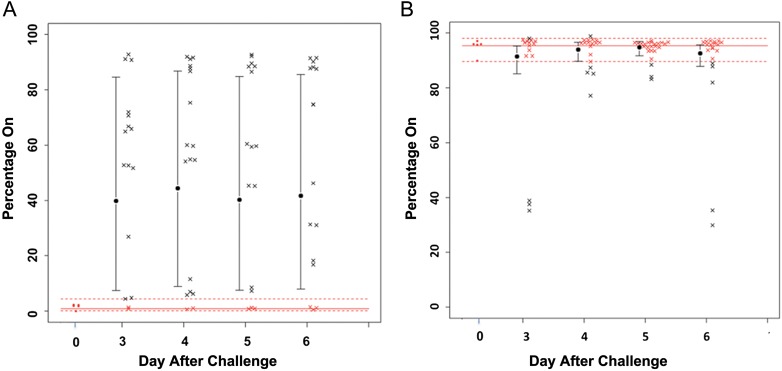
Figure 1.
Figure 1.
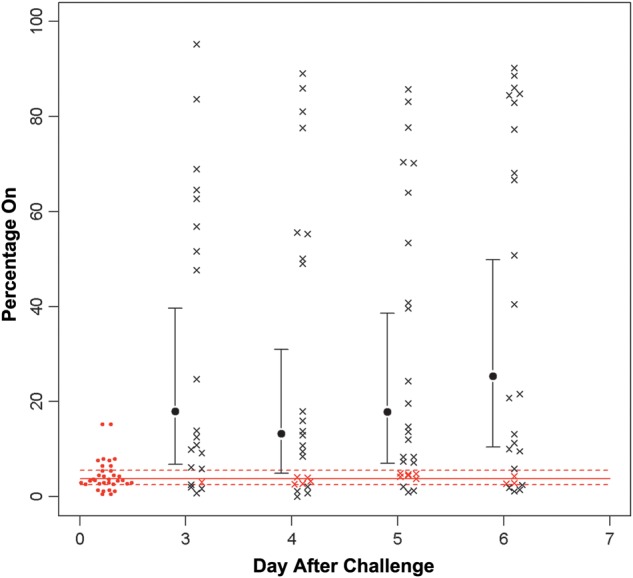
Changes in the expression status (percentage phase on) for licA (A) and lic3A (B) undergoing phase variation in samples during the experimental human nasopharyngeal colonization study. Samples from 9 subjects in the multidose study were examined in this analysis. Each data point represents measurement of an individual sample. Percentage on was determined by capillary electrophoresis of polymerase chain reaction products. As can be seen, licA shows a shift from predominantly phase off in the inoculation strain (day 0) to significantly phase on at each time point over this period, while lic3A stays phase on in the inoculation strain and during the colonization period. The red open circles indicate the percentage phase on in the inoculation strain. The dotted lines represent the 95% confidence interval of the inoculation strain phase-on value. Each black × represents a sample with a phase-on value outside the interval, and each red × represents a sample within the interval.
Figure 2.
Figure 2.
Results of 454 pyrosequencing analysis of phase variation of licA during the colonization period. Samples from all 15 subjects were analyzed by pyrosequencing. The solid red line is the mean phase on in the inoculation samples, and the dotted lines represent the 95% confidence intervals. As can be seen, there is a significant shift in the samples to phase on in the inoculation strain (day 0) over the colonization period. The red open circles indicate the percentage phase on in the inoculation strain. Each black × represents a sample outside of the 95% confidence interval of the inoculation strain, whereas each red × represents a sample within that interval. The differences seen between the inoculation strain and the sample were statistically significant except on day 3.
Figure 3.
Figure 3.
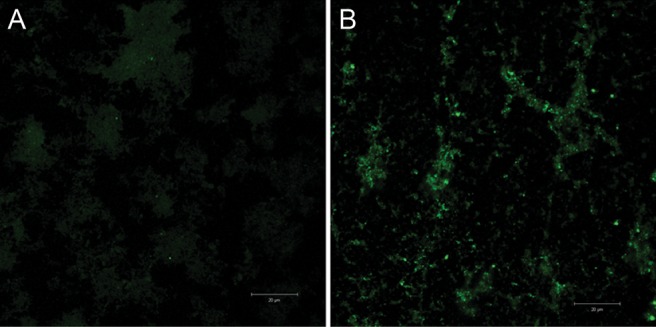
Fluorescent antibody study (original magnification, ×100) showing differences in expression of phosphorylcholine on the inoculation strain, nontypeable Haemophilus influenzae 2019StrR1, and the sample recovered from subject 10 on day 6. Monoclonal antibody 12D9, which is specific for the phosphorylcholine, was used. This study demonstrates the phenotypic change consistent with a phase-on genotype. The white lines indicate 20 microns.
Figure 4.
Figure 4.
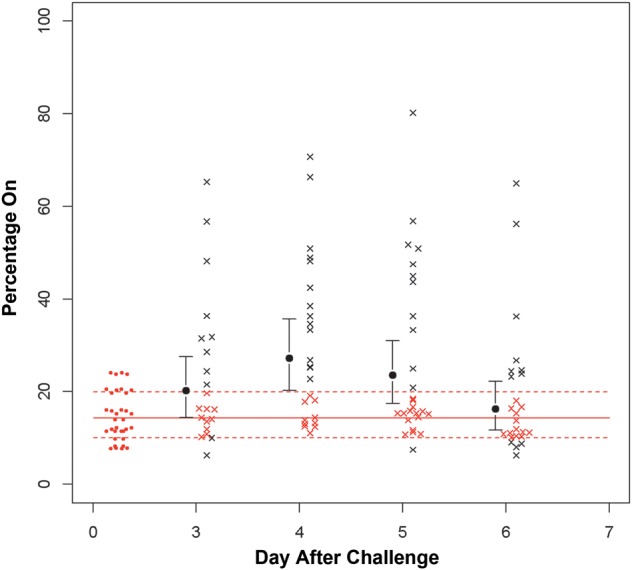
Results of 454 pyrosequencing analysis of phase variation of lex2A during the colonization period. The solid red line is the mean phase on in the inoculation samples, and the dotted lines represent the 95% confidence intervals. As can be seen, there is a shift in the samples to phase on on day 4 of the colonization period, which does not persist into day 6. The red open circles indicate the percentage phase on in the inoculation strain. Each black × represents a sample outside of the 95% confidence interval of the inoculation strain, while each red × represents a sample within that interval.
Figure 5.
Figure 5.
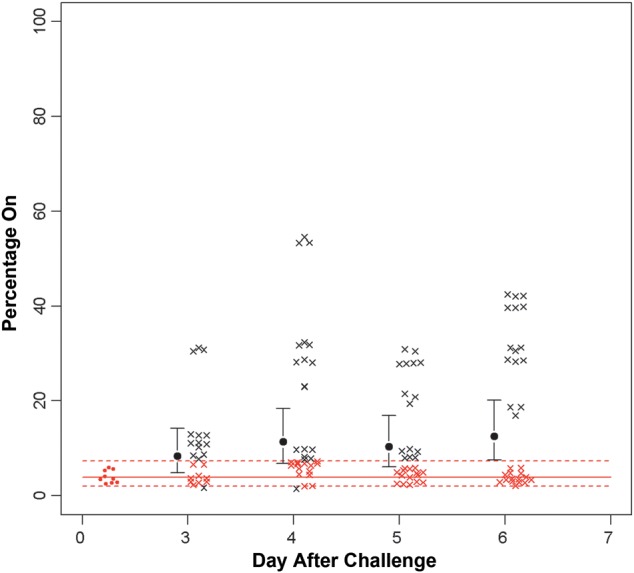
Results of capillary electrophoresis analysis of phase variation of iga during the colonization period. The solid red line is the mean phase on in the inoculation samples, and the dotted lines represent the 95% confidence intervals. The majority of samples within the inoculation strain (day 0) are phase off. As can be seen, there is a progressive shift in the samples to phase on, and by day 6 this difference is significant. The red open circles indicate the percentage phase on in the inoculation strain. Each black × represents a sample outside of the 95% confidence interval of the inoculation strain, while each red × represents a sample within that interval.

Comment in

References

    1. Weiser JN. The generation of diversity by Haemophilus influenzae. Trends in Microbiology. 2000;8:433–5. - PubMed
    1. van der Woude MW. Phase variation: how to create and coordinate population diversity. Curr Opin Microbiol. 2011;14:205–11. - PubMed
    1. De Bolle X, Bayliss CD, Field D, et al. The length of a tetranucleotide repeat tract in Haemophilus influenzae determines the phase variation rate of a gene with homology to type III DNA methyltransferases. Molecular Microbiology. 2000;35:211–22. - PubMed
    1. Weiser JN, Love JM, Moxon ER. The molecular mechanism of phase variation of H. influenzae lipopolysaccharide. Cell. 1989;59:657–65. - PubMed
    1. Weiser JN, Maskell DJ, Butler PD, Lindberg AA, Moxon ER. Characterization of repetitive sequences controlling phase variation of Haemophilus influenzae lipopolysaccharide. Journal of Bacteriology. 1990;172:3304–9. - PMC - PubMed

Publication types

MeSH terms

Substances