. 2013 Aug;62(8):1369-80.
doi: 10.1007/s00262-013-1441-7. Epub 2013 May 30.

Evaluating combinations of costimulatory antibody-ligand fusion proteins for targeted cancer immunotherapy

Affiliations

Evaluating combinations of costimulatory antibody-ligand fusion proteins for targeted cancer immunotherapy

Nora Hornig et al. Cancer Immunol Immunother. 2013 Aug.

Abstract

Combinatory strategies are becoming of increasing interest in cancer immunotherapy. Costimulation by individual members of the immunoglobulin-like (Ig)- and TNF superfamily have already shown promising antitumor potential, thus prompting the exploration of their synergistic abilities in combinatorial approaches. Here, we pursued a targeted strategy with antibody-fusion proteins composed of a tumor-directed antibody and the extracellular domain of the costimulatory ligand B7.1, 4-1BBL, OX40L, GITRL or LIGHT, respectively. Costimulatory activity was assessed in an experimental setting where initial T cell activation was induced by a bispecific antibody (tumor-related antigen × CD3). Advantage of combined targeted costimulation was shown for either B7.1 or 4-1BBL with OX40L, GITRL, LIGHT and 4-1BBL in terms of T cell proliferation and IFN-γ release. Since encouraging results were obtained by the combination of B7.1 and 4-1BBL, we adapted the model system for a time-shift setting. Here, enhanced proliferation and granzyme B expression as well as reduced PD-1 expression on the T cell population demonstrated the benefit of costimulation-assisted restimulation. Finally, the antitumor potential of this combinatorial setting was confirmed in vivo in a lung metastasis mouse model. Thus, combinatorial approaches with costimulatory antibody-ligand fusion proteins seem a promising strategy to be further investigated for cancer immunotherapy.


Conflict of interest statement

The authors declare that they have no conflict of interest.

Figures
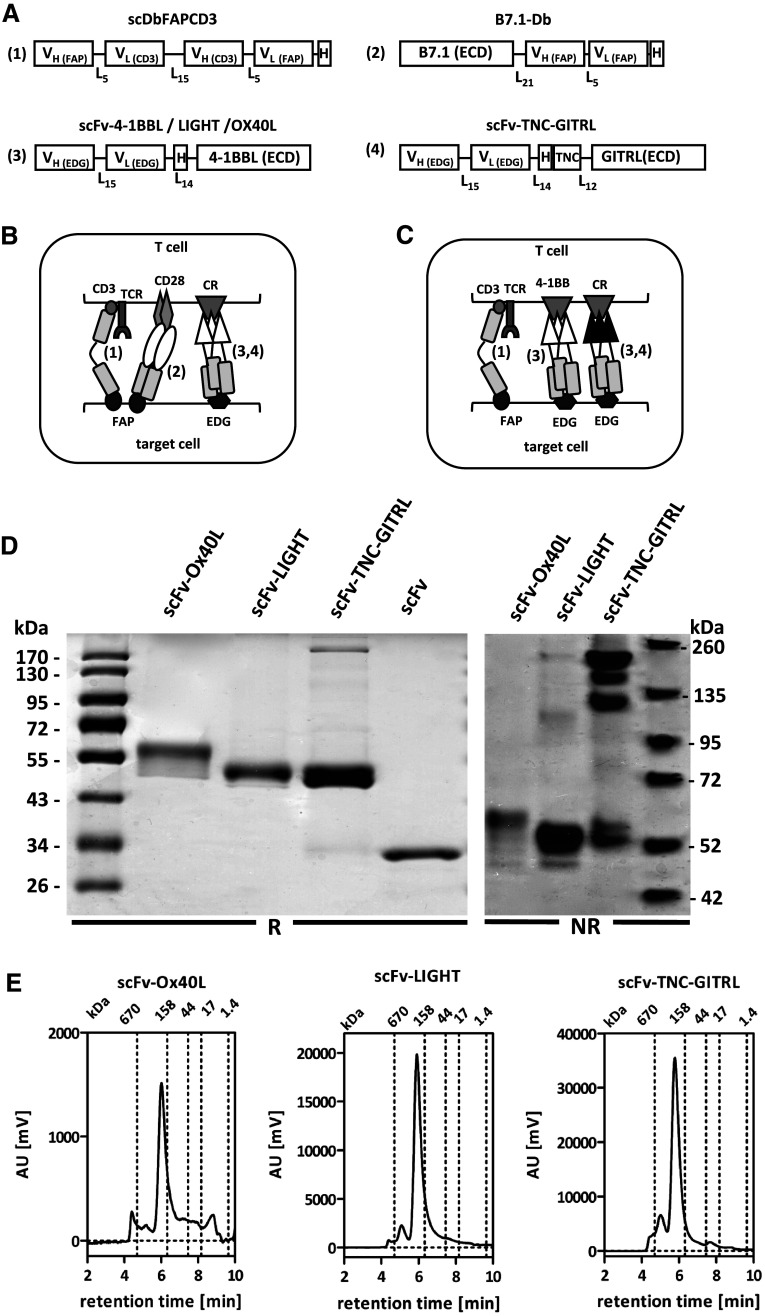
Fig. 1
Fig. 1
a Modular schema of the bispecific antibody and antibody–ligand fusion proteins. V H/L variable region of the heavy/light antibody chain, FAP fibroblast activation protein, EDG endoglin, scDb single-chain diabody, Db diabody, ECD extracellular domain, H Histidine tag, TNF tenascin, L n linker of n amino acids. Schema of the combinatorial settings: b targeting scDb/B7-Db to FAP and the scFv-ligand to endoglin; c Targeting scDb to FAP and scFv-4-1BBL plus a second scFv-ligand to EDG. CR costimulatory receptor. d SDS-PAGE analysis of the scFv–ligand fusion proteins (3 μg/lane) under reducing (R) and non-reducing (NR) conditions on a 12 % SDS-PAGE and 4–12 % Bis–Tris Gel, respectively; Coomassie staining. e HPLC analysis on a TSK-GEL G3000SWXL column (Tosoh Bioscience) of scFv-OX40L (2 μg), scFv-LIGHT (15 μg) and scFv-TNC-GITRL (15 μg). Mobile phase was PBS at a flow rate of 0.5 ml/min
Fig. 2
Fig. 2
Functional properties of scFv-OX40L, scFv-LIGHT and scFv-TNC-GITRL. a Antibody binding by flow cytometry. HT1080-FAP (EDG+) and HEK293 (EDG) cells were incubated with 300 nM scFv-ligand. Bound construct were detected by an anti-hexahistidyl-tag-PE conjugated antibody. Gray filled: cells only; gray line: detection antibody only; black line: scFv-ligand followed by detection antibody. b Ligand activity of the fusion proteins in coated and soluble form. scDbFAPCD3 was coated and incubated with CFSE-labled PBMC together with scFv-ligand (50nM) presented either coated or in solution. Proliferation was determined after 4 days by flow cytometry. [n = 3. Mean ± SD, One-way ANOVA, Tukey post test, *p < 0.05, **p < 0.01, ***p < 0.0001]. c Costimulatory properties of the fusion proteins in a cellular assay. Target cells (HT1080-FAP) were incubated with scDb in combination with the scFv-ligands for 1 h before the addition of CFSE-labeled PBMC. Proliferation of PBMC was measured after 4 days by flow cytometry
Fig. 3
Fig. 3
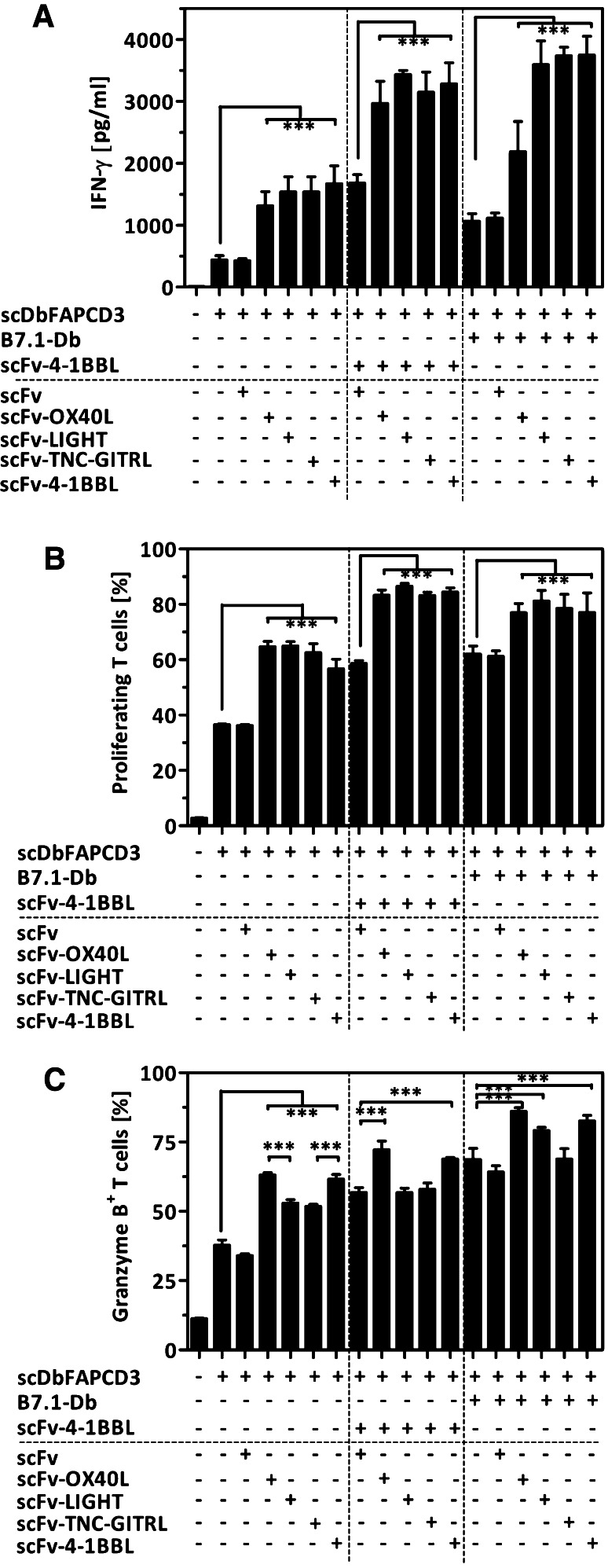
Costimulatory effects mediated by the combined application of the antibody-fusion protein panel. Target cells (HT1080-FAP) were cocultured with PBMCs in presence of scDb (16 pM) in combination with one or two costimulatory antibody-fusion proteins (10 nM). a IFN-γ-release was measured after 4 days by Sandwich-ELISA. b Proliferation of T cells was determined (CFSE/anti-CD3-PerCP) after 7 days by flow cytometry. c Cytotoxic potential of T cells was measured after 7 days via granzyme B staining. Therefore, PBMC were fixed, permeabilized and granzyme B expressing T cells identified (anti-CD3-FITC/anti-granzyme B-PE) by flow cytometry. [n = 3. Mean ± SD, One-way ANOVA, Tukey post test, *p < 0.05, **p < 0.01, ***p < 0.0001]
Fig. 4
Fig. 4
Costimulatory effects of the combination of B7.1-Db and scFv-4-1BBL in a time-shift setting. HT1080-FAP cells were incubated with scDbFAPCD3 (33 pM) for 1 h, followed by washing and the addition of PBMC. After 3 days, PBMC were transferred to a well with freshly seeded HT1080-FAP and cocultured for another 7 days. For restimulation purpose, HT108-FAP had been previously incubated with the scDb (33 pM), followed by washing. Costimulation was applied by the addition of B7.1-Db (10 nM) and scFv-4-1BBL (10 nM) either simultaneously during initial stimulation or during restimulation with the scDb. Alternatively, B7.1-Db was applied together with initial scDb-mediated stimulation followed by scDb-mediated restimulation in presence of scFv-4-1BBL. T cell proliferation (a) and expression of granzyme B (b), PD-1 (c) and CTLA-4 (d) was measured after 7 days via flow cytometry. [n = 3. Mean ± SD, One-way ANOVA, Tukey post test, *p < 0.05, **p < 0.01, ***p < 0.0001]
Fig. 5
Fig. 5
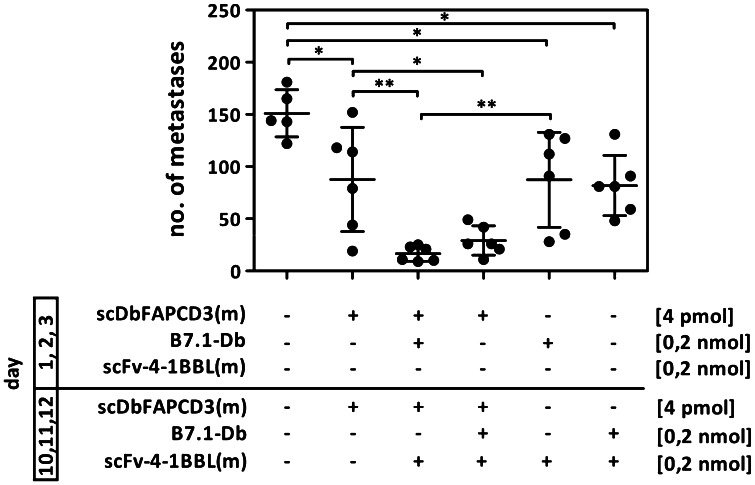
Antitumor effect of the combined treatment with scDb(m), B7.1-Db and scFv-4-1BBL(m) in a metastatic tumor mouse model. C57BL/6 mice were injected i.v. with B16-FAP cells on day 0. Treatment with the scDb(m) (4 pmol) and the antibody–ligand fusion proteins (0.2 nmol) in the indicated combinations were performed once a day on day 1, 2, 3, 10, 11 and 12. Lungs were removed on day 21 and metastasis counted. [n = 5–6 mice/group, One-way ANOVA, *p < 0.05, **p < 0.01, ***p < 0.001]

References

    1. Pardoll D, Drake C. Immunotherapy earns its spot in the ranks of cancer therapy. J Exp Med. 2012;209(2):201–209. doi: 10.1084/jem.20112275. - DOI - PMC - PubMed
    1. Schaer DA, Murphy JT, Wolchok JD. Modulation of GITR for cancer immunotherapy. Curr Opin Immunol. 2012;24(2):217–224. doi: 10.1016/j.coi.2011.12.011. - DOI - PMC - PubMed
    1. Melero I, Martinez-Forero I, Dubrot J, Suarez N, Palazón A, Chen L. Palettes of vaccines and immunostimulatory monoclonal antibodies for combination. Clin Cancer Res. 2009;15(5):1507–1509. doi: 10.1158/1078-0432.CCR-08-2931. - DOI - PMC - PubMed
    1. Takeda K, Kojima Y, Uno T, Hayakawa Y, Teng MW, Yoshizawa H, Yagita H, Gejyo F, Okumura K, Smyth MJ. Combination therapy of established tumors by antibodies targeting immune activating and suppressing molecules. J Immunol. 2010;184(10):5493–5501. doi: 10.4049/jimmunol.0903033. - DOI - PubMed
    1. Serghides L, Bukczynski J, Wen T, Wang C, Routy JP, Boulassel MR, Sekaly RP, Ostrowski M, Bernard NF, Watts TH. Evaluation of OX40 ligand as a costimulator of human antiviral memory CD8 T cell responses: comparison with B7.1 and 4–1BBL. J Immunol. 2005;175(10):6368–6377. - PubMed

Publication types

MeSH terms