


Structure-antifungal activity relationships of polyene antibiotics of the amphotericin B group
- PMID: 23716057
- PMCID: PMC3719701
- DOI: 10.1128/AAC.00270-13
Structure-antifungal activity relationships of polyene antibiotics of the amphotericin B group
Abstract
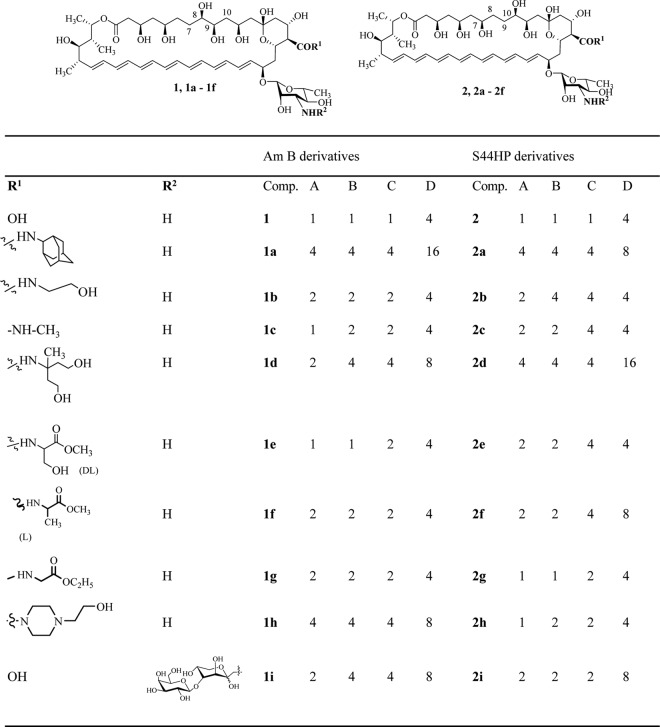
A comprehensive comparative analysis of the structure-antifungal activity relationships for the series of biosynthetically engineered nystatin analogues and their novel semisynthetic derivatives, as well as amphotericin B (AMB) and its semisynthetic derivatives, was performed. The data obtained revealed the significant influence of the structure of the C-7 to C-10 polyol region on the antifungal activity of these polyene antibiotics. Comparison of positions of hydroxyl groups in the antibiotics and in vitro antifungal activity data showed that the most active are the compounds in which hydroxyl groups are in positions C-8 and C-9 or positions C-7 and C-10. Antibiotics with OH groups at both C-7 and C-9 had the lowest activity. The replacement of the C-16 carboxyl with methyl group did not significantly affect the in vitro antifungal activity of antibiotics without modifications at the amino group of mycosamine. In contrast, the activity of the N-modified derivatives was modulated both by the presence of CH3 or COOH group in the position C-16 and by the structure of the modifying substituent. The most active compounds were tested in vivo to determine the maximum tolerated doses and antifungal activity on the model of candidosis sepsis in leukopenic mice (cyclophosphamide-induced). Study of our library of semisynthetic polyene antibiotics led to the discovery of compounds, namely, N-(L-lysyl)-BSG005 (compound 3n) and, especially, L-glutamate of 2-(N,N-dimethylamino)ethyl amide of S44HP (compound 2j), with high antifungal activity that were comparable in in vitro and in vivo tests to AMB and that have better toxicological properties.
Figures



References
-
- Borowski E. 2000. Novel approaches in the rational design of antifungal agents of low toxicity. Farmaco 55:206–208 - PubMed
-
- Jarzebskyi A, Falkowski L, Borowski E. 1987. Synthesis and structure-activity relationships of amides of amphotericin B. J. Antibiot. 40:1023–1027 - PubMed
-
- Paquet V, Volmer AA, Carreira EM. 2008. Synthesis and in vitro biological properties of novel cationic derivatives of amphotericin. B. Chemistry 14:2465–2481 - PubMed
-
- Belakhov V, Shenin Y. 2007. Synthesis and antifungal activity of N-benzyl derivatives of amphotericin. B. Pharm. Chem. J. 41:362–366
Publication types
MeSH terms
Substances
LinkOut - more resources
Full Text Sources
Other Literature Sources
Research Materials
Miscellaneous
