


Immigrant assimilation and BMI and waist size: a longitudinal examination among Hispanic and Chinese participants in the multi-ethnic study of atherosclerosis
- PMID: 23716458
- PMCID: PMC3752334
- DOI: 10.1002/oby.20104
Immigrant assimilation and BMI and waist size: a longitudinal examination among Hispanic and Chinese participants in the multi-ethnic study of atherosclerosis
Abstract
Objective: US birth and longer length of US residence among the foreign-born have been linked to higher anthropometric measures. However, previous studies have been cross sectional and few have examined heterogeneity by ethnic group. Cross-sectional findings that show immigrant weight converging to US-born levels with longer time in the United States imply that immigrants' weight is increasing at a faster rate relative to US-born individuals. Prospective studies are necessary to confirm this pattern.
Design and methods: Using longitudinal data from 1,486 Hispanic and 802 Chinese adults aged 45-84 years in the Multi-ethnic Study of Atherosclerosis, we examined whether foreign-born participants experienced greater increases in BMI and waist circumference (WC) than the US-born over a median follow-up of 5 years. We also investigated heterogeneity in these associations by Hispanic subgroup.
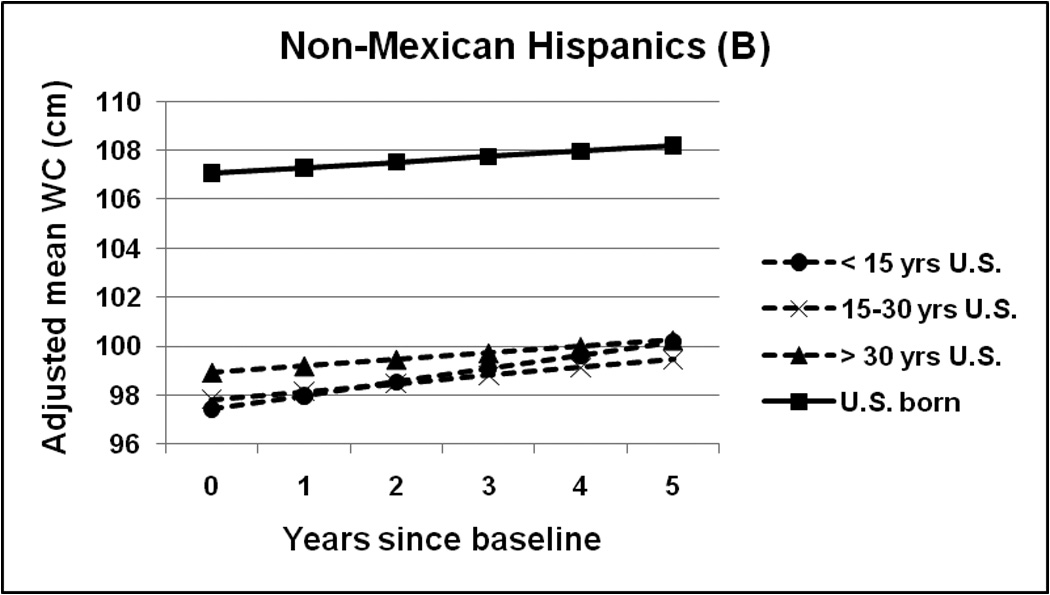
Results: Among Hispanics and Chinese, the foreign-born had a lower adjusted mean BMI and WC at baseline than the US-born, but there were no significant differences in BMI or WC change over time. There was heterogeneity by Hispanic subgroup: despite small baseline nativity differences in WC, foreign-born Mexican Hispanics had a greater annual mean increase in WC over time compared to US-born Mexican Hispanics (mean difference in annual change = 0.28 cm, P = 0.03). There were no nativity differences in the rate of WC increase over time among non-Mexican Hispanics. Foreign-born Mexican Hispanics also experienced a faster rate of WC increase compared to foreign-born non-Mexican Hispanics (mean difference in annual change = 0.24 cm, P = 0.01).
Conclusions: Longer time in the United States, examined prospectively, may only be linked to adverse anthropometric changes in some immigrant groups.
Copyright © 2013 The Obesity Society.
Figures


References
-
- Martin P, Midgley E. Immigration: Shaping and Reshaping America. Washington, DC: Population Reference Bureau; 2003.
-
- Goel MS, McCarthy EP, Phillips RS, Wee CC. Obesity among US immigrant subgroups by duration of residence. JAMA. 2004 Dec 15;292(23):2860–2867. - PubMed
-
- Akresh IR. Overweight and obesity among foreign-born and US-born Hispanics. Biodemography Soc Biol. 2008 Fall;54(2):183–199. - PubMed
-
- Lauderdale DS, Rathouz PJ. Body mass index in a US national sample of Asian Americans: effects of nativity, years since immigration and socioeconomic status. Int J Obes Relat Metab Disord. 2000 Sep;24(9):1188–1194. - PubMed
Publication types
MeSH terms
Grants and funding
- N01-HC-95162/HC/NHLBI NIH HHS/United States
- R01 HL071759/HL/NHLBI NIH HHS/United States
- N01 HC095169/HL/NHLBI NIH HHS/United States
- P60 MD002249/MD/NIMHD NIH HHS/United States
- N01-HC-95159/HC/NHLBI NIH HHS/United States
- N01-HC-95165/HC/NHLBI NIH HHS/United States
- N01 HC095159/HL/NHLBI NIH HHS/United States
- N01-HC-95160/HC/NHLBI NIH HHS/United States
- R01 HL071759 05A1/HL/NHLBI NIH HHS/United States
- N01-HC-95161/HC/NHLBI NIH HHS/United States
- N01-HC-95167/HC/NHLBI NIH HHS/United States
- N01-HC-95163/HC/NHLBI NIH HHS/United States
- N01-HC-95168/HC/NHLBI NIH HHS/United States
- N01-HC-95169/HC/NHLBI NIH HHS/United States
- N01-HC-95164/HC/NHLBI NIH HHS/United States
- P30 DK092949/DK/NIDDK NIH HHS/United States
- R24 HD050924/HD/NICHD NIH HHS/United States
- N01-HC-95166/HC/NHLBI NIH HHS/United States
LinkOut - more resources
Full Text Sources
Other Literature Sources
Medical
Molecular Biology Databases
