. 2013 Jun 11;110(24):10010-5.
doi: 10.1073/pnas.1220015110. Epub 2013 May 28.

Receptor-like kinase SOBIR1/EVR interacts with receptor-like proteins in plant immunity against fungal infection

Affiliations

Receptor-like kinase SOBIR1/EVR interacts with receptor-like proteins in plant immunity against fungal infection

Thomas W H Liebrand et al. Proc Natl Acad Sci U S A. .

Erratum in

  • Proc Natl Acad Sci U S A. 2013 Aug 6;110(32):13228. America, Antione H P [corrected to America, Antoine H P]

Abstract

The plant immune system is activated by microbial patterns that are detected as nonself molecules. Such patterns are recognized by immune receptors that are cytoplasmic or localized at the plasma membrane. Cell surface receptors are represented by receptor-like kinases (RLKs) that frequently contain extracellular leucine-rich repeats and an intracellular kinase domain for activation of downstream signaling, as well as receptor-like proteins (RLPs) that lack this signaling domain. It is therefore hypothesized that RLKs are required for RLPs to activate downstream signaling. The RLPs Cf-4 and Ve1 of tomato (Solanum lycopersicum) mediate resistance to the fungal pathogens Cladosporium fulvum and Verticillium dahliae, respectively. Despite their importance, the mechanism by which these immune receptors mediate downstream signaling upon recognition of their matching ligand, Avr4 and Ave1, remained enigmatic. Here we show that the tomato ortholog of the Arabidopsis thaliana RLK Suppressor Of BIR1-1/Evershed (SOBIR1/EVR) and its close homolog S. lycopersicum (Sl)SOBIR1-like interact in planta with both Cf-4 and Ve1 and are required for the Cf-4- and Ve1-mediated hypersensitive response and immunity. Tomato SOBIR1/EVR interacts with most of the tested RLPs, but not with the RLKs FLS2, SERK1, SERK3a, BAK1, and CLV1. SOBIR1/EVR is required for stability of the Cf-4 and Ve1 receptors, supporting our observation that these RLPs are present in a complex with SOBIR1/EVR in planta. We show that SOBIR1/EVR is essential for RLP-mediated immunity and propose that the protein functions as a regulatory RLK of this type of cell-surface receptors.

Keywords: defense signaling; development; plant innate immunity; plant–microbe interaction; receptor complex.


Conflict of interest statement

The authors declare no conflict of interest.

Figures
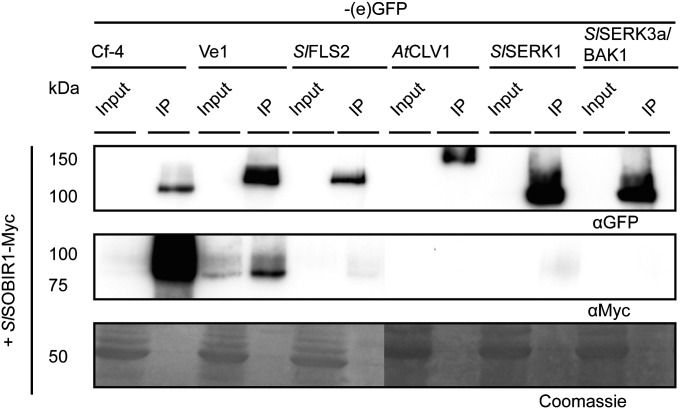
Fig. 1.
Fig. 1.
Tomato SlSOBIR1 interacts with Cf-4 and Ve1, but not with various RLKs. Tagged versions of Cf-4, Ve1, AtCLV1, SlSERK1, SlSERK3a/BAK1, and SlFLS2 (all fused to eGFP, except for SlFLS2, which was fused to GFP) were coexpressed with SlSOBIR1–Myc in N. benthamiana. Total protein extracts of transiently transformed leaf tissue were subjected to immunopurification by using GFP-affinity beads. Total proteins (Input) and immunopurified proteins (IP) were subjected to SDS/PAGE and blotted. Blots were incubated with α-GFP antibody to detect the immunopurified (e)GFP fusion proteins and incubated with α-Myc antibody to detect coimmunopurifying SOBIR1–Myc proteins. Coomassie-stained blots showing the 50-kDa Rubisco band present in the input samples confirm equal loading. Representative results for three independent experiments are shown.
Fig. 2.
Fig. 2.
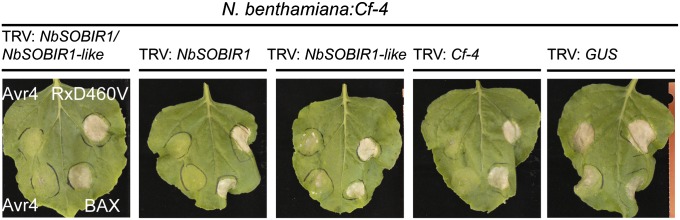
SOBIR1 is required for Cf-4–mediated HR. Transgenic N. benthamiana:Cf-4 plants were subjected to VIGS by inoculation with the TRV constructs indicated above each image. TRV:NbSOBIR1/NbSOBIR1-like targets NbSOBIR1 and NbSOBIR1-like simultaneously. TRV:Cf-4 and TRV:GUS served as controls. Three weeks after TRV inoculation, Avr4 (in duplicate), autoactive Rx (RxD460V), and BAX were transiently expressed in the order indicated in the left image, and leaves were photographed 3 d later. The experiment was performed three times with three plants for each TRV construct, and representative pictures for the experiment are shown.
Fig. 3.
Fig. 3.
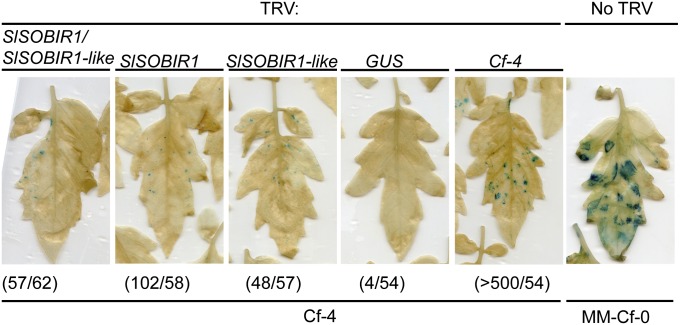
Targeting SOBIR1 and SOBIR1-like suppresses Cf-4–mediated resistance of tomato. Cf-4 tomato was inoculated with the indicated TRV constructs, and 3 wk later plants were inoculated with an Avr4-secreting, GUS-transgenic strain of C. fulvum. A non TRV-inoculated susceptible MM-Cf-0 plant was included as control. Two weeks later, leaflets were stained for GUS activity to detect C. fulvum colonization. For the Cf-4 tomato plants, the amount of successful colonization attempts (blue spots) vs. the total amount of leaflets analyzed for that particular experiment is indicated between parentheses. The experiment was performed three times, and representative pictures are shown.
Fig. 4.
Fig. 4.
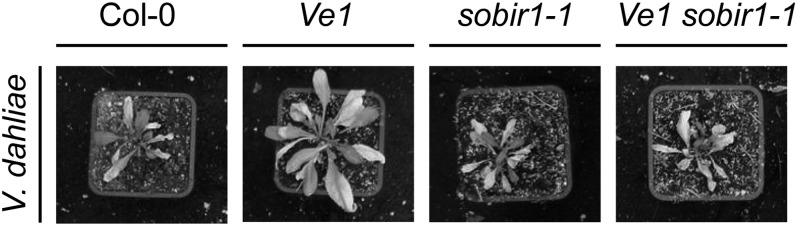
Ve1 is not functional in an Arabidopsis sobir1-1 mutant background. Arabidopsis ecotype Col-0 is susceptible to V. dahliae race 1 expressing Ave1 (Col-0). When transformed with the Ve1 gene, expressed under control of the 35S promoter, Col-0 gains resistance to the fungus (Ve1). Similar to the Col-0 wild-type, sobir1 mutants are susceptible (sobir1-1), whereas sobir1-1 mutant plants transformed with Ve1 remain susceptible to the fungus (Ve1 sobir1-1). The inoculation experiments and qRT-PCR quantifications (Fig. S7A) were performed three times, with similar results. A representative picture is shown.
Fig. 5.
Fig. 5.
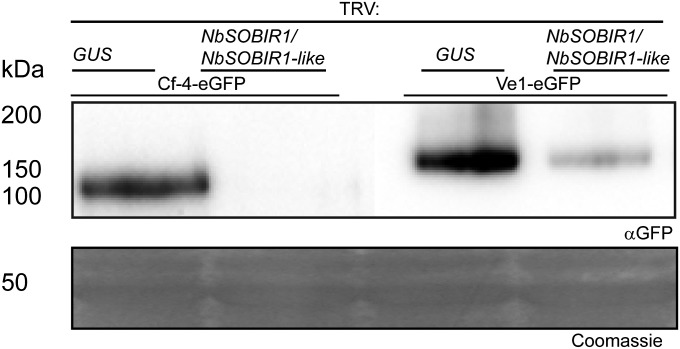
SOBIR1 is required for the accumulation of Cf-4 and Ve1 proteins. Cf-4 and Ve1, fused to eGFP, were expressed in leaves of N. benthamiana subjected to VIGS by inoculation with the indicated TRV constructs. Transiently expressed fusion proteins were immunopurified and subjected to SDS/PAGE, and blots were incubated with αGFP antibody for detection of the expressed proteins. The Coomassie-stained blot shows the 50-kDa Rubisco band present in the input samples to confirm equal loading. The experiment was repeated three times with similar results, and a representative picture is shown.

References

    1. Jones JDG, Dangl JL. The plant immune system. Nature. 2006;444(7117):323–329. - PubMed
    1. Boller T, Felix G. A renaissance of elicitors: Perception of microbe-associated molecular patterns and danger signals by pattern-recognition receptors. Annu Rev Plant Biol. 2009;60:379–406. - PubMed
    1. Göhre V, Robatzek S. Breaking the barriers: Microbial effector molecules subvert plant immunity. Annu Rev Phytopathol. 2008;46:189–215. - PubMed
    1. de Jonge R, Bolton MD, Thomma BPHJ. How filamentous pathogens co-opt plants: The ins and outs of fungal effectors. Curr Opin Plant Biol. 2011;14(4):400–406. - PubMed
    1. Thomma BPHJ, Nürnberger T, Joosten MHAJ. Of PAMPs and effectors: The blurred PTI-ETI dichotomy. Plant Cell. 2011;23(1):4–15. - PMC - PubMed

Publication types

MeSH terms

Substances