


A Comparative Study of the Efficacy of 4% Hydroquinone vs 0.75% Kojic Acid Cream in the Treatment of Facial Melasma
- PMID: 23716817
- PMCID: PMC3657227
- DOI: 10.4103/0019-5154.108070
A Comparative Study of the Efficacy of 4% Hydroquinone vs 0.75% Kojic Acid Cream in the Treatment of Facial Melasma
Abstract
Background: Melasma is a common acquired cause of facial hyperpigmentation seen predominantly among females with significant psychological and social impact. It is often recalcitrant to treatment. Several topical hypopigmenting agents have been used to combat melasma. Hydroquinone and Kojic Acid are well established monotherapeutic agents for treating melasma.
Objectives: This study focuses mainly on the efficacy of once daily application of 4% Hydroquinone and 0.75% Kojic Acid cream (containing 0.75% Kojic acid and 2.5% vitamin C) so as to determine an effective modality of treatment for facial melasma.
Materials and methods: A total number of 60 patients with facial melasma attending the Out-patient department of Dermatology, Venerology and Leprosy, Fr. Muller Medical College Hospital, Mangalore from Oct 2008-April 2010 were studied. Patients were allocated alternately to group A and group B. Group A patients received 4% Hydroquinone cream and group B patient received a Kojic Acid cream (which contained 0.75% Kojic acid and 2.5% vitamin C) and were advised to apply topically once daily at night. Patients were followed up on 4(th), 8(th) and 12(th) week. At each visit side effects were noted and clinical response to treatment was calculated using the MASI score.
Statistical methods: Chi square test, student 't' test.
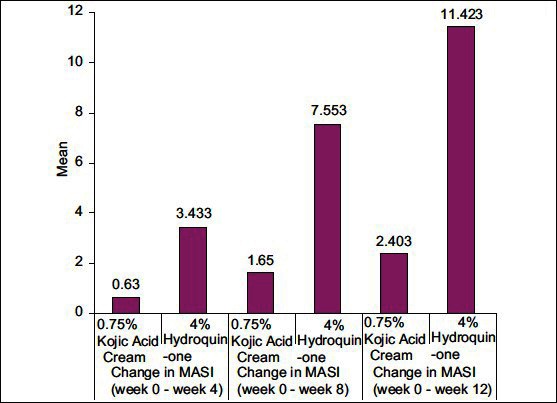
Results: At the 4(th) week post treatment evaluation, facial hyperpigmentation responded early to 4% Hydroquinone cream than to 0.75% Kojic Acid cream. At the end of 12 week treatment period, 4% Hydroquinone cream had an overall superiority to 0.75% Kojic Acid cream as a topical hypopigmenting agent.
Conclusion: The results of the study show that 4% Hydroquinone cream is a better topical hypopigmenting agent with rapid rate of clinical improvement when compared to 0.75% Kojic Acid cream.
Keywords: 0.75% Kojic Acid cream; 4% Hydroquinone cream; Melasma.
Conflict of interest statement
Figures
References
-
- Guevara IL, Pandya AG. Safety and efficacy of 4% hydroquinone combined with 10% glycolic acid, antioxidants, and sunscreen in the treatment of Melasma. Int J Dermatol. 2003;42:966–72. - PubMed
-
- Thappa DM. Melasma (Chloasma): A review with current treatment options. Indian J Dermatol. 2004;49:165–76.
-
- Torok HM. A comprehensive review of the long term and short term treatment of Melasma with a triple combination cream. Am J Clin Dermatol. 2006;7:223–30. - PubMed
-
- Stratigos AJ, Katsambas AD. Optimal management of recalcitrant disorders of hyperpigmentation in dark skinned patients. Am J Clin Dermatol. 2004;5:161–8. - PubMed
LinkOut - more resources
Full Text Sources
Other Literature Sources
Miscellaneous